A bare-bones European technical blueprint for a home-grown nuclear shield is emerging. It sits on the foundations of two existing arsenals—France’s Force de dissuasion and the United Kingdom’s Continuous-at-Sea Deterrent (CASD)—and on the hard lessons from Ukraine about missile warfare, electronic denial and the value of prompt, survivable strike.
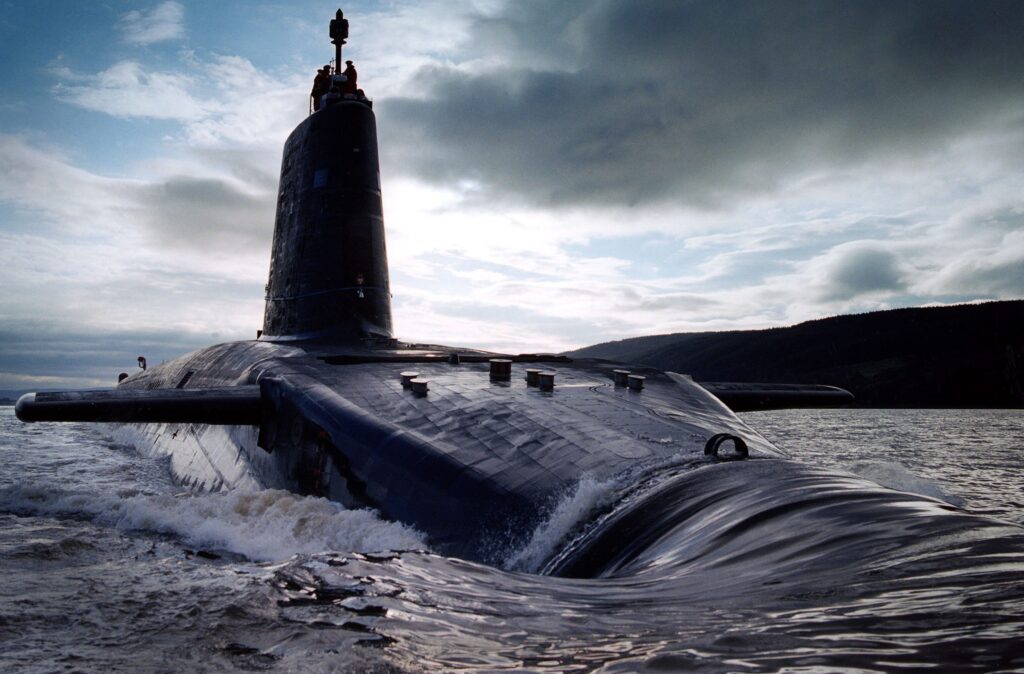
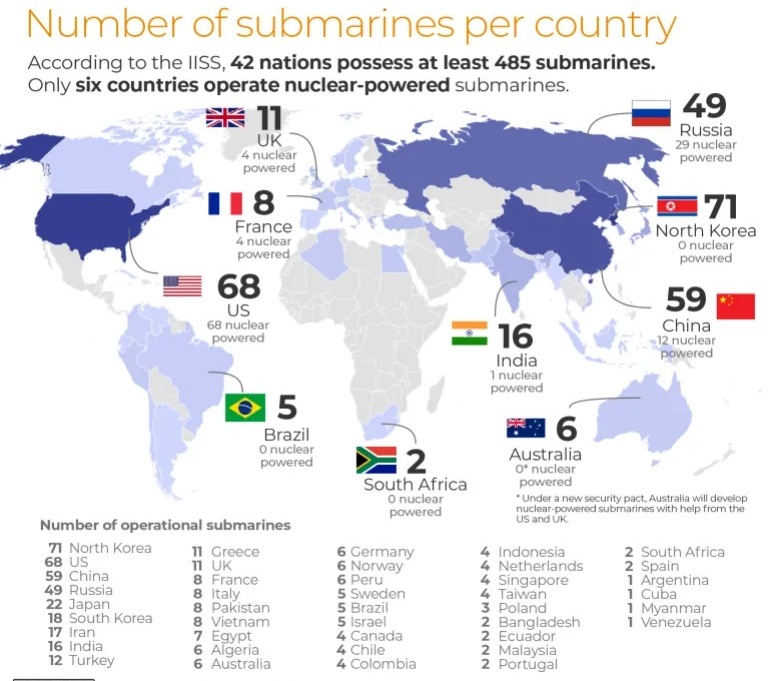
The status quo constitutes more functional capability than much of current analysis admits, says George Friedman, head of the US think-tank Geopolitical Futures. Britain keeps four hydrogen-armed submarines on continuous patrol; France maintains one, with more boats in reserve. France holds about 290 warheads, Britain roughly 250. Each submarine carries 16 nuclear missiles, and both navies can surge extra boats in a crisis.
Sea-based forces are far harder to pre-empt than land missiles. “Pinpointing five subs at once is extremely difficult, as deep-ocean searches strain satellite sensors and would be noticed. If just one boat survived, it could fire 16 hydrogen bombs—each far more powerful than Hiroshima—capable of destroying 16 Russian cities,” Mr Friedman says.
“A reasonable umbrella”
For Moscow to strike Europe, it would need near-certain proof that every British and French sub had been sunk; a single oversight would be disastrous. Such perfection in intelligence is implausible. At least one launch platform would likely endure and retaliate before incoming warheads arrived.
“Also take into account with some certainty that intelligence would have allowed Britain and France to locate Russian strategic command posts, and they would aim one missile in each submarine to target the command post and one at Moscow,” the Budapest-born US analyst of Ukrainian descent says. “I would regard that as a reasonable umbrella.”
Such a scenario is, for now, hypothetical. But engineers in Cherbourg, Barrow-in-Furness and Aldermaston are already getting ready, turning ideas into metal, circuitry and software. “Russia’s war on Ukraine has continuously highlighted the importance of both long-range precision strike capabilities and missile defences as transformative capabilities in modern conflict,” writes Heather Williams in a CSIS publication.
That judgement drives every design choice being discussed from Paris to Warsaw. The task is not to match America weapon for weapon. It is to produce a minimum yet credible European deterrent able to survive a first strike, retaliate against the attacker and do so under a command chain that functions even when satellites fall silent.
Steel under the Atlantic
Neither has European production itself to start from zero. “On fissile materials, Germany and the Netherlands operate commercial uranium-enrichment facilities as part of Urenco,” observes Alexander Bollfrass of the International Institute for Strategic Studies. Sea-borne launchers, advanced cruise missiles and high-performance fighters already populate European inventories. The question is how to weld them into one technical architecture.
France has pushed furthest. “France’s third-generation nuclear-powered ballistic missile submarine program, known as SNLE 3G, has entered its full industrial realization phase at Naval Group’s Cherbourg site in Normandy,” reports Armyrecognition.com. The boat will stretch beyond 140 metres and displace roughly 15,000 tonnes.
Russia’s war on Ukraine has continuously highlighted the importance of both long-range precision strike capabilities and missile defenses as transformative capabilities in modern conflict. — Heather Williams, CSIS
“Propulsion will rely on a new nuclear reactor developed by TechnicAtome, optimized for acoustic discretion and extended life cycles,” the report adds. Crew size will drop to about 100 thanks to automation, yet each hull will still carry 16 launch tubes for the M51 family of submarine-launched ballistic missiles (SLBMs).
Three buckets
The missiles are improving in parallel. “The M51.3 ensures the continued credibility of the ocean-based component in the face of evolving enemy missile defences,” notes the French Armed Forces Ministry in a statement quoted by DefenceNews. The next variant, likely dubbed M51.4, will fit the lengthened SNLE tubes after 2035 and carry manoeuvring re-entry vehicles to foil interceptors.
Across the Channel, the Royal Navy follows a similar cadence. Four Dreadnought-class SSBNs are under construction in Barrow. “The triple lock guarantees: the building of the four Dreadnought nuclear submarines in Barrow; that we will maintain the UK’s Continuous At-Sea Deterrent 24 hours a day, 365 days a year; and the delivery of all future upgrades to ensure the safety and effectiveness of our deterrent,” said United Kingdom Secretary of State for Defence John Healey in May 2025.
On fissile materials, Germany and the Netherlands operate commercial uranium-enrichment facilities as part of Urenco. — Alexander Bollfrass, IISS
Northwood, a joint Franco-British declaration signed the same year, begins to weld the two fleets together. “Northwood sets out ‘three buckets’ for formal coordination: nuclear policy, operational planning, and capability development,” write Jonathan Burchell and Astrid Chevreuil for CSIS. For the first time patrol areas, maintenance schedules and even tactical communications can be aligned, allowing eight submarines—four British, four French—to guarantee at least two hulls on station at any given moment.
Brass and beryllium
Missiles need warheads. Britain’s Atomic Weapons Establishment (AWE) is designing Astraea, the successor to the current Mk4A. Multi-billion-pound facilities such as MENSA and the Future Materials Campus are taking shape at Aldermaston and Burghfield. Across the Channel, France relies on CEA Valduc and the Laser Mégajoule super-laser to certify its devices without underground testing. President Emmanuel Macron has authorised a modest stockpile increase—the first in three decades—to match Russia’s louder rhetoric.
Simulation now underpins certification. Super-computers run hydrodynamic codes that model implosion symmetry down to microns. Sub-critical experiments provide real data without generating a nuclear yield. Combined, the two national complexes can refurbish or build about 20-25 warheads a year, enough to sustain a joint stock of roughly 500-600 devices through the late 2030s. That number offers sufficiency against Russia while avoiding the appearance of an arms race.
Warheads alone do not make a deterrent. They require a hardened command, control and communications (NC3) spine. The United Kingdom’s Skynet 6 satellites and France’s Syracuse IV constellation will provide jam-resistant, low-probability-of-intercept links to submarines, aircraft and national command centres. Fibre networks between Paris, London and NATO’s Supreme Headquarters Allied Powers Europe (SHAPE) are being buried deeper and shielded against electromagnetic pulses.
Seven miracles
Sea-based rockets assure retaliation; aircraft add flexibility. Here Europe faces a credibility gap. “This stockpile is no longer regarded as credible,” writes Frank D. Kuhn for War on the Rocks when describing America’s remaining B-61 gravity bombs stored in Europe. The aging Tornados and fourth-generation F-16s that would deliver them fare poorly against modern Russian air defences. “Using fourth-generation fighters such as the F-16 or the aging Tornado to penetrate modern Russian air defences and deliver unguided bombs on Russian territory would represent ‘seven consecutive miracles.’”
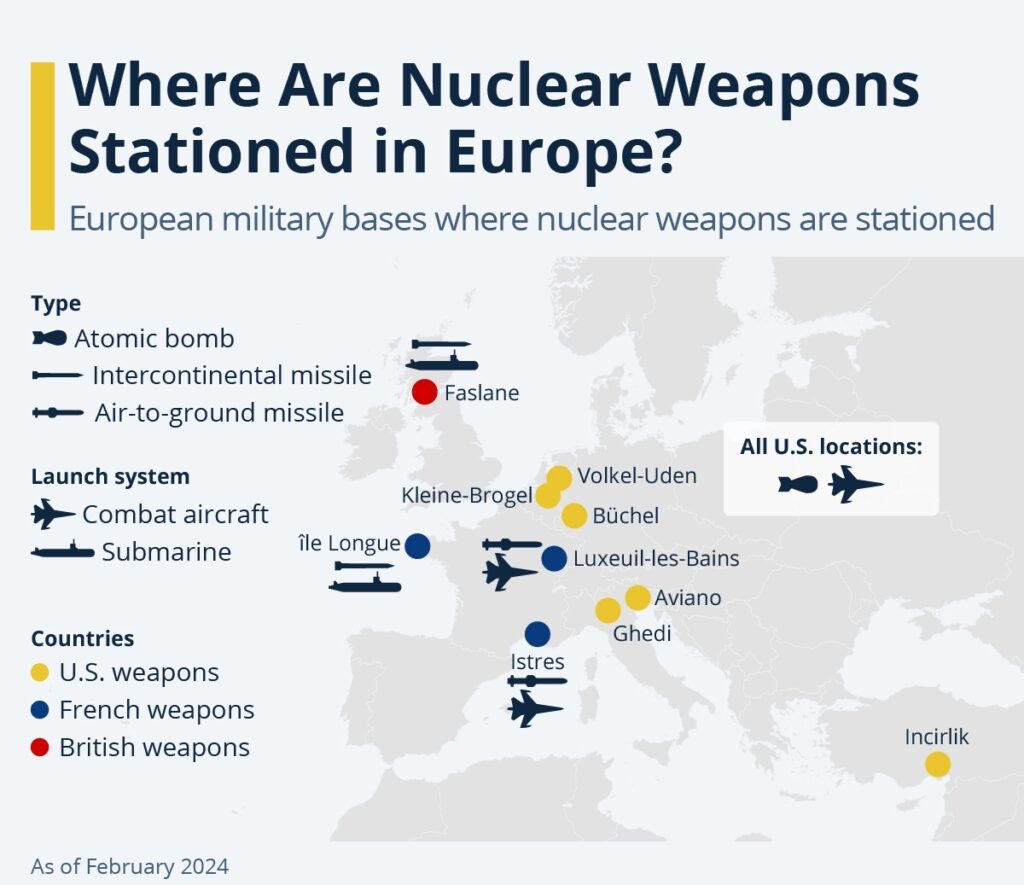
Relief comes in two waves. First, NATO nuclear-sharing states—Belgium, the Netherlands, Germany, Italy and possibly Poland—are purchasing F-35A Block 4 jets, which the Pentagon will certify to carry the guided B61-12. According to Mr Kuhn, “Only a small number of B-61 gravity bombs, designed to be employed against enemy targets using so-called dual-capable aircraft operated by European NATO members, remain on a handful of allied air bases across the continent.”
France’s third-generation nuclear-powered ballistic missile submarine program, known as SNLE 3G, has entered its full industrial realization phase at Naval Group’s Cherbourg site in Normandy. — Armyrecognition.com report
“According to recent estimates, about 100 bombs are deployed in Italy, Germany, Türkiye, Belgium, and the Netherlands,” the Leibniz-Institut für Friedens- und Konfliktforschung researcher writes. Once the stealthy F-35s arrive, those bombs regain some relevance, especially if dispersed to hardened runways at Łask, Ämari or Rovaniemi.
Screens against fire
Second, France is developing the ASN-4G, a hypersonic air-launched ballistic missile to replace the supersonic ASMPA around 2032-33. Fired from Rafale F5 fighters, the weapon should outrun interceptors and strike at a distance of 1,000 kilometres or more. Britain studies whether to revive an airborne leg of its own, perhaps leveraging the Teutates scientific exchanges with France.
Offence breeds defence. Ms Williams reminds policymakers that “Both Europe and the US continue to make significant investments in missile defence through the European Sky Shield and Golden Dome initiatives, respectively.” Sky Shield, led by Germany, plans a network of Patriot, Arrow-3 and IRIS-T batteries supplemented by early-warning radars stretching from Estonia to Romania.
The M51.3 ensures the continued credibility of the ocean-based component in the face of evolving enemy missile defenses. — French Armed Forces Ministry
Golden Dome, an American home-land project, aims at the same problem of intercepting manoeuvring hypersonic gliders. “Missile defence at large scale will be expensive, and burden sharing, particularly in technology development, could alleviate allied concerns and enhance alliance cohesion,” Ms Williams concludes.
Integrated sensors are vital not only for interception but also for confirming an attack before authorising retaliation. Data from French Graves, British Fylingdales and German Hensoldt radars must fuse within seconds. A cyber-hard back-end—air-gapped, quantum-proof, battery-backed—has become as critical as steel or uranium.
Silent watches, noisy drills
Doctrine demands visibility as well as secrecy. The Franco-British Nuclear Steering Group held its first meeting in December 2025. “Its inaugural meeting in December 2025, held alongside the unprecedented British observation of France’s Operation POKER, signals a willingness on both sides to invest political and bureaucratic capital in a long-term nuclear partnership,” note Mr Burchell and Ms Chevreuil. Future POKER iterations may involve British Typhoons escorting French bombers over foreign training ranges, while Royal Navy frigates shadow French SSBNs as they slip into deep patrol boxes.
Northwood’s operational logic is simple. If two submarines are always hidden somewhere, Russia cannot gamble on a disarming strike. If stealth jets sit dispersed on the eastern flank, any incursion risks quick nuclear escalation. And if missile-defence radars see the first flash, leaders gain minutes rather than seconds to decide. “For over fifty years, CASD has been the bedrock of our national security, protecting the UK and our NATO Allies against the most extreme threats to our way of life,” Mr Healey reminded Parliament.
Behind the hardware stand people. “Across the country, the enterprise relies on the dedication and skills of tens of thousands of people who provide critical support to our National Endeavour and guarantee our security,” Mr Healey said. Britain forecasts a defence-nuclear workforce of 65,000 by 2030. France faces similar demographic gaps as veteran warhead physicists retire. Both countries recruit aggressively from universities and polytechnics, offering bursaries, security clearances and the chance to work with exascale computers.
Latent giants, wary dwarfs
Should others join? Mr Bollfrass thinks so. “A small arsenal based on modified existing delivery platforms and repurposed enrichment infrastructure could plausibly be fielded in three to five years, assuming full political commitment,” he writes. Germany owns gas-centrifuge know-how, Sweden builds Gripen fighters and cruise missiles, Italy runs the Vega space launcher.
All of these platforms could be adapted to carry nuclear payloads, yet costs would soar. “Building and maintaining nuclear forces is extraordinarily expensive,” he warns. Risks would rise too: “Increasing the number of European countries possessing nuclear weapons would also raise the nuclear risks on the continent: there would be a higher probability of accidents, miscalculations and arms racing.”
Technical hurdles accompany political ones. Warheads must survive launch stresses, re-entry plasma and decades in storage. Without access to past American or British test data, newcomers would rely on simulations unvalidated by real explosions. “Without unity and clarity, even a technically capable force cannot deter,” Mr Bollfrass cautions. Command structures grow messy when several presidents hold a veto.
Keeping the lights on
For now, the most plausible expansion lies in financing rather than physics. Brussels circles around a tiered scheme: Britain and France provide the warheads and launchers; Germany, Poland, Belgium and the Netherlands cover perhaps ten per cent of yearly operating costs in return for explicit coverage. Such pooling lowers bills yet preserves the Non-Proliferation Treaty, which both nuclear powers vow to uphold.
Hardware ages. Submarines need deep refits every eight to ten years, each lasting two years. Aligning French and British yard periods lets at least two boats patrol while the rest sit in dry dock. Warheads require surveillance, new detonators, fresh tritium. MENSA and Valduc can each process roughly 25 units a year. That is just enough to cycle through the stockpile every decade. Virtual testing regimes such as EPURE in France and Orion in Britain sidestep treaty bans on explosive trials, yet even the fastest codes still demand power-hungry clusters and armies of coders.
Money remains manageable. Aggregate capital spending—£42 bn in Britain and €45 bn in France over ten years—plus annual running costs of about €10-12 bn equals less than a quarter of one per cent of EU-27 GDP. Inflation in labour, rare-earth magnets and enriched zirconium could blow holes in those budgets, but burden-sharing agreements would cushion shocks.
Shot clock
Timelines crystallise. B61-12 replaces all legacy gravity bombs by 2029. ASN-4G reaches initial operating capability in 2030. Skynet 6 and Syracuse IV achieve full service two years later. The first SNLE-3G and Dreadnought should join the fleet in 2035. Astraea warheads roll off the Aldermaston line by 2036. Rotational basing of French nuclear aircraft in eastern Europe could start soon after if Russia keeps its missiles in Belarus.
Not every analyst cheers the endeavour. “Ultimately, deterrence by denial, by investing in conventional forces, is far more relevant to the threats Europe faces,” argues Mr Bollfrass. That is partly true; Ukraine’s drone swarms and precision artillery blunt Russian advances daily. Yet missile salvos on Kyiv remind Europeans why a nuclear back-stop still matters.
Using fourth-generation fighters such as the F-16 or the aging Tornado to penetrate modern Russian air defenses and deliver unguided bombs on Russian territory would represent ‘seven consecutive miracles. — Frank D. Kuhn, War on the Rocks
The European project remains a concept paper rather than an order sheet. But welders in Cherbourg, engineers in Barrow and coders in Valduc are already fabricating its critical components. Add hardened satellites, dispersed stealth fighters, shared radar pictures and a clear chain of command, and the continent could field a lean but lethal shield within a decade.
“Northwood demonstrates an unprecedented willingness to advance a European approach to deterrence,” conclude Mr Burchell and Ms Chevreuil. Europe need not chase numerical parity with the US or Russia. It must field just enough invisible steel, hardened silicon and assured command lines to make any aggressor pause. The technical blueprints are now being born.