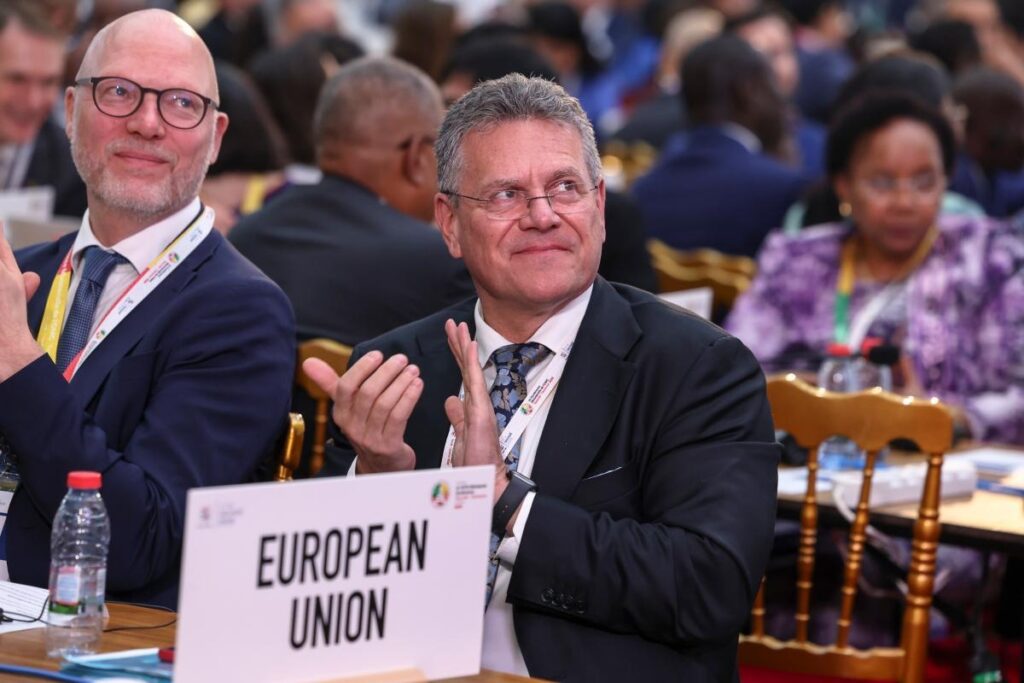
The World Trade Organisation’s 14th Ministerial Conference ended on March 30 without agreement on e-commerce, agriculture, or institutional reform. But Europe did not leave empty-handed. Brussels used the impasse to build coalitions, signal reform ambitions, and quietly align with Britain on industrial trade defence.
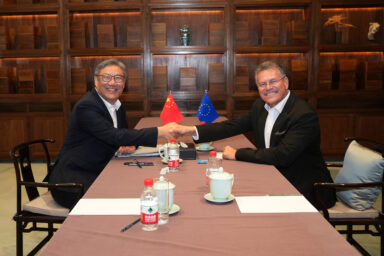
Trade Commissioner Maroš Šefčovič arrived at the conference in Yaoundé, Cameroon with a message that would have been unthinkable from a Brussels official a decade ago: the World Trade Organisation’s (WTO) foundational Most-Favoured Nation (MFN) principle needs rethinking. The MFN principle requires countries to treat all trading partners equally—meaning any tariff reduction or favour granted to one nation is extended to all WTO members. The EU, he told delegates, wants a “more flexible framework of rules”—coalition-based agreements among like-minded partners, rather than the universalist consensus model that China has long exploited.
Brussels used Yaoundé to stake out a position at the centre of a structural debate now consuming the multilateral trading system. It did so on its own terms—not as a junior interlocutor between Washington and Beijing. “You have declining political support for the WTO and we want to reverse it,” Šefčovič told the Financial Times. “We want to make sure that WTO becomes relevant again.”
Credibility gap
The EU showed up determined to be its credible rehabilitator. That posture sits awkwardly against recent Brussels behaviour. Over the past two years, the bloc has built a unilateral trade defence architecture—the Carbon Border Adjustment Mechanism (CBAM), the Foreign Subsidies Regulation, and an anti-coercion instrument that critics argue bypasses WTO authorisation entirely.
On the sidelines, Europe extracted real strategic value from the convening. The Netherlands’ trade minister called for Britain to be inside a Western “steel wall” against Chinese overcapacity, with EU and UK tariffs both standing at 50 per cent. The quiet alignment between Brussels and London on industrial trade defence is a meaningful development. It illustrates why a convening WTO still has relevance—even when it cannot deliver formal outcomes.
The coalition model is the new reality
Coalitions of the willing are more than a European phenomenon. Sixty-six WTO members covering 70 per cent of global trade—including the EU, UK, China, and Australia—faced a consensus deadlock on e-commerce.
Don’t wait until everybody agrees on everything.
—South Korea’s trade minister
They announced they would implement the plurilateral e-commerce agreement through domestic legislation, without waiting for universal agreement. “Don’t wait until everybody agrees on everything,” South Korea’s trade minister told POLITICO bluntly. “Time is of the essence.”
The WTO’s consensus requirement—once its greatest strength—has become a structural veto mechanism, routinely exploited by a small number of holdouts. In Yaoundé, Brazil blocked the e-commerce moratorium extension to protest the lack of agriculture progress. India blocked the Investment Facilitation for Development Agreement to defend consensus-based norms. The result: a stalemate on everything.
Fragmentation risk
The coalition workaround is messy and legally ambiguous. It does not carry the legitimacy of a full WTO outcome—but it is, increasingly, the only way anything gets done. Yaoundé made that reality impossible to ignore.
The risk is fragmentation. As coalitions press ahead and consensus holdouts dig in, the new model advantages large, well-networked actors—like the EU—while leaving behind those still hoping the multilateral system functions as advertised. It no longer does. The question now is who shapes what replaces it.