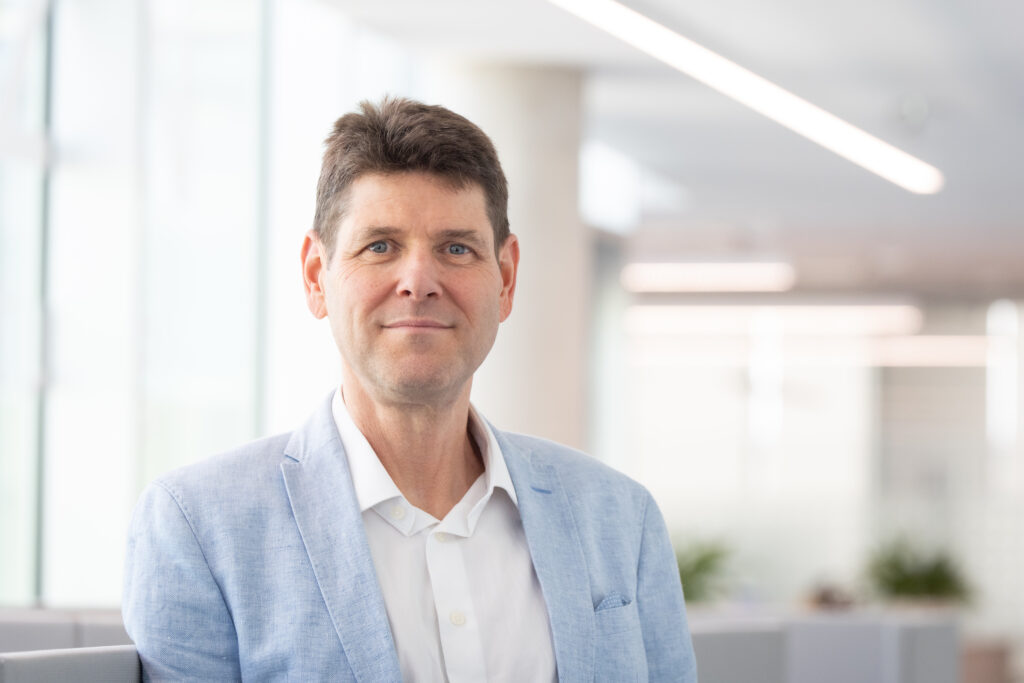
Life sciences model in Europe is a broken ‘societal agreement’, says Tomer Feffer of the pharmaceutical company Bayer. Companies take on long-term risk and investment with no guarantee of success — only to face delayed access, price erosion and regulatory complexity once a treatment is ready.
Mr Feffer’s message is deliberately two-sided. Bayer’s Head of Region Northeast-Central Europe argues that while Europe is losing ground in competitiveness it still retains strong scientific, industrial and healthcare foundations that make it worth investing in.
In an interview with EU Perspectives, he warns that declarations about making life sciences a strategic priority will mean little unless they are matched by concrete policy choices. And by efforts to avoid what he describes as “inflation in regulation”, a growing number of overlapping rules that risk slowing innovation.
Why are patients still facing long delays in accessing new treatments in Europe?
After 15 years of research and development, after clinical trials and regulatory approval, you still have to wait. In Europe, it takes on average close to 600 days until the drug becomes available. And even then only for some patients.
It takes on average close to 600 days until the drug becomes available for patients. The situation is very different across Europe — in some countries it can take several years.
The approval often comes with limitations, and insurance systems do not implement it in the same way or at the same speed. So when you think everything is completed, you realise that the effort is still not reaching the right patient at the right time.
And the situation is very different across Europe. In some countries patients can get access relatively quickly, and in others it can take several years.
Where do you see the biggest breakdown today between innovation and patient access in Europe?
If you think holistically, there is a societal agreement between the industry and governments. The deal is this: we take all the risks, put all the money, do all the work and invest way before we have a proof of concept. We run clinical trials, go through regulators, and prove that the product is safe and effective. And when we come after such a long journey, our expectation is to see urgency and willingness to collaborate to make the drug available to patients as quickly as possible.
Instead, what we see are increasingly complex bureaucracy processes and fragmented systems that prevent that from happening, even with goodwill on all sides. So, we need to remind ourselves of this agreement and make it sustainable again for patients.
What does this mean in practice for clinical trials and investment in Europe?
When you run clinical trials, it’s a huge investment and it takes a lot of time. You hope that approval processes will be as fast and as centralised as possible. In Europe, what we see in many cases is that you still need to go hospital by hospital, region by region.
The second element is recruitment and retention of patients. The healthcare system needs to be motivated to participate in clinical trials. And the third element is that clinical trials are not only about proving efficacy. They also build experience for healthcare professionals. When the drug reaches the market, they already know how to treat patients.
If you don’t see that the product will be available, why should you invest in clinical trials?
In many cases, new therapies are coming on top of the standard of care. But if the standard of care is not reimbursed or not widely used, then you don’t have the foundation to bring the new therapy.
If you don’t see that the product will be available, why should you invest in clinical trials?
Europe often speaks about supporting innovation. How does it treat truly first-in-class therapies compared to incremental ones?
If you look at what we are doing, we are not working on ‘me-too‘ products. We invest in first-in-class innovation, where you don’t know if it will work. We take very high risks, over many years, with no guarantee of success.
Take Parkinson’s disease. We are working on a potential cell therapy that could fundamentally change how the disease is treated. This is not about managing symptoms, it is about trying to address the disease itself. These kinds of programmes require a lot of patience. So the question is: how do you value that kind of innovation?
If systems treat breakthrough innovation in the same way as incremental innovation, then you create a disincentive to take these risks. This is high-risk science with uncertain outcomes. But it is assessed in systems that are not designed to differentiate that level of innovation.
How does this challenge evolve with newer treatments such as cell and gene therapies?
Cell and gene therapies are disruptive. They move away from chronic treatment models towards potentially one-time interventions with long-term benefit.
The value is not only within the healthcare system, it also affects social security, families, and disability.
Healthcare systems are still built around repeated payments over time. Now they face a situation where they need to pay upfront while dealing with uncertainty about long-term outcomes.
So systems need to adapt. We need new payment models, and we need to rethink how value is assessed.
The EU is already working on several health and life sciences policies. Are they sufficient to address these challenges?
I see the positive intent. I see the willingness to change. And I see the understanding of the current situation. But I don’t yet see how this is translated into solutions.
We are dealing with many different agencies, many different offices. You can see one improvement coming from one side. And then another regulation coming from another side that harms the industry. This is the reality of regulatory inflation in Europe. Regulation should be used when needed, but we need to avoid adding layers that ultimately slow down innovation.
To some extent, Europe became a victim of its own success. Reducing prices may look like a short-term success, but it creates a situation that is not sustainable.
What should policymakers focus on if they want to keep innovation in Europe?
First, we need to think long term. Not only about the next 12 months. If you are dealing with prevention or secondary prevention, the value is not immediate. It can take years to fully materialise.
We need to move from declarations to real action. We need to define what it actually means to say that life sciences are strategic.
We still believe in Europe. Europe has a strong legacy in life sciences, strong science, strong universities and strong foundations, and a healthcare system built on the ambition to provide equal access.
And third, innovation must be recognised and rewarded. If there is no willingness to pay at the end of the process, then the next round of innovation will simply not happen.
Despite these challenges, Bayer continues to invest in Europe. What keeps that commitment going?
We still believe in Europe. Europe has a strong legacy in life sciences, strong science, strong universities and strong foundations, and a healthcare system built on the ambition to provide equal access.
Our footprint in Europe is still very meaningful. We are present in production, in R&D, in clinical trials and in the commercial organisation. We are committed to patients across Europe and we continue to invest.
You can ask yourself: how come you believe in Europe after presenting all the reasons not to? But we still strongly believe that Europe plays an important role globally for the life sciences industry. Both from a research and development point of view, from production, and for access to patients.
At the same time, we are a global company. We need to make decisions based on where we can best support innovation and patients.
Looking ahead, what would need to change for Europe to remain competitive in life sciences?
We need to move from declarations to real action. There is already an understanding that something is broken, but it remains at a declarative level. We need to define what it actually means to say that life sciences are strategic. For patients, for access, and for investment and translate that into real decisions.