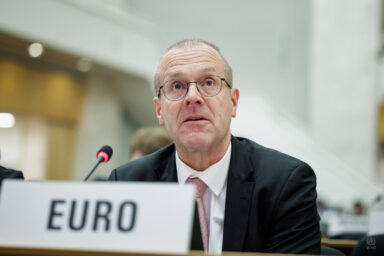
The idea of common EU defence received a symbolic boost on Tuesday. “We need a genuine European defence union,” MEP Marie-Agnes Strack-Zimmermann (Renew/DEU), chair of the Parliament’s defence committee, told fellow EU lawmakers during the Strasbourg plenary debate on the bloc’s next long-tem budget.
The plenary debate and the subsequent vote on the report on the European Commission’s proposal for the next Multiannual Financial Framework kicked off what promises a tense shodown over the bloc’s spending priorities. The report was ultimately approved by 370 lawmakers, while 201 voted against and 84 abstained, underscoring both its passage and the deep divisions surrounding it.
The preceeding debate quickly splintered along ideological lines, as ranking MEPs voiced their concerns for the well-being of their factions’ pet projects. Dear Santa-like pleas for more Brussels money abounded, as they would, at the positional-warfare stage of the talks.
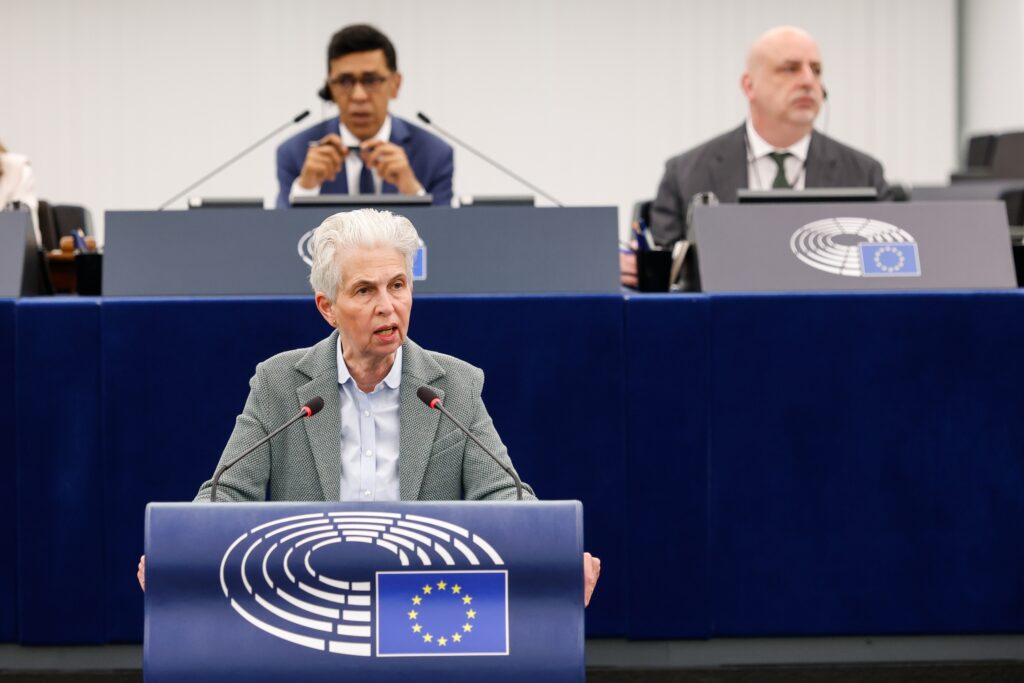
Despite that, important matters found their way into the debate. MEP Marie-Agnes Strack-Zimmermann (Renew/DEU), chair of the Parliament’s defence and security committee (SEDE), took the rostrum.
Europe is vulnerable
“Ladies and gentlemen, with this MFF route on the right path, security and defence are in focus more, and it’s high time that this happened,” said Ms Strack-Zimmermann. “Recent years have shown how vulnerable Europe is and how quickly our situation can change,” she added.
“We must be able to prepare in due time to be able to react decisively to wars,” the SEDE chair said. “If you rely on others, you become history. We need more flexibility in the budget because it allows us to react quickly, more quickly and allows us to act,” she said. “But that in and of itself is not sufficient,” she stressed.
“We need a genuine European Defence Union and that means commitment from everybody and the drive from everybody to make sure the existing structures can be changed,” said Ms Strack-Zimmermann. “Security, ladies and gentlemen, is something that cannot be organized solely on national lines. Either we defend the Union together or we fail together. And that is not an option,” she said.
“We cannot rely on others supporting us if problems crop up,” said Ms Strack-Zimmermann. “We’ve seen what happened,” she noted. “When that happens, let us go beyond the cross party divisions and protect life here,” she concluded. As she was leaving the stand, Ms Strack-Zimmermann was rewarded with quite some applause.
Funding lines
The topic dominated a part of the debate. MEP Siegfried Mureșan (EPP/ROU), the rapporteur warned that shrinking the purse would sap Europe’s reach. “We believe we cannot do more with less,” said Mr Mureșan. He argued that defence, research and energy resilience all require thicker funding lines.
From the centre-left, MEP Carla Tavares (S&D/PRT), the co-rapporteur rejected any raid on farm or cohesion cash to bankroll guns. “Investing in competitiveness without safeguarding traditional polities and vice versa, is a false dilemma,” said Ms Tavares. She expained why the report pushed for a ceiling of at least 1.27 per cent of EU gross national income, with pandemic-era debt service kept outside the frame.
With this MFF route on the right path, security and defence are in focus more, and it’s high time that this happened.
—MEP MarieAgnes Strack-Zimmermann (Renew/DEU)
Commissioner Piotr Serafin backed ambition yet reminded members that fresh “own resources” are unavoidable. Capitals fret about new levies on digital giants and cryptocurrency trades. Yet Brussels insists that only such revenue can square bigger plans with national wallets.
The spotlight is on
Supporters cheered the prospect of bulk procurement and integrated forces cutting unit costs. Sceptics feared a Brussels power-grab and higher bills at home. Yet few disputed Ms Strack-Zimmermann’s core point: Washington’s umbrella may no longer open on demand.
It was the SEDE chair’s use of the charged term ‘European Defence Union’ what raised eeybrows. It no longer belongs to Brussels cocktail chatter. Over the past year the phrase has crept from think-tank slide decks into the EU’s official paperwork and parliamentary rhetoric, hinting at a shift from slogan to (an embryo of) an organising principle.
Six flagship texts now invoke it, up from a solitary mention the year before. Internal briefings sport sections titled Enabling a European Defence Union, while a scoping paper for the 2030 defence-readiness roadmap frames every drone and missile order as preparatory work. Senior figures are now cheerleaders: the EU’s legal-service jamboree featured Defence Commissioner Andrius Kubilius’ keynote Towards a Genuine European Defence Union; Kaja Kallas, the Union’s foreign-policy supremo, told arms chiefs that if Brussels’s patchwork of schemes “will one day be called a European Defence Union, then so be it.” February even saw a plenary debate explicitly dedicated to the concept.
Sir Winston is back
The media follow the tip-sheet: Financial Times alone ran four opinion pieces naming the term over the past year. The Jacques Delors Institute finds four in five Europeans backing deeper collective defence; a YouGov survey gives majority support for a ‘European army’ in most big states.
Yet traction is not the same as treaty change. Still, with money on the table, bureaucratic structures forming and public sentiment unusually aligned, the notion of a European defence union is edging from talking point to—to adapt Sir Winston Churchill—something like the end of the beginning.