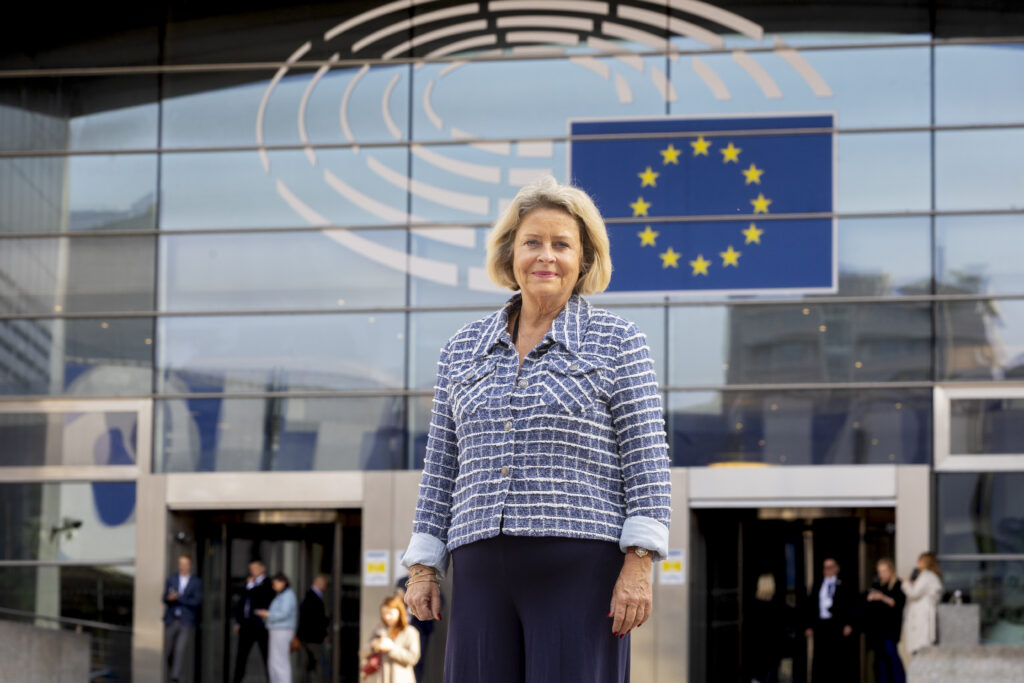
Europe may be running out of time to protect one of its last global tech advantages. If we fail, biotech could become the next chapter in the story of missed opportunities: “Defence, we lost. Digital, we also lost,” says MEP Stine Bosse. “The price of our patients’ life-saving medicines cannot be set in the White House,” she stresses in an exclusive interview with EU Perspectives.
Ms Bosse is working on amendments to the EU Biotech Act that would create a targeted “28th regime” for rare diseases and rare cancers, allowing companies to seek one European approval instead of navigating 27 national systems.
Her proposal would also introduce a single ethical committee for cross-border clinical trials in these areas, alongside stronger incentives for innovation and investment in Advanced Therapy Medicinal Products (ATMPs), such as cell and gene therapies.
Speaking to EU Perspectives, MEP Bosse said the measures should be embedded directly into the Biotech Act. The amendments are due by 7 July this year.
“It is now or never,” MEP Bosse said, warning Europe risks repeating its failure in digital technologies if it does not move quickly enough. “If we don’t get this right, then look at ten years from now, it would look like digital. And that would be a disaster for Europe.”
There is a growing sense of urgency around Europe’s biotech sector. Do you share that feeling?
Yes, absolutely. It is really urgent. It is now or never, that is the sensation I have.
That does not mean we should move so fast that we become sloppy. But we do have to move quickly.
Biotech is one of Europe’s last strategic advantages. Defence, we lost. Digital, we also lost. So if we do not get biotech right, then in ten years Europe could look at this sector the way it now looks at digital. That would be a disaster.
From the Parliament’s side and on behalf of Renew Europe, I will of course push for an even higher level of ambition for the Biotech Act.
The price of our patients’ life-saving medicines cannot be set in the White House. – MEP Stine Bosse, Vice-Chair, Committee of Public Health (SANT)
Because this Act is the one opportunity we have, so we have to get this right in this mandate.
Draghi warned us that biotechnology is one of the last sectors where Europe is still globally competitive. We still have some edge. Until one day, we won’t have it anymore.
Our share of global investment in research and innovation, global clinical trials and manufacturing is rapidly shrinking.
Do you think the Biotech Act can still arrive in time to change that trajectory?
I do think it can still be in time. But we also have to look at this in the broader geopolitical context. What we see today is the result of the last twenty years. And now you see what the United States is doing with tariffs and with the debate around Most Favoured Nation pricing for pharmaceuticals. It directly targets one of Europe’s remaining strong industries.
They have also read the Draghi report. They know biotechnology is one of Europe’s last major strategic advantages, so they attack exactly that.
And the first to notice the harmful effects of policies like Most Favoured Nation will be our patients, as life-saving drugs are delayed or even withdrawn from our markets.
I will say it clearly: the price of our patients’ life-saving medicines cannot be set in the White House. European leaders must now take matters into our own hands.
The US will always be able to pay more for medicines because it does not operate a universal public healthcare system like Europe.
And China is a completely different model again. China subsidises heavily, moves very fast and tests things in a very different way from Europe.
China will continue to use public money to make their products and services artificially cheap, also in the pharmaceutical sector.
This is quickly undermining our European value chains for pharmaceutical research and manufacturing. Once innovation and manufacturing leave Europe, it is hard to see how they would ever come back.
The Biotech Act is one of your main priorities. What is your assessment of the proposal currently on the table?
It is a good start. Timing matters. It is very good that the Commission did not wait. There are many good initiatives already.
But we should also push for more. We need more speed, stronger intellectual property protection and more ambition.
My task is clear: we need to protect EU patient access to new and life-saving therapies. A key element of that is ensuring that our innovative life science companies stay and invest in Europe. If they go, patient access also goes.
The Biotech Act will enable Europe to pick and choose the medicinal technologies of the future that will be most useful for our continent, both in terms of helping patients and building a robust base of science, innovation and manufacturing in Europe.
If Europe does not understand the need to pay for innovative medicines, then those medicines simply will not be developed here.
Beyond targeted industrial policy for innovative medicines, I also want Europe to remain a world-leading manufacturer of biosimilars.
And of course, this is why we need to have “European preference” as part of our EU industrial policy for pharmaceuticals.
You have also been pushing for a “28th regime”. What exactly are you proposing?
The idea actually started here in my office after Ursula von der Leyen launched the broader concept of a 28th regime and said she hoped legislators would be inspired.
So we started thinking: why not apply this logic to biotech?
What we are proposing is a model where, for a very targeted category of products, particularly rare diseases and rare cancers, companies would no longer need approvals in 27 Member States. One European approval would be enough.
The same should apply for clinical trials. Instead of multiple ethical committees, there should be one single ethical committee for these cross-border trials.
As part of the push for a “28th Regime”, I want to create an obligatory, once-only EU pathway for centralised ethics decisions in areas such as rare diseases, paediatrics and public health emergencies.
This will help speed up access to clinical trials, which can save lives for patients whose only chance to access the right medicine might be through a clinical trial.
Member States could second their existing ethics experts into this system.
For rare diseases and rare cancers, several countries already cannot meaningfully deploy all the necessary experts alone. And these therapy areas already depend on cross-border cooperation and trials.
Around 93 per cent of rare diseases still have no treatment. Imagine if we could bring that figure down even partially.
And it would also attract more capital because companies could move much faster.
This is why the time is right to centralise and simplify all that we can. To reduce the duplication of procedures that is holding our Union back.
How would this 28th regime be integrated into the Biotech Act in practice?
If Europe had a functioning 28th Regime today, we would have much more efficient and predictable regulatory pathways and much faster time-to-market. It would create room for innovative companies to really grow and scale here in Europe, and it would attract companies from other regions to launch their medicines here sooner.
Europe also needs a truly world-class regulator through EMA.
One option could also be an opt-in system for Member States. Countries that want to participate could participate.
And frankly, I think it would become very difficult politically not to opt in if patients benefit from faster access to treatment, which can mean many lives saved.
Europe also struggles with valuing innovation. How do you address concerns about pricing and affordability?
Europe struggles with this question.
At a recent roundtable with businesses, researchers and other stakeholders, there was broad agreement that if Europe does not understand the need to pay for innovative medicines, then those medicines simply will not be developed here.
Europe actually has an advantage here over the United States because we have public healthcare systems and therefore large amounts of health data.
The cheapest way to support innovation is actually by working together more at European level. And this discussion is linked to procurement as well, even if procurement itself is not solved through the Biotech Act.
Treatment is often actually cheaper than doing nothing. If a child with a severe rare disease does not receive treatment, that still creates enormous costs for society. Parents may not be able to work. Families are affected. So we have to look at the broader societal cost.
Where can Europe realistically lead in biotech, not just compete, but set the global pace?
European health data is an untapped goldmine. Europe actually has an advantage over the United States because we have public healthcare systems and therefore large amounts of health data.
If we properly fund the European Health Data Space and the European Reference Networks, and integrate this with strategic projects foreseen in the Biotech Act, we can create clusters of excellence that will help us compete globally.
We cannot win every battle. But we can create more of a level playing field through “European preference” and by responding to policies like Most Favoured Nation.
We should focus on niches where Europe has a real “right to win”. This includes ATMPs, rare diseases, women’s health and addressing the gender health gap.
If we can crowd in more private investment in women’s health, and demonstrate that European-made medicines are the safest and best for women, then Europe can build a genuine global competitive advantage.
Do Europe’s current legislative proposals provide enough of an answer?
Maybe 50 per cent. The rest still sits with reimbursement systems and Member States. That part also needs to be addressed.
Access timelines remain a huge problem. Today, after EMA approval, it still takes around 578 days before medicines reach patients. That is far too long.
One of the most important mechanisms in the Biotech Act will be the Strategic Projects for biotechnology and the ATMP Centres of Excellence.
These projects should help solve Europe’s “data volume” and “patient volume” problems, particularly in cancers and rare diseases, by supporting cross-border trials, diagnosis and care.
Europe has to start thinking differently in this area. Otherwise, we risk losing ground permanently.