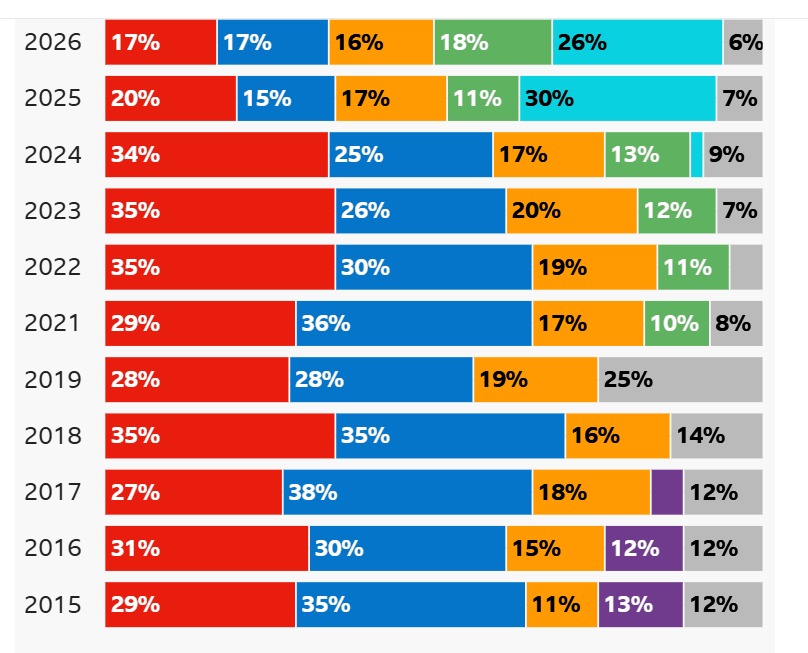
The United Kingdom has officially applied to join the growing club of ungovernable countries. In a preview of the next general election, voters appeared ready to ditch the stable two-party system, returning five entities of roughly equal strength. Ominously for the EU-UK relationship, waves of support carried Reform, an insurgent right-wing party, to unprecedented gains.
Sir Keir Starmer returned from the May-day weekend to find municipal rubble outside Downing Street. His Labour party had shed 1,492 seats and surrendered once-reliable redoubts such as Wigan, Salford and Tameside. The wins went to the rabidly anti-European Reform UK, led by Nigel Farage, and the Greens, led by Zack Polanski.
The prime minister stiffened his jaw yet struck a penitent note. “The hope wasn’t there enough in the first two years of this government,” he conceded while scheduling a reset speech on Monday. Few colleagues listened. By Saturday evening 39 Labour MPs had urged him to quit; more than 100 councillors demanded an “orderly” exit.
Stalking horses
Catherine West, a low-ranking ex-minister from Hornsey and Friern Barnet, then struck the match. She threatened a stalking-horse challenge unless a cabinet heavyweight moved first. “You know what sometimes happens to stalking horses? They become the candidate,” Ms West told reporters.
Allies of Andy Burnham (not being an MP, he is currently ineligible for any leadership contest) scrambled. The camp of Wes Streeting (Mr Starmer’s health minister and most serious potential rival) counted votes. A semblance of cabinet unity gave way to open hostilities.
Reform’s surge terrified Labour strategists most as the party keeps hemorrhaging working-class votes. The next general election is due no later than August 2029. Imitating Reform’s hard-Brexit posture now may feel tempting even to ministers who once extolled closer EU ties.
A cluster of EU deadlines sharpens the drama. The five-year review of the Trade and Co-operation Agreement (TCA) opened in May. Parallel dossiers—on sanitary-and-phytosanitary (SPS) food rules, electricity-market coupling, an emissions-trading link and a youth-mobility scheme—languish half-finished. An annual UK–EU summit is pencilled for late May.
The Brussels calendar
EU capitals watch in wary silence. Officials calculate that Labour’s local-election wipe-out drains British leverage. They can afford to wait until Westminster steadies itself. The risk, however, is that Britain drifts further away while they wait.
Continental business shares the worry. European portfolio managers told France 24 that a weakened Labour government could delay regulatory decisions vital to cross-Channel finance and data flows. Uncertainty travels quickly down supply chains.
Mr Starmer can cling on yet pivot right, or he can fall to a successor who pledges “Brexit-plus” sovereignty. Either way, the course bends toward a cooler Brussels. Each path begins with a calculation about Reform UK’s appeal in neglected northern boroughs.
One road, two forks
In a display of how limited his options are, the prime minister’s first response to the electoral disaster was the reintroduction of Gordon Brown to Downing Street. The long-time erstwhile Chancellor was the mastermind of Tony Blair’s New Labour project some 30 years ago. Yet he is best remembered for his only general election result as prime minister, a staggering loss in 2010.
The hope wasn’t there enough in the first two years of this government. — Sir Keir Starmer, UK prime minister
Should Mr Starmer survive, tougher migration talk may well come first. The youth-mobility scheme would halt; work-visa quotas would tighten. Ministers would re-brand SPS and ETS talks as supply-chain security, not stealth single-market steps. The Cabinet Office would slow the repeal of retained EU law, while trumpeting “sovereign divergence where it helps growth.”
Brussels would reciprocate coolly. Technically easy energy links might proceed, yet dynamic SPS alignment and mobility concessions would pause until British politics calms. Exporters would howl. Food firms that banked on an SPS truce would see their prize vanish.
A tightening Irish-Sea line
Northern Ireland would feel the strain. Diverging vehicle standards widen the Irish-Sea border. Dublin would warn of instability; London might flirt with invoking Article 16. The Commission has drafted a retaliation list—cars, Scotch whisky, chemicals—to roll out within weeks should Britain pull that trigger.
Treasury officials, confronting feeble growth, would later lobby for customs facilitation. A Norway-style veterinary accord could re-emerge nearer 2028. Yet EU negotiators, having been burnt before, would keep ambition low. Functional but thin relations deliver incremental gains on energy and carbon, while services and people links stagnate.
Markets stay jittery. Office for Budget Responsibility stress-tests suggest a 0.3-0.5 percentage-point GDP hit by 2027 relative to a co-operative baseline. Sterling may wobble, though the Bank of England can cushion sharp swings.
Coup d’état—coup de froid
If Ms West detonates a contest, the field narrows to Mr Streeting, Angela Rayner and—if he can swap Manchester city hall for Westminster—Mr Burnham. Each jostles to appear ‘Reform-proof’. A victorious challenger would trumpet a UK Standards Act forbidding regulators from shadowing future EU rules, a Made-in-Britain subsidy scheme and strict visa caps.
National election estimates over time
Brussels would assume little scope for warmth before the election. Officials could start consultations on stripping diagonal accumulation—vital for British carmakers—from EU trade deals, sapping Sunderland and Swindon plants. German trade advisers warn that harder British demands during the 2027 review would stoke uncertainty.
Markets would flinch yet not crater. Sterling already prices in some post-Brexit friction. Tearing up SPS plans or quitting the Lugano civil-justice convention would add yield points to gilts, darkening merger prospects.
Continental voices
Official EU statements remain sparse, yet the tone is plain. Bénédicte Paviot of France 24 intoned, “The outcome will pile pressure on Prime Minister Keir Starmer.” Jani Kokko, a Finnish Social-Democrat MP on the Council of Europe observer mission, offered a helpful observation, “The vote was more important than ever because of the increasing threat posed by foreign interference, attempts to undermine democracy, and disinformation.”
German pundits see familiar fragmentation. Analysts note that Britain now boasts five significant parties—echoes of Berlin’s fractious Bundestag. Investors echo that view: French equity strategists reckon the shock carries “no immediate impact” on sterling, yet prolonged turmoil could nudge the UK risk premiums up.
The Commission senses leverage. It can dangle data-adequacy extensions or mutual-recognition deals, then withdraw them if London diverges. For now it prepares defensive tools — safeguard clauses, rebalancing tariffs and incentives to reroute euro-clearing onto the continent.
Security strands
Military co-operation endures inside NATO and the G7. Yet sanctions design, cyber-threat sharing and police-database access depend on legal trust and Court of Justice oversight. A harder anti-EU tilt would chill that work. Criminal syndicates would cheer.
Northern Ireland remains the flashpoint. A mis-timed Article 16 gambit could trigger a trade war. Scottish distilleries, Midlands car plants and Yorkshire cheese makers would head Brussels’s tariff list. Treasury bean-counters deem the macro hit modest, though the political sting would be fierce.
The vote was more important than ever because of the increasing threat posed by foreign interference, attempts to undermine democracy, and disinformation. — Jani Kokko, Council of Europe
A post-coup leader might pivot back toward Brussels before polling day. Treasury mandarins will push. Mr Streeting once mused about a customs-union option; Mr Burnham hopes Britain will “re-enter” the EU in his lifetime. Either could rediscover the virtues of an SPS accord and a narrow customs territory.
Brussels would welcome that. A Swiss-plus package—dynamic food alignment, customs facilitation, youth exchanges, limited court reach—could be sewn up by 2028. Mutual recognition for professional qualifications might follow. Treasury models put the GDP gain at roughly 0.7 percentage points by 2030. Reform would yell betrayal. Yet cheaper supermarket shelves and calmer bond yields could soothe voters. That calculus will dominate Labour’s civil war all summer.
Endgame choices
Downing Street begged Ms West to delay her ultimatum until after Mr Starmer’s speech; she refused. Cabinet grandees still baulk at wielding the knife, but back-benchers fearing for their seats may not. The coming general election will decide whether Britain drifts further from the continent or paddles back.
EU leaders recall the 2019 roller-coaster that ended in Boris Johnson’s landslide and years of frost. They will hedge until the pendulum stops swinging, completing energy links, shelving mobility schemes, drafting tariffs. London can shout about sovereignty; the single market will not blink.
You know what sometimes happens to stalking horses? They become the candidate. — Catherine West, UK’s Labour MP
Britain, therefore, faces a unappealing choice: mimic Reform to save seats and pay a European price, or risk Reform gains to reset ties with its largest trading partner. The municipal rubble outside Downing Street shows that ducking that decision is no longer possible.
All this leaves the fraught EU-UK relationship in a quandary. When it comes to horses, stable and shambles are synonyms; not so in top-level politics. Brussels knows: Sir Keir has been a good ally. He may choose a sharp pro-EU turn as a long-shot survival strategy; unfortunately, that appears not to be a popular path. When the best you can hope for is your friend’s electoral suicide, you are not in a good place.