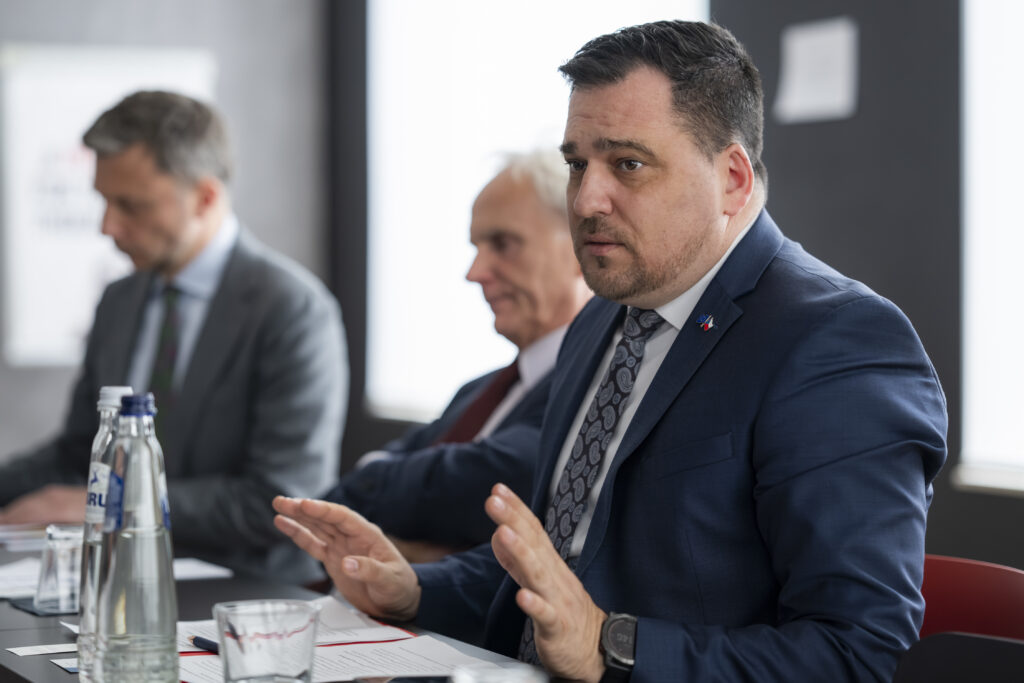
Europe is rearming. But who should bear the costs? According to MEP Tomáš Zdechovský (EPP/CZE), member states need to pay more — and farmers and regions need to settle with less. “If someone is speaking about new resources, they’re naive or they don’t understand how the EU functions,” he argued in a roundtable organised by EU Perspectives, where he spoke alongside Burkard Schmitt, Director of Defence and Security of Aerospace, Security, and Defence Industries Association of Europe and Melchior Szczepanik, head of the Brussels bureau of the Polish Institute for International Affairs.
Zdechovský, who is a member of the European Parliament’s Budgetary Control Committee laid out his reading of the EU’s shifting financial priorities. Under the current 2021–2027 Multiannual Financial Framework, funds allocated directly to defence remain a fraction of what flows to agricultural and cohesion policy, a gap he puts at roughly €374 billion.
Misplaced billions
To close the gap, member states need to open their wallets. “Member states must pay if they want something more for the European Union. The European Union can be very effective, we have many tools,” Mr Zdechovský said. “But the problem with everything is that it looks very good on paper, but in reality the member states don’t want it.”
After twelve years on the committee, Mr Zdechovský sees enormous scope for spending funds more effectively. “The biggest gap, the biggest opportunity for money to be stolen, is agricultural policy and green policy. Many things are very ideological from the Budget Control Committee’s point of view. We want projects that are truly green,” he said.
“We must change our mindset and be absolutely certain that what happened in Ukraine will happen very quickly in another country” — in both conventional and hybrid warfare scenarios.”
— MEP Tomáš Zdechovský (EPP/CZE)
In a plenary debate on the MFF, Mr Zdechovský had already expressed his concerns about greater investment in the environment at the expense of European security. “Enough euros for non-existent cycle paths, enough euros for non-existent watchtowers, enough euros for senseless projects. We must combat geopolitical threats, we must expand infrastructure, we must invest in security, and we must firmly state that Europe must be stronger,” he said.
Now, he is clear in his opinion that to fund defense, Europe needs to cut expenses elsewhere. “Yes. And all the screening programmes,” he replied to a question on the possibility of cohesion and agriculture policy cuts, chapters which take up most of the EU budget.
Changing mindset
The perception of the Russian threat varies sharply across the bloc. “Portugal and Spain aren’t concerned about Ukraine, but it’s logical that they don’t have borders with Ukraine. For us, as for the Czechs or Poles, it’s much more essential to increase defence funding,” Mr Zdechovský said. “We must change our mindset and be absolutely certain that what happened in Ukraine will happen very quickly in another country” — in both conventional and hybrid warfare scenarios.”
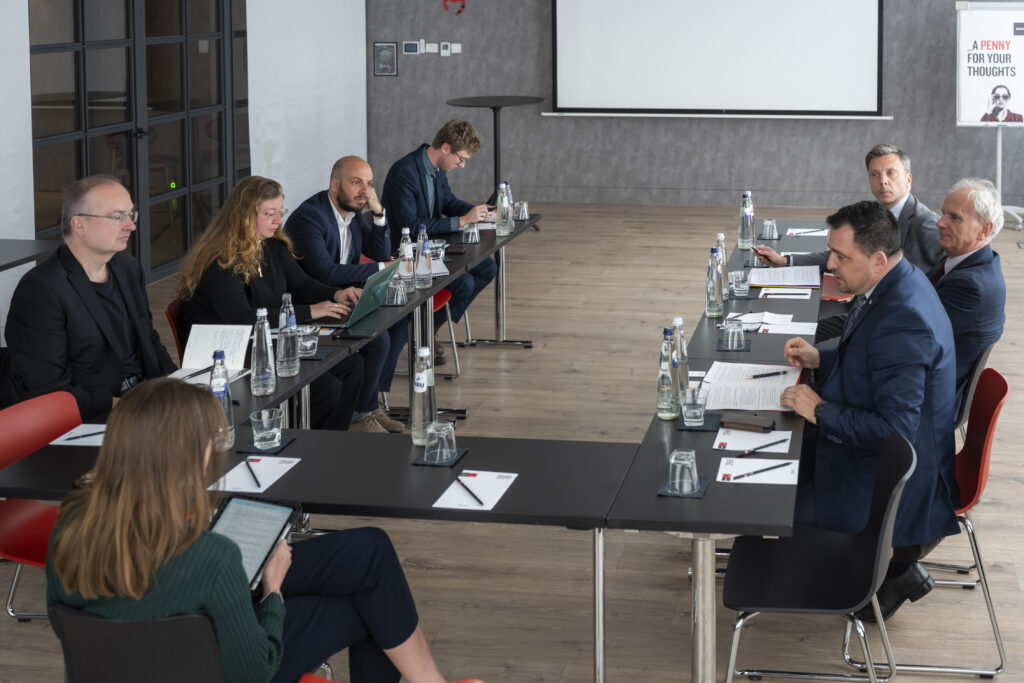
Melchior Szepanik, head of the Brussels office of the Polish Institute of International Affairs, agreed. “The majority of the EU member states see Russia as a direct threat,” he said.
Within the committee, the main discussion centres on what might happen if the United States withdrew from NATO, though Mr Zdechovský is certain “that will never happen.” He and his colleagues remain agreed that defence is ultimately the responsibility of member states.
We’re funding someone, Elon Musk, who is completely unpredictable, and the information we share about our satellites.
— MEP Tomáš Zdechovský (EPP/CZE)
Mr Zdechovský also raised concerns about the EU’s dependence on American equipment and services, including Starlink. “We’re funding someone, Elon Musk, who is completely unpredictable, and the information we share about our satellites,” he said. “It’s very important to be very careful about what we do and what we pay for. We have enough money, but how are we using it?”
Burkard Schmitt, Defence and Security Director at ASD Europe, echoed the warning: the EU remains dependent on the US even as the broader strategic landscape shifts. However, he remains optimistic that change is possible.
“Technologically speaking, almost everything is,” he said. But there’s a catch: “You have to give it priority. You have to put money on the table, invest strategically and give preference to the procurement and / or development of European systems” he argued.
Whether that will happen is a question only time can answer, with the EU budget negotiations likely to outline just how much Europe is willing to pay for its own security — and what it is willing to sacrifice.