NATO membership for Dublin is out of the question, and mutual EU members’ assistance is by no means a common defence, Irish Europe and defence minister says.
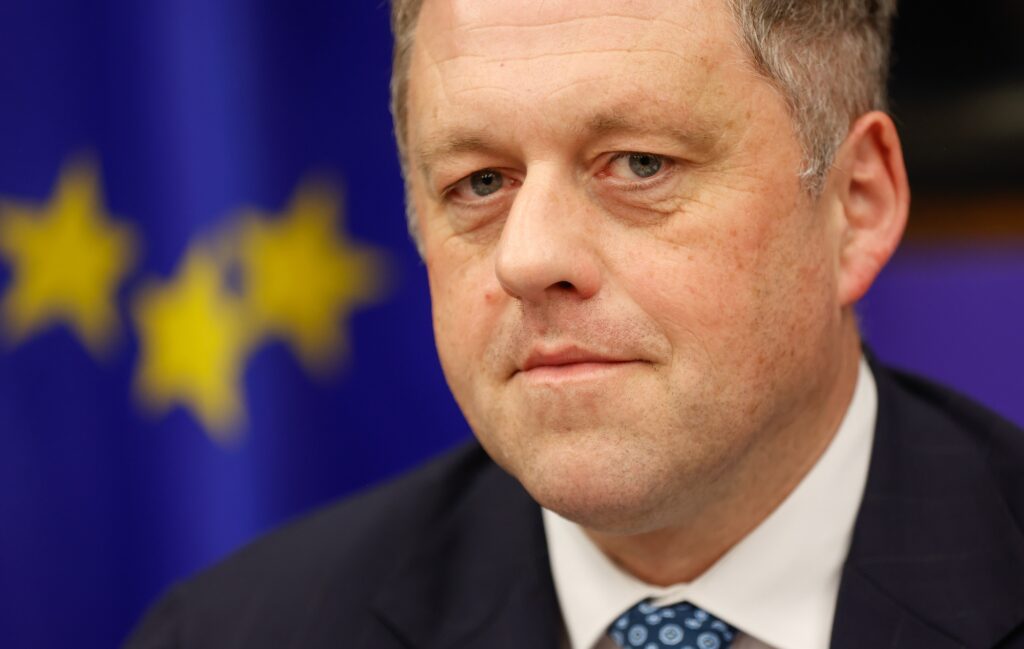
Two weeks before Ireland officially unveils priorities of its upcoming EU presidency, Thomas Byrne, Ireland’s minister for Europe and defence, outlined them in Brussels. A Bruegel debate on 27 May, moderated by Guntram Wolff, heard about three pillars—competitiveness, values, and security—that will structure the six-month term.
Dublin is to inherit no small task. It is to manage a bloc consumed by war on its eastern flank, a fractious transatlantic relationship, and an unfinished enlargement queue. On the first two pillars, Mr Byrne was expansive. On the third, he was precise to the point of being restrictive. The distinction matters. Brussels has been pushing for a more unified European defence architecture. If what Mr Byrne said is anything to go by, Ireland does not seem to be its champion.
Keeping Ukraine in the fight
The presidency’s most consequential near-term task on security is keeping Ukraine financially and militarily afloat. The €90bn loan, long delayed by Hungarian obstruction, has now cleared. Mr Byrne welcomed it as more than a financial instrument. “It’s an example of enhanced cooperation,” he said, noting that Ireland had invoked special constitutional provisions to participate — the first time it had done so.
The implication was deliberate. The mechanism could serve as a template for future EU-wide arrangements where unanimity proves elusive. Military supply to Ukraine will continue, Mr Byrne confirmed, though he framed it as a bilateral matter. Ireland has provided equipment and financing directly.
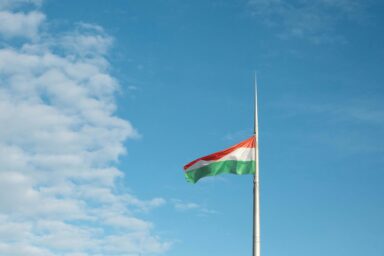
Enlargement, he argued, remains the most durable guarantee of all. “The enlargement of the European Union to include Ukraine is the greatest security guarantee we can give, not just to Ukraine, but to the European Union as well,” he said. Hungary’s veto on opening formal accession negotiations remains the immediate obstacle. Mr Byrne expressed confidence it would be resolved within weeks.
On collective defence, Mr Byrne was as unambiguous as he was unapologetic. NATO membership is not under consideration. When asked what other member states could do to advance a debate on Irish NATO accession, his answer was brief: Irish membership of NATO was not on the cards. No elaboration followed.
Neutrality, carefully defined
More revealing was his handling of Article 42.7 of the EU treaty, the mutual assistance clause. Some in Brussels have taken to describing it, loosely, as the EU’s answer to NATO’s Article 5. Is that a difficult question for Ireland, Mr Wolff asked. Mr Byrne pushed back with some force. “First of all, it’s not a difficult question for Ireland,” he told the audience. “We’re not a part of NATO and that is basically the description of neutrality.”
It is important to remember that the language is of mutual assistance, not of mutual defence. — Thomas Byrne, Ireland’s minister for Europe and defence
“We’re also not part of EU common defence because it doesn’t exist,” he said. The distinction between mutual assistance and mutual defence, he insisted, was not semantic. “It is important to remember that the language is of mutual assistance, not of mutual defence,” he said. “And I think it’s not correct for people to use the term mutual defence. And we’ve heard that in some of the discussion and it’s very unhelpful.” Ireland has already acted under Article 42.7. When France invoked the clause after the 2015 Paris attacks, Dublin responded.
Mr Byrne cited Dublin’s response to Paris as evidence that Ireland is “fully part of that, fully signed up to that”. The assistance rendered was military in nature; but the clause itself, he stressed, does not constitute common defence. Ireland retains an explicit opt-out on any move towards a NATO-style EU defence structure, and any such proposal would require a referendum. “There has been no proposal and there won’t be any proposal I think anytime soon on a common defence,” he said.
A bilateral instinct
The tension between Mr Byrne’s position and the direction of travel in Brussels is real. The Commission and several member states have been pushing for a more integrated European defence architecture, one that goes beyond ad hoc bilateral arrangements. Mr Byrne’s framing runs counter to that ambition at almost every turn. Military support for Ukraine is bilateral. Collective security guarantees stop at mutual assistance. Common defence is off the table.
Mr Wolff put the challenge directly: “(Is the bilateral framework adequate) especially in light of a still difficult transatlantic relation where Article 5 may be challenged?” Mr Byrne acknowledged the gravity of the moment without conceding any ground. “If ever there were to be a terrible event involving one of the Baltics or Finland or whatever, it would be unthinkable for us simply to stay on the sidelines,” he said. “I mean, we have not stayed on the sidelines with regard to Ukraine. And I think the support we would give would be, I would have thought, along the same lines.” The commitment was moral and political. It was not structural.
On enlargement—the values pillar of the presidency—Mr Byrne was considerably more animated. Montenegro is first in line. Mr Byrne said Ireland would work to conclude its accession negotiations by the end of the year. Albania is progressing, though member states require further reassurance. Ukraine and Moldova remain blocked by Hungary on the opening of their first cluster negotiations, a situation Mr Byrne expected to resolve shortly.
The queue at the door
He was notably cautious about proposals to create alternative or accelerated pathways for Ukraine, or ‘membership light’, associate membership, or reverse enlargement. “All I can say at the moment is that I have to work with the process that we have at the moment,” he said. Chancellor Friedrich Merz of Germany has floated ideas requiring broader discussion. The European Commission has its own proposals. Mr Byrne declined to endorse any of them.
If ever there were to be a terrible event involving one of the Baltics or Finland or whatever, it would be unthinkable for us simply to stay on the sidelines. — Thomas Byrne, Ireland’s minister for Europe and defence
His instinct was to keep the existing process moving rather than redesign it mid-flight. “If these countries fulfil what we’ve asked them to do, I think we’ll have no option but to admit them then as member states of the European Union,” he said. “We haven’t had an accession since Croatia in 2013. That’s one of the longest periods without it. So let’s go for it would be my view.” The European Council will take up the broader question the following month.
A Reuters correspondent asked whether Britain’s renewed debate about rejoining the EU might surface during the Irish presidency. Mr Byrne allowed himself a moment of candour. “My own personal views on that, of course, which, you know, personally I’d love to see it,” he said. But he quickly pivoted to the immediate agenda: a sanitary and phytosanitary agreement, alignment on the emissions trading system, and a youth experience scheme.
The British question, briefly
“If we start talking about rejoining or we start talking about the single market, then we lose focus on what’s actually on the agenda today for the next few weeks, which could bring huge benefits,” he said. The near-term prizes are practical and achievable. Mr Byrne wants them secured before any larger conversation begins.
The door to deeper UK–EU integration is not closed. It is simply not the door Ireland is knocking on right now. For a presidency that must balance enlargement, security, and competitiveness across six demanding months, that discipline—however frustrating to some—may prove its defining characteristic. How it is going to turn out, of course, nobody knows for sure.