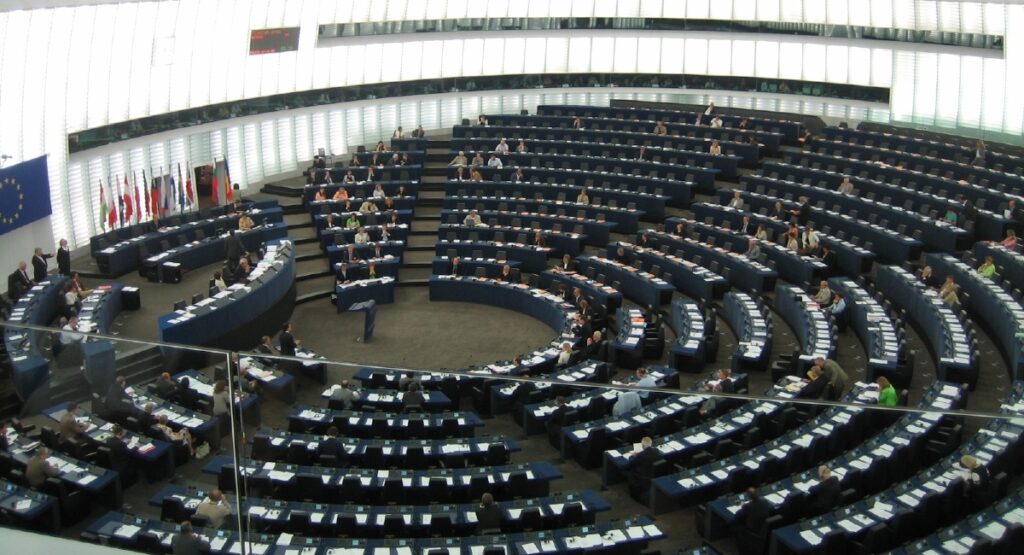
In a move branded “undemocratic,” the European Parliament extended controversial Chat Control rules even though more lawmakers voted against the proposal than in favour. Critics say the rare procedural outcome could reshape negotiations on the EU’s permanent child sexual abuse legislation.
The move effectively brings back a lapsed derogation allowing providers of electronic communication services to voluntarily detect child sexual abuse material (CSAM) – the temporary legislation widely known as “Chat Control 1.0.”.
“I remain deeply disappointed that the Council, with the backing of one political group, managed to force this vote upon us.”
— Member of the European Parliament Irena Joveva (RE/SI)
Members od the European Parliament (MEPs) had already rejected the extension twice, but an “urgent procedural measure” forced a new vote. Because this was the second reading, defeating the Council’s position required an absolute majority of the entire Parliament—361 votes. However, only 314 MEPs voted to reject it, while 276 voted against rejection and 17 abstained. As a result, the proposal was not defeated, and mass scanning remains permitted until 2028.
Parliament also adopted an amendment stating that end-to-end encrypted communications should not be scanned. However, critics call it “symbolic”. As former Pirate Party MEP Patrick Breyer pointed out “in practice, service providers do not scan these anyway.”
Breyer, who is also a jurist, told EU Perspectives that it is unprecedented for the Parliament’s president to reopen legislation that lawmakers had already rejected. And that a 2nd reading procedure is also exceedingly rare. In the previous parliament legislative term, only 1% of all legislative proposals went through the second reading process.
Pressure from the Commission and member states
Irena Joveva, Renew shadow rapporteur on the Temporary derogation extension, said: “While it is a small victory for this House that we successfully excluded end-to-end encryption from the scanning of private communications, it is simply not enough. I remain deeply disappointed that the Council, with the backing of one political group, managed to force this vote upon us.”
MEPs were also under pressure from the European Commission as Commissioners Henna Virkkunen, Magnus Brunner, Michael McGrath and Glenn Micallef wrote to the law-makers on Monday urging them to accept the derogation.
“Since Council now has what they want, they won’t agree to anything else.”
— Patrick Breyer, former Pirate MEP and jurist
The Parliament position will now be sent to the Council, which has three months to approve or reject the amendments – including that on protecting encrypted communications. If the Council does not accept all of the amendments, the legislation will enter a conciliation process, where both institutions must negotiate a final compromise.
The derogation is meant to be a temporary measure to prevent a legal vacuum while talks on a permanent directive to combat child sexual abuse are ongoing. Many elements of the permanent law were agreed under the Cyprus Presidency, with the next trilogue scheduled for September.
However Breyer is concerned today’s vote will undermine the negotiations. “Since Council now has what they want, they won’t agree to anything else. This could derail the process,” he said.