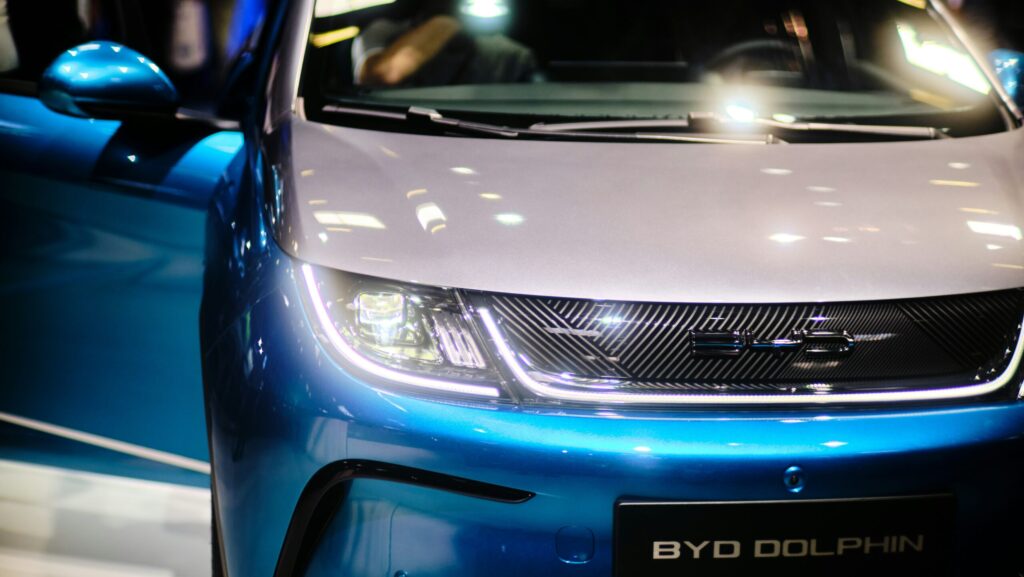
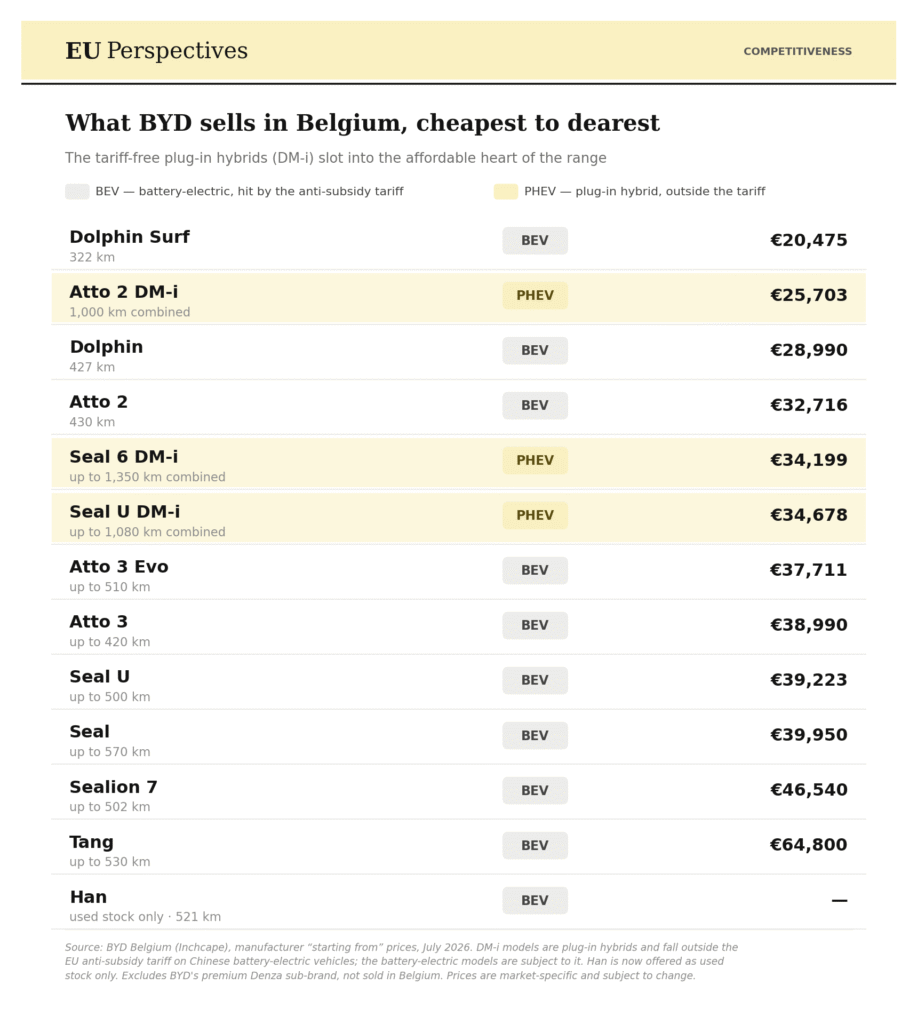
The Chinese carmaker has overtaken Tesla and become Europe’s fastest-growing major brand. Critically, it has done so not by absorbing the EU’s tariffs on Chinese EVs, but by pivoting to hybrids that effectively sidestep them.
BYD overtook Tesla in European registrations in the first half of 2026, registering 174,144 vehicles against Tesla’s 170,351.
When Brussels imposed anti-subsidy duties on Chinese-made electric vehicles, BYD faced a total tariff of around 27 per cent.
According to Matthias Schmidt of Schmidt Automotive Research, the tariffs haven’t had a major impact. “Chinese Original Equipment Manufacturers mitigated their effects by leveraging non-BEVs such as hybrids and combustion models, which aren’t impacted,” he said. “Over half of BYD’s deliveries feature a combustion engine.”
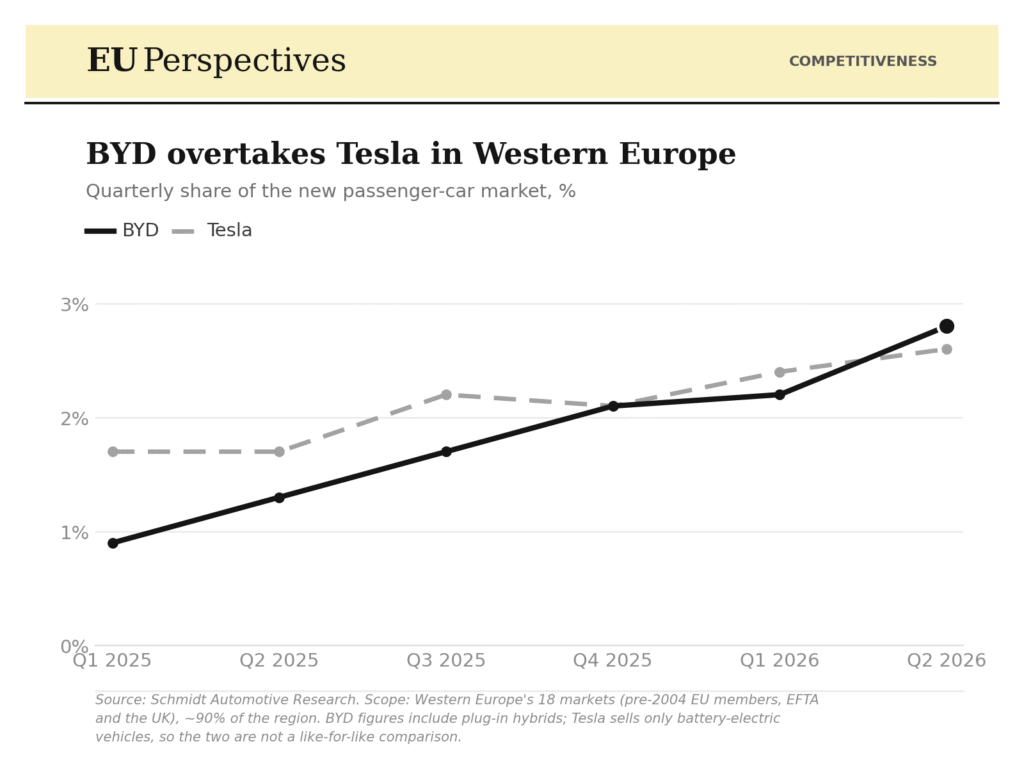
In Schmidt’s Western European dataset—18 markets covering roughly 90 per cent of the region—BYD’s quarterly share climbed from 0.9 per cent in early 2025 to 2.8 per cent by the second quarter of 2026, edging past Tesla’s 2.6 per cent. A key market difference is that Tesla sells only battery-electric cars while BYD’s lead is padded by hybrids that can’t be compared cleanly.
Schmidt notes that SAIC’s MG was the first Chinese brand to dominate in Europe and remains the largest by cumulative volume of 190,000 units. BYD is just the latest rise in a Chinese surge.
Europe is also just a part of the brand’s puzzle that is changing what car people drive globally. BYD is now the largest global producer of electric vehicles, selling 4.6 million in 2025 compared to Tesla’s 1.6 million.
Any available plant
BYD will begin assembling cars at a €4bn plant in Szeged, Hungary, in the fourth quarter of 2026, starting with the Dolphin Surf. These manufactured cars will also then count as European and escape the tariffs entirely.
According to executive vice-president Stella Li, BYD aims to produce all its European EVs locally by 2028. Li said the company is “looking for any available plant in Europe” to turn into a new BYD manufacturing hub.
BYD’s rise however does have a limit. “BYD will struggle to surpass 3 per cent for a prolonged period as other Chinese carmakers enter the region, which will cause a form of cannibalisation going forward,” Schmidt said. And the European push is partly flight from home, where BYD’s domestic market is locked in a brutal price war.
“There’s still no clear-cut winner,” analyst Lei Xing told CNN. For now, BYD can be seen increasingly in any European city, thanks in large part to a hybrid engine the tariffs never touched.