It can save young lives but it is not attractive enough for investors. That is the cruel economics of childhood cancer treatment. Léonor, a ten-year-old cancer survivor, asks Europe to change that.
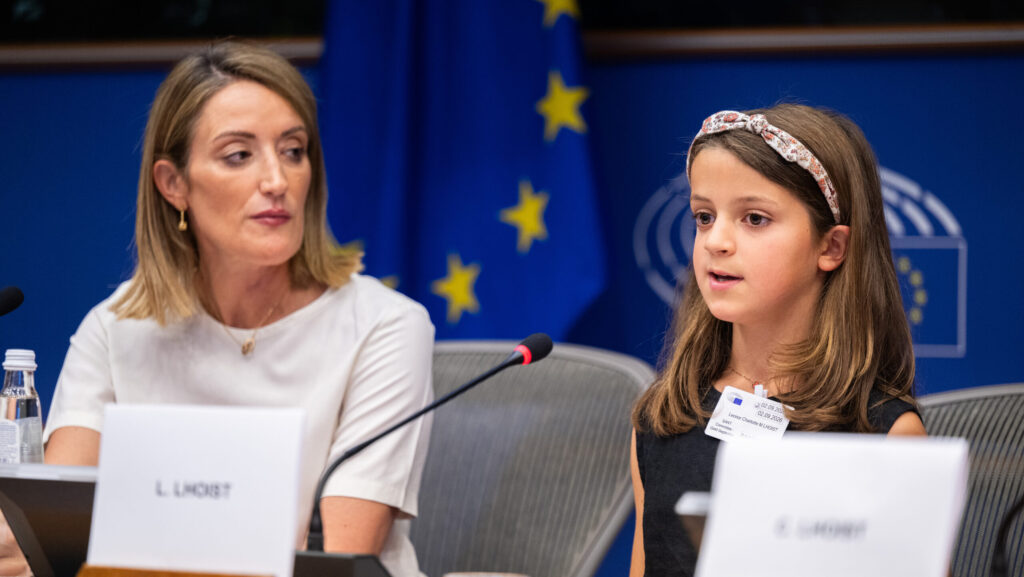
Léonor Lhoist survived childhood cancer. “Curing cancer is improving for everyone, except for children,” she says. So she has a question for the people who write Europe’s medicines laws. “Do you prefer to help us or to let us suffer?”
Children with cancer mostly get medicines built for adults. “Although of course childhood cancers are less common than adult ones, it’s unfair that they get treated differently and are given less valuable drugs,” says-ten-year-old Léonor. “The medicine is much too strong for children, and lots of us suffer because of it.”
These medicines have lifelong impacts on survivors, such as cognitive dysfunction, amputation, organ removal, cardiac failure, secondary cancers, or post-traumatic stress disorders, Léonor listed. “I, for example, am under a specific diet for my damaged kidneys,” she said. She added that childhood cancer survivors are often bullied at school because of their differences.
Today you can make history for all the little ones like me. — Léonor Lhoist, ten-year-old cancer survivor
Less common is not the same as few. “Every year there are 35,000 new cases in Europe,” she says. “It is the number one cause of death (from disease) for children.”
Speaking in the European Parliament during Gold September, the childhood cancer awareness month, she asked lawmakers to approve medicines for children. “Today you can make history for all the little ones like me.”
Roberta Metsola, President of the European Parliament, put the shortfall on the record. “This house is ready to work with you so that other families in your situation have the support that they so desperately need and still so desperately lack in so many states of our Union.”
Priceless for a child, worthless as an investment
Sam Daems can explain why companies build so little for children, and he sees it from both sides. He is chief investment officer at a European investment firm and a researcher at the University of Brussels. He is also Faye’s father. Doctors found a brain tumour when she was two, and she died six months later.
Childhood cancer is not one disease but many, each split into molecular subtypes needing different treatments. ATRT, or atypical teratoid rhabdoid tumour, the disease that killed his daughter, affects around 200 patients a year across the United States and Europe combined.
A therapy can have an enormous value for a child and still at the same time be a completely terrible investment. — Sam Daems, economist and parent
“A therapy can have an enormous value for a child and still at the same time be a completely terrible investment,” Mr Daems says. He does not blame companies for it. “The business case doesn’t work and that’s not bad intent from the pharmaceutical industry. It is just a logical consequence of the underlying economics and of the fundamental structure of paediatric oncology.”
“We should not expect the markets to come up with a solution for paediatric oncology. That will never happen,” he says. Because no market picks the winners, public authorities have to choose deliberately where the money goes. And that takes “the guts to make choices”.
Before a medicine is authorised, its maker has to set out how it will be tested in children, in a document called a paediatric investigation plan. Companies could be excused from that when the adult disease the drug treats does not occur in children, which covers most adult cancers.
Europe’s new rules still leave a gap
Europe’s revised pharmaceutical law, agreed last December, narrows the excuse. Where a drug acts on a molecular target that also drives a disease in children, the plan can be required anyway.
Gilles Vassal of the European Society for Paediatric Oncology (SIOPE) counts that as real progress. “A drug for lung cancer, targeted drug, should be developed in neuroblastoma in a paediatric disease if the target is relevant,” he says, referring to a childhood cancer of the nerve tissue. “That was not the case in the previous regulation because lung cancer does not exist in children.”
But the rule only reaches medicines that begin life as adult drugs. Where the target exists only in a childhood cancer, there is no adult application for the obligation to attach to. And the rewards on offer are worth little to a company with no adult product to extend.
“There is no specific incentive for a drug developed only for children with the first marketing authorisation in children,” Vassal says. “This is exactly the question that we are raising here.”
Four medicines in 26 years
Medulloblastoma is the proof. The brain tumour, which appears around the age of 10, is now understood as ten biologically distinct diseases. Each with targets that could be attacked.
“Not a single medicine has been approved for the treatment of children and adolescents with medulloblastoma,” Vassal says despite major progress in understanding of the disease and a strong rationale to develop specific medicine to treat these children.
The orphan medicines rules, written for rare conditions, did not fill the gap either. “If you look at the drugs approved so far, only four medicines have been approved specifically for paediatric cancer,” he says, in the 26 years those rules have existed.
“We couldn’t get it through”
Lawmakers tried to fix this during the pharmaceutical negotiations and lost. “I tried to fight as much as possible in the pharma package to have special incentives for paediatric medicines. Unfortunately, we were not able to do it,” says MEP Tomislav Sokol. “We couldn’t get it through. And I’m really sorry for that.”
What remains is spread across several files. Stakeholder want a paediatric incentive written into the European Biotech Act. Childhood Cancer International Europe and KickCancer want the next EU budget, the 2028 to 2034 framework, to invest structurally in diseases where the market falls short.
With dedicated European money behind unmet medical needs. And Parliament is demanding a standalone health programme worth at least 10 billion euro. They want the cross-border rules rewritten so a child can join a clinical trial in another country. And they want a new fund that the pharmaceutical industry would pay into.
One article, and a fight over it
The Biotech Act is where SIOPE has put its weight. “There is one thing in addition that you could do,” as Vassal frames it.
Article 27 of that law would extend the supplementary protection certificate, or SPC, by twelve months. An SPC is the extra stretch of protection a medicine gets once its patent expires. The Biotech Act would raise the maximum for medicines judged best in class. Its four qualifying conditions say nothing about children.
Vassal wants a paediatric route written into the same article. “We are really proposing that in this article 27, you introduce a specific measures of extension of the SPC for the cases of product developed for severe life-threatening paediatric rare disease, such as childhood cancer,” he says, with the twelve months granted where the first marketing authorisation is in children.
The warning comes with it. “If there is no specific measures in the EU biotech act focussing on the need of severe paediatric life-threatening rare disease, such as childhood cancer, it will not work as it did not work in the orphan drug regulation.”
MEP Sokol has promised to try. “I can promise you that I will support that we try to find the specific incentive in the Biotech Act as much as possible.” He will not promise it will work. “The problem is usually the opposition from the member states, at least some of them and the council.”
A fund the industry would pay into
MEP Stine Bosse, the Danish Renew Europe member, wants the Commission to create a fund where the pharmaceutical sector can contribute. The fund needs to cover the European Reference Networks, the European Health Data Space, and the cost of the treatments themselves.
Delphine Heenen, who runs European affairs for Childhood Cancer International Europe and founded the Belgian foundation KickCancer, would go further. “We could have a non-for-profit company, a joint venture between industry and academia and with funds from the industry,” she says. “If you can set this up, I’m signing for it tomorrow.”
MEP Vytenis Povilas Andriukaitis, who is now co-writing Parliament’s position on the Biotech Act, wants the Commission to move. “No one country can solve those problems,” he says. “It’s time now to deliver our obligation.”