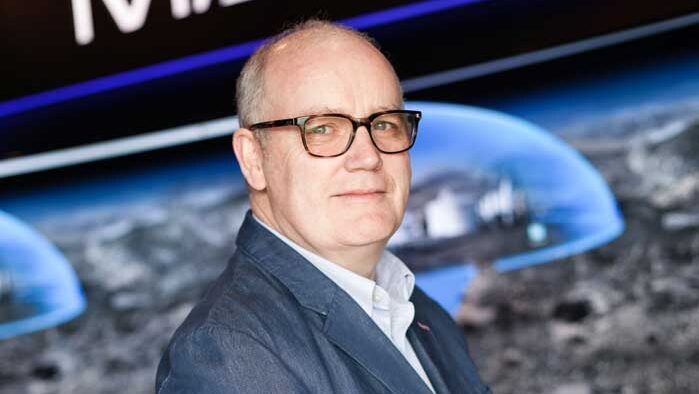
A small company born to protect yachts now sits at the nerve centre of Europe’s counter-drone ambitions. EU Perspectives learned about its journey from Rob Balloch, Chief Growth Officer at MARSS Systems Limited.
Rare is a man with a simple recipe for what his company should do to help solve Europe’s defence problem. Rob Balloch is one. “If there’s one thing I would like to do better, it’s to better educate governments about the capabilities in the SME supply chain. To show what we’re capable of delivering today and not just tomorrow,” the chief growth officer at MARSS told EU Perspectives at Eurosatory 2026 in Paris. The company signed the most significant deal in its two-decade history there.
The company he represents is not a household name. MARSS (for Marine and Remote Sensing Solutions) started in Monaco in 2005. Johannes Pinl founded it to develop security sensors for superyachts. Twenty years later, it sits at the centre of a fast-growing European counter-drone ecosystem. Its NiDAR platform is deployed in over 60 locations worldwide, protecting military assets, critical infrastructure, and borders.
The end-to-end proposition
The trajectory from yacht security to battlefield command-and-control is less improbable than it sounds. The core engineering challenge is in detecting, classifying, and responding to small, fast-moving objects in cluttered environments. It is the same for a dinghy approaching a billionaire’s vessel or a drone swarm approaching a military base.
In May 2026, Australian defence technology firm Electro Optic Systems (EOS) acquired the MARSS defence business for US$36m upfront. A contingent earn-out of up to €100m was tied to €500m of new contract orders. The deal created a vertically integrated counter-UAS group: MARSS supplies the AI-powered brain; EOS supplies the directed-energy and kinetic effectors that act on its decisions.
Mr Balloch frames the combined offer in blunt operational terms. “MARSS and EOS deliver and create end-to-end kill chain solutions against the asymmetric threats that are faced by nations on land, sea, and air,” he said. The phrase “end-to-end kill chain” is the key commercial proposition: a single supplier covering detection, decision, and defeat, without the integration headaches that plague multi-vendor CUAS programmes.
EOS guidance points to approximately US$185m in MARSS revenue for 2026 after consolidation, reflecting 50 per cent-plus compound growth over the prior three years. NiDAR software licences carry estimated gross margins of 55 to 65 per cent. Hardware integration adds lower-margin but strategically important volume.
The BAE Systems moment
The deal that defined Eurosatory 2026 for MARSS came on the show’s second day. BAE Systems selected NiDAR as the command-and-control layer for BATS. Despite the name, its Anti-Threat System is its most advanced counter-UAS capability to date.
The selection carries weight beyond its financial value (undisclosed at that). BAE Systems is one of the world’s largest defence primes. Its endorsement of NiDAR as the “intelligent nerve centre” for BATS opens procurement channels across NATO and international markets that a Monaco-founded SME could not otherwise access.
“NiDAR’s proven track record in managing complex, multi-layered air defence systems made it the natural choice,” said Ms Heywood. “Its AI-powered capabilities and agnostic architecture will play a crucial role in delivering the rapid, intelligent responses that modern Counter-UAS operations demand.”
Mr Pinl was equally direct about what the partnership represents. “This agreement exemplifies how agile, technology-focused SMEs can support tier-one defence primes to deliver world-leading capabilities at the pace demanded by current threats,” he said.
The architecture question
NiDAR’s central claim is sensor and effector agnosticism. It integrates with legacy systems and next-generation hardware alike, meaning a customer need not replace existing kit to plug in the platform. The decision cycle, from threat detection to coordinated response, runs in under ten seconds. That figure, highlighted by BAE Systems in its Eurosatory briefings, is the metric that matters most to military procurement officers weighing CUAS options.
If there’s one thing I would like to do better, it’s to better educate governments about the capabilities that exist in the SME supply chain and show what we’re capable of delivering today and not just tomorrow. — Rob Balloch, MARSS
The European counter-drone market stood at approximately US$1.24bn in 2025, and analysts forecast it will reach US$4.16bn by 2030, a compound annual growth rate of 27.5 per cent. The global counter-UAS sector is projected to reach US$20.3bn by 2030.
MARSS competes in this space against DroneShield, Dedrone, Anduril, and the legacy GBAD divisions of Thales and Leonardo. Its differentiator is the maturity of its AI fusion layer and, now, the vertical integration with EOS effectors that gives it an ITAR-free European supply chain.
The awareness gap
Mr Balloch’s frustration (expressed twice, in almost identical terms, in his Eurosatory interview) is not with the technology. It is with the institutional knowledge gap between what European SMEs can deliver and what European governments believe they can deliver.
“If there was one thing I could do better to try and explain to people what we’re doing, it is to raise better awareness within the EU of the capability and the legacy of the different manufacturers and systems capability that we have within the EU that can deliver the end-to-end kill chain against the air threat being posed by foreign facilities,” he said.
The timing of that appeal is not accidental. The EU’s Action Plan on Drone and Counter-Drone Security (COM(2026) 81) proposes mandatory remote identification standards, common CUAS performance benchmarks, and an EU industrial forum, D-TECT by the third quarter of 2026.
A slow march
MARSS is positioning NiDAR’s cloud modules to meet forthcoming EU certification requirements. The idea is to leverage EOS’s manufacturing base to qualify European-origin hardware for planned EU drone-security funding instruments.un
A new European AI hub in Nice, announced in June 2026, will double the engineering headcount dedicated to that effort. A German test site, linked to EOS’s directed-energy division, is also under consideration.
The threat Mr Balloch describes is immediate. Drone swarms, state-sponsored and otherwise, already menace European borders, naval assets, and energy infrastructure. The question he is asking governments (politely, repeatedly, at trade shows and in procurement offices) is whether they will trust a European SME with the answer, or wait for a larger prime to package the same capability at greater cost and slower speed. The BAE Systems deal suggests at least one prime has already decided.