The European Union has only begun to consider how to operate its mutual defence clause, leaders conceded at the end of informal European Council summit in Cyprus. The Union’s institutions will design a ‘handbook’, and member states are to reach out to Brussels, the officials said on Friday.
Europe’s leaders ended on their two-day meeting in Cyprus by dissecting the most sensitive sentence in the Lisbon treaty. Article 42.7 obliges every member to assist a partner “by all the means in their power” if that partner is attacked. The obligation is loud; the mechanism is mute.
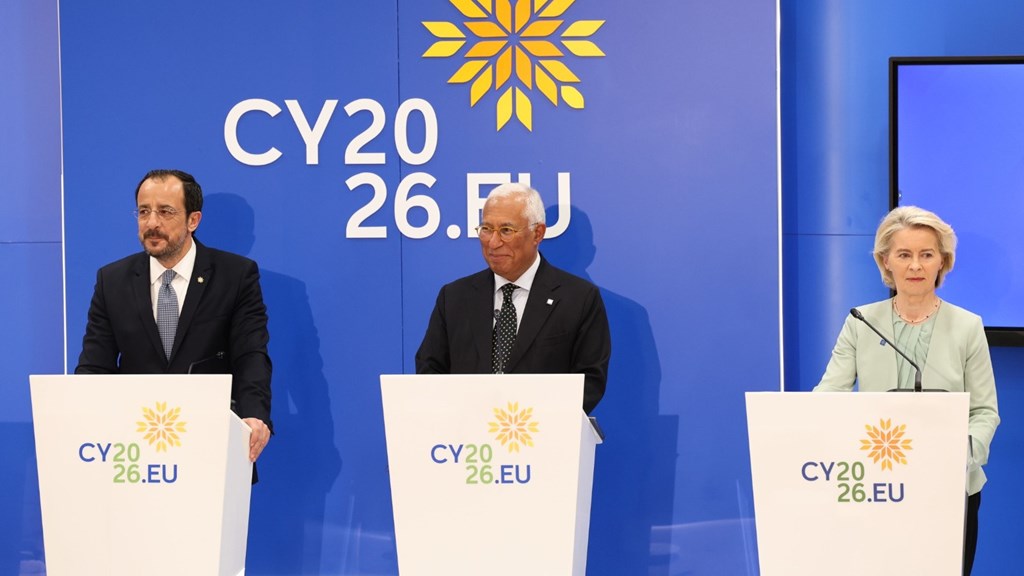
“We had a timely and necessary discussion on the mutual defence clause,” Ursula von der Leyen, President of the European Commission said at the press conference immediately after the meeting on 24 April. “The treaty is very clear about the ‘what’, and it is very strong that there is an obligation for other member states to support the one who is in need.”
The whats and hows
Yet Ms von der Leyen stressed the gap between commitment and execution. “The treaty is not clear about the ‘how’,” she noted. Her solution borrows from disaster relief. “There Member States know exactly how to trigger,” she said, citing the Union Civil Protection Mechanism as a template. Brussels will now draft a ‘handbook’, co-authored by the High Representative for Foreign Affairs and the Commissioner for Defence, that sets out alert levels, force packages and funding rules.
“There is a second element that we started to discuss,” Ms von der Leyen added. “It is a time where you can work to prevent an escalation to an armed conflict and to de-escalate.” That pre-crisis window—where hybrid assaults creep but tanks have not rolled—demands its own playbook. The work has only begun.
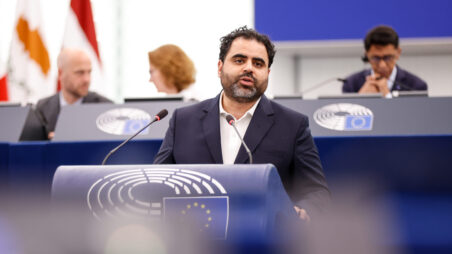
For Nicosia the debate is more than theory. “For Cyprus and not only Cyprus, Article 42.7 cannot just be something in theory,” declared President Nikos Christodoulides. “It must have substance.” The island, which is outside NATO, sees the clause as life insurance against threats from the Middle East.
“It should be fully operational and credible many times also as a deterrent to need to use the article like the President of the European Commission mentions,” Mr Christodoulides said, implicitly admitting it lacks substance and is neither operational nor credible.
Pressure from the periphery
Cyprus’ president wants an operational plan endorsed by capitals stretching from Lisbon to Vilnius. “We have a very good precedent, the civil protection mechanism. And this could be a blueprint on how we’re going to work,” he argued. Support comes from quarters that rarely align with Cypriot security concerns. “I’m talking about Poland, which are talking about the need to go ahead and give substance and an operational plan for Article 42.7,” Mr Christodoulides said.
The treaty is very clear about the ‘what’ (…), not about the ‘how’. — Ursula von der Leyen, European Commission President
Sovereignty is the prize. “Because we cannot be talking about autonomy of the European Union if we don’t have a specific plan in these sectors and we don’t know how to move,” the Cypriot warned. Member states are to reach out to the Comission for specific ideas. With some goverments, “we are already in contact (…) and will address the Commission wth very specific ideas”. Mr Christodoulides thus conceded the talks are at a very early stage even after more than four years of war.
António Costa, President of the European Council, tried to keep transatlantic nerves calm. “We have our headquarters in the same city than NATO, but we are an independent institution,” he said. “We cooperate with NATO, but we don’t discuss the internal issues of NATO.” Talk of Washington punishing hesitant allies over Middle-East deployments, he implied, should stay outside the EU chamber.
Codifying improvisation
The bloc has already tested solidarity, Mr Costa insisted. “In fact, we have had in practice a first test here in Cyprus.” He recalled the moment: “When Cyprus was threatened by Hezbollah. Immediately Greece and then France, Italy, Spain and Netherlands mobilized military equipment and forces to come to Cyprus to help Cyprus to defend from the external attacks.”
Now the task is to codify improvisation. Leaders asked their foreign-policy chief to table options before the June summit. If the handbook is agreed, Article 42.7 will begin to move from parchment to protocol. Without it, Europe’s mutual-defence promise may remain, in Mr Christodoulides’s words, “just something in theory”.