The war in the Middle East has made Europe’s energy dependence impossible to ignore. China, still the world’s largest CO₂ emitter, has nonetheless lapped Europe in electric vehicles, clean energy investment, and battery manufacturing. The EU must now decide how much of Beijing’s industrial playbook it is willing to borrow.
Both Europe and China are chasing the same goal: cutting emissions without sacrificing economic growth. But the paths they have chosen differ sharply — and the gap between them is widening.
China has moved fast, deploying state coordination, subsidies, and long-term industrial planning across entire supply chains. Europe has relied on regulation and carbon pricing. The results show. According to Transport & Environment, Europe is now roughly three years behind China in electric vehicle sales alone.
Electric vehicles
In transport, the shift towards electrification has been particularly visible. China built the world’s largest electric vehicle market in a short period of time, with EV sales and production scaling rapidly on the back of industrial policy, subsidies and infrastructure rollout. Europe followed a similar direction, but at a much slower pace. Many car manufacturers remained reluctant to make the switch to electric.
That gap is even more visible when looking at industrial capacity. China not only produces the majority of the world’s battery supply chain — it has turned EV manufacturing into a major export industry. The European Council on Foreign Relations notes that this expansion is increasingly visible in Europe’s own neighbourhood, where Chinese EVs and related technologies are rapidly gaining market share.
Beyond electric vehicles
The scale of China’s electrification push is also reflected domestically. China accounts for well over half of global electric car sales in recent years, and it leads in the deployment of charging infrastructure and battery manufacturing capacity.
In parallel, China’s broader energy system has undergone rapid change. Wind and solar have expanded at record speed, supported by sustained public investment and long-term planning frameworks embedded in successive five-year plans. China accounts for a significant share of global clean energy investment and manufacturing capacity, particularly in solar panels, batteries and grid technologies. In 2024 alone, clean energy investment reached more than $625bn, according to the International Energy Agency, reinforcing a position that now shapes global supply chains.
The ‘build-first’ model
In China, renewable deployment and industrial scaling have often proceeded in parallel with continued fossil fuel use, rather than replacing it upfront. Coal still accounts for a substantial share of electricity generation, but its relative role is gradually declining as new capacity is added at scale. Leiden University describes this as a ‘build-first’ model — new low-carbon systems constructed alongside existing energy infrastructure, not instead of it.
Europe’s approach has taken a different form. Policy has centred on regulation and carbon pricing, most notably through the EU Emissions Trading System. This has contributed to a steady decline in emissions, but the physical rollout of electrification remains uneven. Renewable energy deployment, grid expansion and EV infrastructure vary significantly across member states, with permitting timelines and planning constraints continuing to slow implementation. The recent turmoil in global energy markets has, however, given electrification new impetus.
The coordination gap
China’s more rapid transition can also be ascribed to a difference in industrial organisation. It is closely linked to coordinated investment across the value chain—from raw materials to manufacturing and deployment—enabling rapid scaling and cost reductions.
Without a coherent European industrial strategy, we risk falling behind.
— Michael Bloss, MEP (Greens–EFA/DEU)
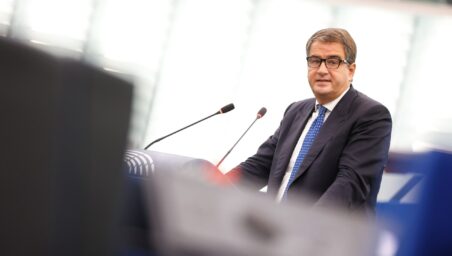
In Europe, these systems remain more separated. Energy policy, industrial policy and transport policy operate through different instruments and timelines. This reduces coordination effects between sectors, particularly in areas such as batteries, charging infrastructure and grid reinforcement. As MEP Michael Bloss (Greens–EFA/DEU) has warned: “Without a coherent European industrial strategy, we risk falling behind.”
Research from Bruegel describes China’s approach as more supply-side and industry-coordinated, while the EU relies more heavily on regulatory instruments and carbon pricing. In EVs, this translates into faster synchronisation between production capacity and demand growth in China, and a more gradual adjustment process in Europe. The industrial dimension of this gap has become part of the European policy debate — the European Commission’s Clean Industrial Deal, published in February 2025, is the bloc’s most direct response yet. Europe remains hesitant about large-scale industrial investment and an assertive industry policy.
Infrastructure rollout reflects similar differences. In China, charging networks, grid expansion and renewable deployment have progressed in parallel with EV adoption. In Europe, infrastructure expansion progresses more unevenly, with bottlenecks in permitting, grid capacity and cross-border coordination.
Lessons for Europe
At the same time, China’s decarbonisation pathway remains hybrid. Coal continues to play a role in electricity generation even as renewable capacity expands at record pace. Analysis from the OSW Centre for Eastern Studies describes this as a dual-track approach in which energy security and industrial expansion continue alongside emissions reduction.
Europe’s approach is more directly anchored in emissions reduction frameworks. Carbon pricing systems, regulatory standards and legal obligations have driven sustained emissions declines in several sectors. But regulation alone does not build factories, lay cables, or roll out charging points. That requires the kind of coordinated industrial ambition Europe has so far been reluctant to embrace.
In an era of rising geopolitical tensions and the energy transition, we must decarbonise, remain competitive and strengthen our resilience.
— Jeannette Baljeu, MEP (Renew/NLD)
If anything, recent developments in global energy markets have reinforced the urgency of the green transition in Europe. As MEP Jeannette Baljeu (Renew/NLD) recently put it: “In an era of rising geopolitical tensions and the energy transition, we must decarbonise, remain competitive and strengthen our resilience.” The irony is hard to ignore: the country Europe once watched as a climate threat has become the benchmark it now struggles to match.