Europe’s steel industry is running out of breathing room. In response, Brussels has approved sweeping new curbs on steel imports, arguing the bloc can no longer afford to leave its market exposed to cheap foreign competition.
“Next year, global overcapacity will reach 720 million tonnes, more than five times Europe’s annual steel consumption.” That was the warning delivered by Costas Kadis to the European Parliament on Monday, less than 24 hours before lawmakers approved the measures.
“This is not just about the steel industry, but about the overall economy,” Kadis argued as he urged lawmakers to back the new restrictions.
“It is not enough to know where the bread was baked, you also want to know whether the flour is clean.”
— MEP Karin Karlsbro (Renew/SE)
And back them they did. The measures, intended to replace the current temporary safeguard regime expiring on 30 June 2026, were adopted with broad cross-party support.
Kadis stressed that the decision had “not been taken lightly”, arguing the EU was seeking to protect its industry “in a fair and transparent manner.”
Steel flows freely, European manufacturers struggle
Pressure on the sector has intensified amid growing global competition and rising imports. Around 80 per cent of EU steel imports currently enter under free trade agreements, while lawmakers argue Europe’s producers are increasingly struggling to compete with subsidised or lower-cost production abroad.
With the new measures, the EU intends to protect its industry while remaining in line with World Trade Organisation (WTO) rules.
Under the new regulation, tariff-free steel imports into the EU will be capped at 18.3m tonnes per year, a sharp reduction from current levels. Imports exceeding that threshold will face a 50 per cent tariff, up from the existing 25 per cent rate.
The regulation also introduces stricter “melt and pour” traceability rules, defining the origin of steel based on where it was first melted and cast rather than where it was later processed. Lawmakers say this is designed to close loopholes allowing Russian steel to continue entering the EU market indirectly.
Broad political support
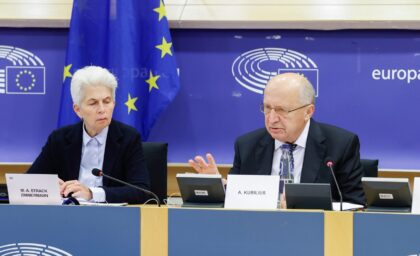
The file was spearheaded in Parliament by rapporteur Karin Karlsbro (Renew/SE), who insisted the measures were not about protectionism but about safeguarding Europe’s industrial future.
“This is not protectionism,” Karlsbro said during the debate. “There is broad political support for future-proofing Europe’s industry.”
She strongly backed the introduction of the melt-and-pour rule, arguing that tracing the true origin of steel was essential to closing remaining loopholes for Russian products. “It is not enough to know where the bread was baked, you also want to know whether the flour is clean,” she said.
Karlsbro also welcomed a joint declaration by the Parliament, Council and Commission committing to phase out all imports of Russian steel slabs, describing them as “the lowest hanging fruit.”
The European Parliament ultimately approved the measures by 606 votes to 16, with 39 abstentions.
Ukraine concerns
A major point of contention during negotiations was the impact on Ukraine’s steel industry, which remains heavily dependent on exports to the EU while operating under wartime conditions.
Renew Europe pushed for explicit references guaranteeing support for Ukraine under the new regime. In the end, the regulation foresees a separate tariff quota for Ukraine, which the Commission says must take into account the country’s “specific security challenges.”
“A collapse of the Ukrainian steel industry would be an immense catastrophe, not only for Ukraine but for the whole of Europe,” Renew Europe said in a statement following the vote.
Karlsbro repeatedly stressed that Ukraine should not be treated as a source of global overcapacity. “Ukraine is not the source of global overcapacity,” she said. “We must treat them as a future EU member and strategic partner.”
Industry representatives have warned that new restrictions could nevertheless hit Ukrainian exports hard, fearing impacts similar to production losses the country suffered in 2022 following Russia’s full-scale invasion.
Industry divided
The measures have received strong backing from Europe’s steel producers, who argue the sector is facing an existential threat from global overcapacity and cheaper imports.
Industry groups have warned that thousands of jobs are at risk if additional protections are not introduced. European steelmakers have also pointed to declining capacity utilisation and ongoing plant closures across the bloc.
Downstream industries, however, remain more sceptical. Manufacturing groups fear stricter import limits could increase costs for companies relying on imported steel inputs, potentially weakening Europe’s broader industrial competitiveness.