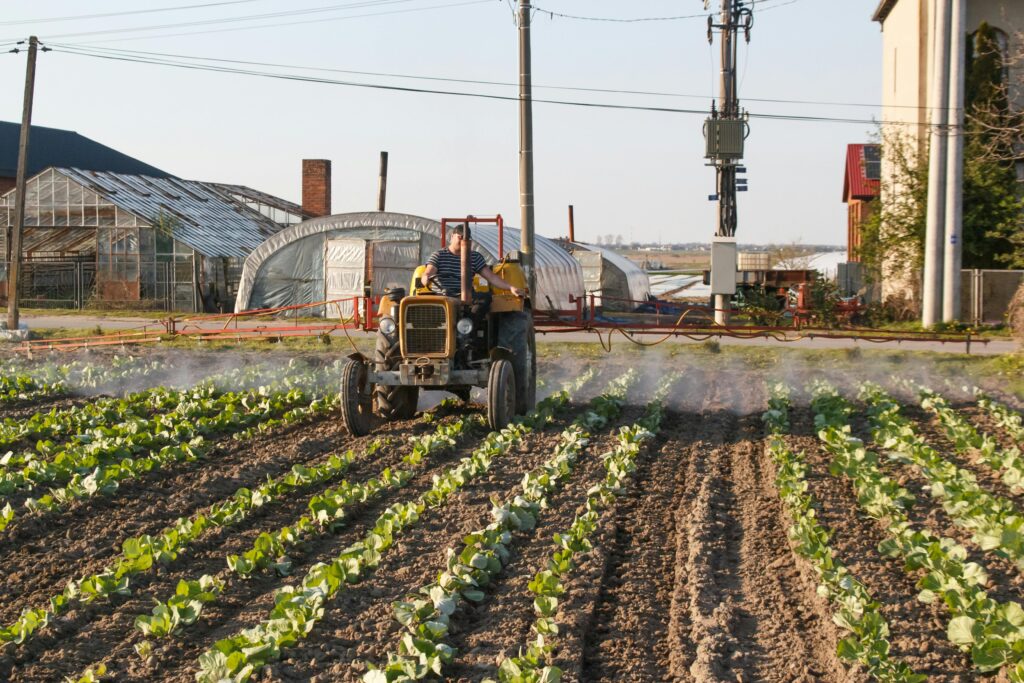
European farmers may not be able to plant this autumn as fertiliser costs spiral. Brussels is responding with an action plan and a new trade deal with Mexico. Commissioner Hansen admitted, however, that there is no quick fix.
At the Agrifish Council, ministers raised the alarm over fertiliser prices that show no sign of easing. Hansen defended the Commission’s action plan, arguing Europe needs both immediate relief and a structural shift away from its dependence on imported inputs. The new EU–Mexico trade deal, he said, should help deliver that shift.
“There is no silver bullet to the problem of dependency and high costs we are facing currently,” Hansen said, calling for a combination of short-term and long-term action. His immediate priority is enabling farmers to purchase fertilisers before the autumn season. But the EU must also tackle deeper structural weaknesses: its reliance on imports and the growing number of European fertiliser plant closures.
Mexico and the long game
Hansen stressed the importance of stable trade relations in an increasingly volatile geopolitical landscape. “This is why providing for more stable and predictable trade relations through a strong network of fair trade agreements is more important than ever,” he said.
In this context, he welcomed the signing of the modernised EU–Mexico agreement. The deal removes high tariffs on European agri-food products entering Mexico and opens new opportunities in a country of more than 130 million consumers. Hansen also announced a high-level mission to Mexico in November 2026 to strengthen the EU–Mexico agri-food partnership.
Consumers must trust the products they buy, and farmers must trust that competition is fair and transparent
— Christophe Hansen, Commissioner for Agriculture and Food
But the Commissioner said trade policy must go beyond simply opening markets. It must also preserve trust and fairness. “Consumers must trust the products they buy, and farmers must trust that competition is fair and transparent,” he said. He linked this to the Commission’s proposal for origin labelling in the next Common Market Organisation regulation.
The Commission argues that better origin labelling supports traceability and informed consumer choice. It would also protect European producers who observe higher production standards from competitors who do not.
Autumn planting in the balance
On the budget, Hansen said the Commission had to draw on the remaining volume in the agricultural reserve, but argued the amount should be doubled. On 12 June, the Commission will present a corrected version of the 2026 budget to the budgetary authority.
Timing matters, Hansen stressed, because farmers need time to plan before the autumn planting season. He also pointed to the flexibility of the Common Agricultural Policy, arguing the EU should not lose undertaken savings through decommitments but channel them to support farmers, particularly in the second pillar.
For the Commission, this is not only about reducing input costs, but also about diversifying trade, increasing domestic production, circular fertilisers, market transparency, and strategic autonomy. The challenge is to deliver the fertiliser action plan quickly and harness trade agreements like the EU–Mexico one to improve Europe’s long-term position in agri-food trade.