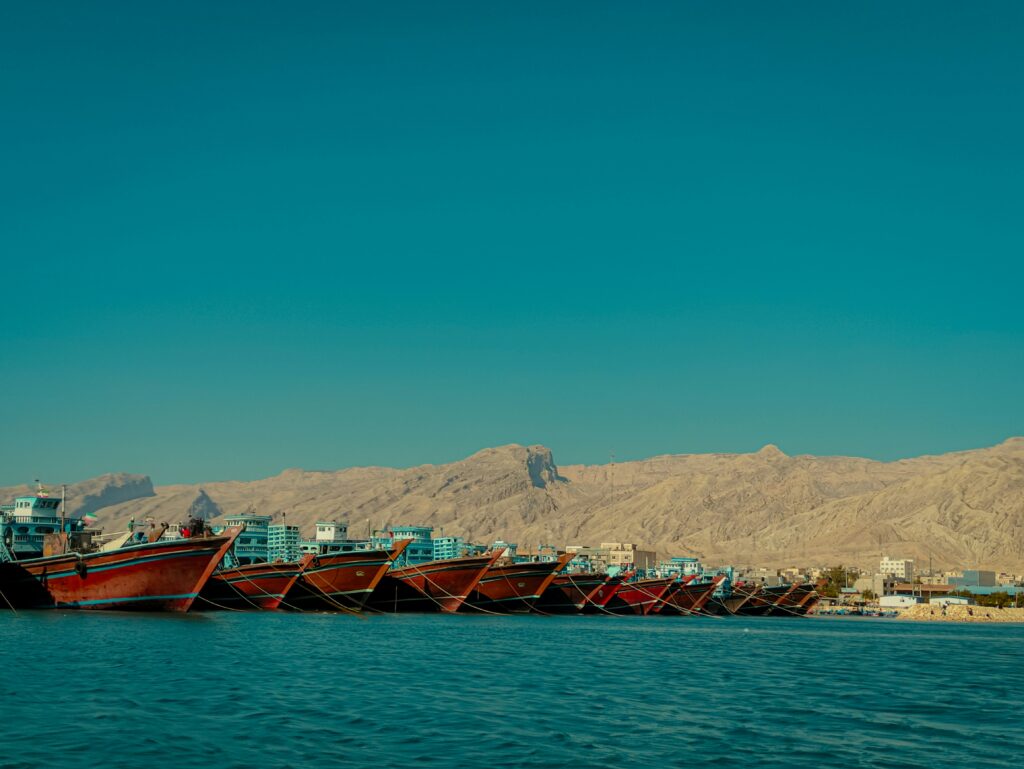
Tehran has crossed a line. Iran is no longer threatening to disrupt the Strait of Hormuz but actively doing it, and the consequences reach far beyond oil prices. Blocking a strait may now be a more powerful weapon than a nuclear bomb and Europe has no framework to respond.
For years, closing the Strait of Hormuz was treated as a contingency scenario — a last resort Tehran would threaten but never use. That calculus has shifted. Recent escalation in and around the strait has changed everything. Iran has operationalised its control over one of the world’s most critical trade routes, turning a long-standing threat into an active pressure tool.
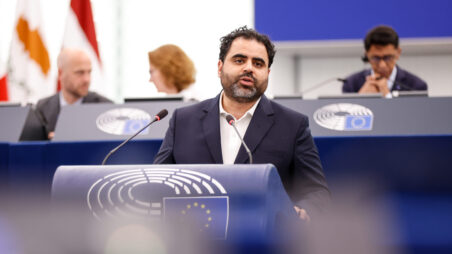
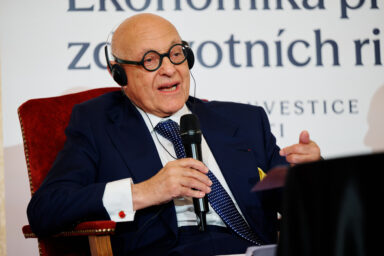
Mohsen Behzad Karimi, Senior Fellow at the European Foundation for Democracy, does not read this as a sudden collapse or rapid transformation. Speaking to EU Perspectives, he describes what is unfolding as the early stages of a controlled, phased dismantling. The system has existed for almost half a century. Any expectation of quick regime change, he argues, is analytically flawed — the structure remains deeply entrenched, and its erosion will unfold in stages.
Chokepoint as a weapon
For Mr Karimi, this is not a break from the regime’s doctrine but a continuation of it. The Islamic Republic has long relied on asymmetric leverage rather than direct confrontation. Its preferred tools are low-cost and high-impact — drones, maritime disruption, and anything that prolongs pressure and raises costs for its opponents.
“The realisation that strategic chokepoints can paralyse global trade has effectively provided Tehran with a tool that, in its calculus, rivals or even surpasses nuclear capability in immediate impact,” he says. What has changed is that the threats have become operational.
The energy market is only part of the story. The deeper danger is trade disruption — and what it normalises. If blocking a strait or interrupting supply routes becomes an accepted instrument of pressure, the consequences will not stop at Hormuz. They could cascade into other trade corridors, creating what Mr Karimi describes as a systemic risk for the global economy.
“The real issue is not the price of jet fuel,” he says. “The real issue is that someone has stopped the flow of trade.”
An escorting vessel is not a strategy
Karimi is sceptical of military fixes. Escorting vessels through Hormuz, he argues, is neither practical nor sustainable. “How many ships do you want to escort?” he asks, noting that even small interruptions have shown how difficult it is to restore trade flows once disrupted. The GCC countries and their partners, he says, must stop thinking in terms of reaction and start thinking in terms of rules.
We have to have a regime for the Strait of Hormuz.
— Mohsen Behzad Karimi, Senior Fellow, European Foundation for Democracy
“We have to have a regime for the Strait of Hormuz,” he says. Such a framework would guarantee passage and reduce uncertainty for all who depend on the route. The goal is not symbolic — it is economic and geopolitical. A stable Hormuz regime would allow the GCC countries to export freely, give Europe reliable supply chains, and offer a future Iran a path into a more predictable international order.
External pressure alone will not break the Iranian system. Decades of sanctions have produced a parallel economy the regime uses to its advantage — an informal layer that absorbs shocks and keeps life going even under sustained pressure. This makes it difficult to distinguish weakness from resilience. Iran, Karimi argues, can tolerate considerable pressure and still retain substantial capacity to disrupt.
Legitimacy is the deeper problem
No regional architecture will be sustainable unless it addresses Iran’s broader legitimacy crisis. Drones and chokepoints can buy leverage, but they cannot substitute for internal credibility or long-term stability. “A system that has lost credibility domestically and operates in tension with international norms cannot provide long-term stability,” Mr Karimi says.
He argues that the US must support what he calls the long-term trajectory of the Iranian people: a more stable, self-determined, and economically integrated future. The transition, he acknowledges, is slow and uneven but it is already under way.
For European policymakers, his message is direct. The challenge is no longer just how to respond to the next disruption in Hormuz. It is whether they are prepared to build a framework that prevents disruption from becoming the new normal.