The European Union has refused to join the US-backed Peace Board. Brussels says the body gives Palestinians no meaningful role and is not temporary. Once again, the EU finds itself a payer rather than a player in the region.
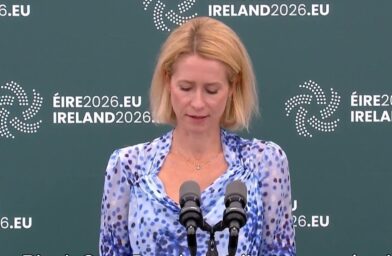
High Representative Kaja Kallas announced the decision ahead of the ad hoc liaison committee meeting on the two-state solution. The EU had set two conditions for joining: a role for Palestinians, and a temporary mandate. The Peace Board meets neither.
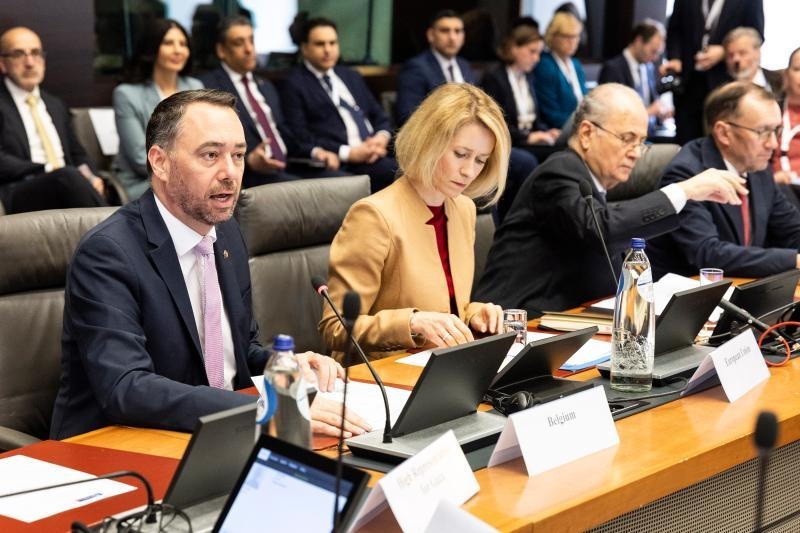
The announcement came on a day Brussels dedicated entirely to the Israeli-Palestinian file. Kallas co-chaired two ministerial meetings. The first was the ninth gathering of the Global Alliance to Implement the Two-State Solution, alongside Belgian Foreign Minister Maxime Prevot. The second was the Ad Hoc Liaison Committee meeting with Norwegian Foreign Minister Espen Barth Eide.
Kallas pushes back on double standards
Kallas was quick to reassure that the EU “is not losing sight” of the Palestinians and remains their largest global supporter. The meeting came at a time of notable hardening in Europe’s stance toward Israel. Brussels has reopened debate on sanctions against violent settlers in the West Bank and on the EU-Israel Association Agreement.
“I often hear accusations of double standards: that we support Ukraine, but we don’t support the Palestinians,” she said at the opening press briefing. “European missions on the ground support the Palestinian police, justice and governance, and border management. You won’t find a stronger supporter of the Palestinian people anywhere else in the world.”
Two events, one file
The meetings come ahead of the EU Foreign Affairs Council. There, ministers will discuss the Middle East peace process in light of the Global Alliance gathering, as well as the situation in the West Bank and Europe’s commitment on the ground. Kallas also reaffirmed the EU’s support for the Palestinian Authority.
The Global Alliance is a diplomatic format launched in 2024 by the EU, Saudi Arabia, Norway, the Organisation of Islamic Cooperation, and the Arab Contact Group. Its goal is to revive a two-state political solution. Nearly 90 countries have joined, aiming to support both the recognition of a Palestinian state and the building of its institutions.
Two states, growing obstacles
The EU reiterated its condemnation of unilateral actions, such as settlement expansion, that undermine the two-state solution. It urged Israel to reverse course. “Israel should also urgently release withheld customs funds to ensure the proper functioning of the Palestinian authorities,” Kallas added. For Prevot, the two-state solution remains “the only realistic goal,” guaranteeing “security for Israelis” and “sovereignty for Palestinians.”
But Belgium and many European and Arab partners continue to believe that this remains the only realistic path to lasting peace, for Israelis, for Palestinians, and for the stability of the entire region.
—Maxime Prevot, Belgian Foreign Minister
The Belgian Foreign Minister admits “without naivety” that the two-state solution is becoming more difficult every day. “But Belgium and many European and Arab partners continue to believe that this remains the only realistic path to lasting peace, for Israelis, for Palestinians, and for the stability of the entire region,” he said.
Gaza’s staggering reconstruction bill
On the same day, the EU, the UN, and the World Bank Group finalised the Rapid Damage and Needs Assessment (RDNA). “A clear picture of the damage and financial needs is essential to guide early recovery and reconstruction efforts”, Commissioner Dubravka Suica said. The hardest-hit sectors include housing, health, education, commerce, and agriculture. “Over 371,888 housing units have been destroyed or damaged, more than 50 per cent of hospitals are non-functional, nearly all schools destroyed or damaged, and the economy has contracted by 84 per cent in Gaza,” it stated.
Around 1.9 million people have been displaced, often multiple times. More than 60 per cent of the population has lost their homes. Women, children, persons with disabilities, and those with pre-existing vulnerabilities will bear the greatest burden.
For all the talk of being a player rather than a payer, the scale of Gaza’s destruction makes clear that financial support remains the EU’s most tangible contribution. For now, that will have to be enough.