VBI Inspire Protection, a producer of safety equipment, believes European market rewards the wrong things. CEO Vianney Brillat told EU Perspectives why it needs to change.
Pouilly-sous-Charlieu is not a name that appears on many industrial maps. The Loire town sits quietly in the Auvergne-Rhône-Alpes region, better known for Burgundy’s vineyards than for manufacturing. Yet inside a purpose-built 4,000 m² plant on the Impasse Hélène Boucher, Inspire Protection turns out up to 13 million masks a month. The company is small—47 employees—and family-run. Its managing director, Vianney Brillat, is also its most insistent advocate.
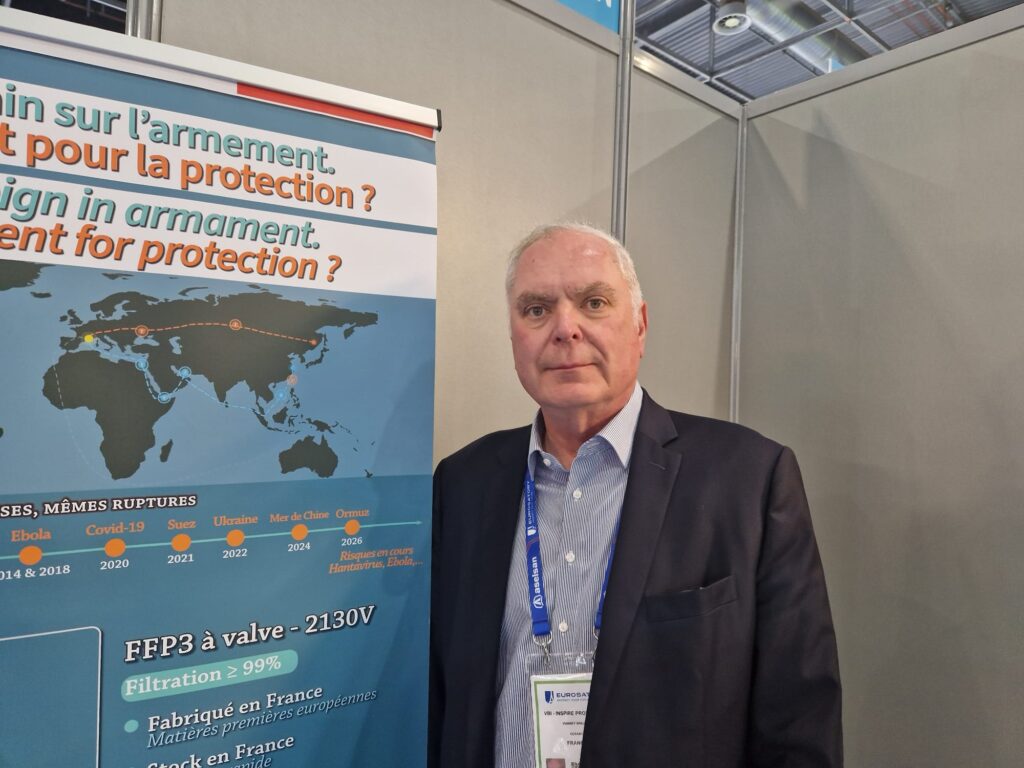
The company participated in Eurosatory 2026, the world’s largest defence and security trade show, pitching itself as a strategic supplier to armed forces and internal security services. That is where Mr Brillat spoke to EU Perspectives about the challenges his company faces today.
The covid pivot
Inspire Protection is the trading name of V.B.I. SARL, a non-woven textile manufacturer incorporated in 2000. The Inspire Protection brand itself came later, born directly out of the COVID-19 crisis in May 2020, when the vulnerability of France’s mask supply chain became impossible to ignore.
“The Covid-19 crisis has highlighted the risks associated with dependence on foreign supplies of critical personal protective equipment (PPE),” the company states. “A domestic production chain is the only guarantee of true availability, both in normal times and during a crisis.” Mr Brillat did not need much persuading. He had the factory and the raw materials. He pivoted.
Six years on, the plant runs eight fully automated lines and produces FFP2 and FFP3 respirators, surgical masks in 13 colours, and a range of disposable hygiene consumables—shoe covers, hair caps, gowns, and the Anti-Gliss’ overshoes that have become standard equipment in French nuclear power plants.
Compliance sits at the centre of Mr Brillat’s world. Inspire Protection follows ISO 9001, EN 149 for respiratory masks, and EN 146 for surgical masks. These are not optional. “If you don’t match with the standards, then you can’t sell,” he says. The standards also keep changing. “I think it could be easier. I think every year it’s becoming a little harder because you have to follow different ways that are new and you always have very little time to adjust and to improve.” The attrition has been real. Many companies that entered mask production during the pandemic have since shut down, unable to keep pace.
The regulatory catch
Mr Brillat is cautiously optimistic that tighter European regulation will, over time, work in his favour. His main competitive threat is China. Chinese manufacturers benefit from low labour costs and generous state subsidies, he argues, creating what he calls an uneven playing field. “We expect that having more regulations and more control will help to balance this competition,” he says. The logic is straightforward: stricter rules are harder to meet when your product has spent six weeks at sea.
That transit time is, in Mr Brillat’s telling, one of his strongest commercial arguments, though one that the market has been slow to appreciate. Chinese masks typically carry a three-year shelf life when they leave the factory. By the time they clear European ports, little more than two years remain. Inspire Protection offers between five and seven years, depending on the product. “We are the only one to offer seven years on the FFP2 mask,” Mr Brillat says.
For buyers stocking emergency reserves, the arithmetic matters. “When you have seven years compared with five, the difference is 40 per cent,” he explains. A longer shelf life reduces the effective cost per year of cover. An organisation that buys for a seven-year horizon pays significantly less, in annualised terms, than one that must replenish every five years—or, worse, every two.
The shelf-life argument
The problem, Mr Brillat acknowledges, is that European public procurement has not caught up with this logic. “It is really difficult today to explain to the public markets. When there are tenders in Europe, they are not well organised well enough to give value to this kind of advantages,” he says.
A domestic production chain is the only guarantee of true availability, both in normal times and during a crisis.
— Vianney Brillat, CEO of VBI Inspire Protection
The gap between product quality and procurement design has real consequences. Mr Brillat cites SNCF, the French national railway operator, which recently ordered several million masks after discovering that its existing stock had expired. Inspire Protection was able to offer a five-year shelf life with at least one month already elapsed—still a compelling proposition. The anecdote illustrates a broader point: emergency stockpiling done without attention to longevity is stockpiling done badly.
Mr Brillat’s ambitions extend beyond his own order book. He speaks as a European federalist as much as a manufacturer. Asked what single change he would make to the European market, he does not hesitate. “I’m a European citizen, so I believe that together we are stronger. And if we want to fight with the new empires like the USA, Russia, China, we have to be united in Europe. And for that we must stop preferring goods coming from abroad outside Europe,” he argued resolutely.
The China lesson
The principle, he argues, must apply internally as well as externally. Is he then a staunch supporter of the ‘buy European’ principle? “We must accept in France that we have products coming from, say, Poland. But there are also French-made products in Poland,” he replies. A genuine single market for PPE—one that treats a French mask and a Polish mask as equivalents—would, in his view, strengthen the whole bloc.
History provides the cautionary tale. “I remember in 2003, with the SARS crisis, during two or three months, China didn’t agree to send any masks abroad and that was the beginning of the crisis.” The lesson, for Mr Brillat, is unambiguous: sovereignty is not a slogan. It is a supply chain.
Inspire Protection is now positioning itself for the defence and industrial sectors, where operational continuity requirements are, if anything, more demanding than in healthcare. The company’s FFP3 2130V mask, with an exhalation valve and filtration efficiency of at least 99 per cent, is its flagship for long-duration operations. The Eurosatory showcase was a statement of intent. Today, Mr Brillat’s most pressing concern is whether Europe’s procurement systems are ready to reward it.