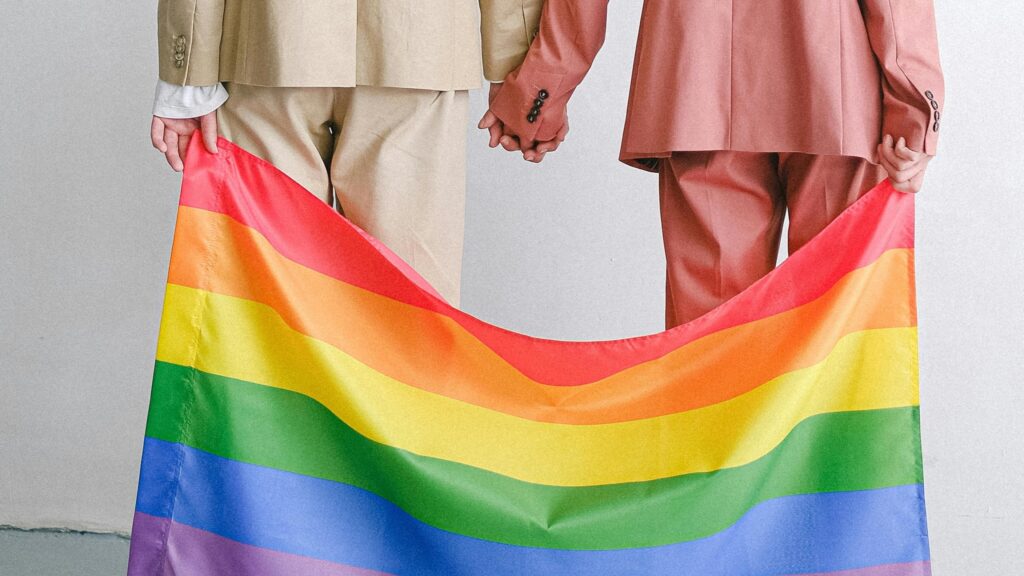
The end of practices aimed at changing a person’s sexual orientation or gender identity is one step closer. The European Commission is seeking to encourage member states to outlaw them, building on pressure from more than a million citizens across the bloc. From Brussels, the message is unequivocal: these practices have no place in Europe, even if an EU-wide ban is not currently on the table.
It marks one of the most significant citizens’ initiatives in recent years. Over 1.1 million people from across the EU have called for a prohibition of so-called conversion practices — interventions intended to alter or suppress sexual orientation or gender identity.
European Commissioner for Equality Hadja Lahbib spoke in stark terms: “Conversion practices are built on a lie. The lie that LGBTIQ+ people need to be fixed. That there is something wrong with who they are.”
You cannot torture away a person’s identity. You cannot legislate it away.
— Hadja Lahbib, European Commissioner for Equality
She has shared the experiences of people who have been subjected to such practices, including forced medication, electroshocks, psychological coercion, verbal, physical, and sexual abuse. “It is violence disguised as therapy,” the Commissioner said. “You cannot torture away a person’s identity. You cannot legislate it away.”
The psychological toll, she warns, is profound. Victims may gradually internalise the belief that something is “wrong” with them, losing confidence, support networks and ultimately finding themselves isolated. In some cases, this trajectory leads to thoughts of suicide.
Backed by people
The shift in the debate has been driven by a European Citizens’ Initiative. It managed to gather more than a million signatures across member states. According to the Commission, this represents a clear signal that the issue is no longer a marginal concern, but a political demand with broad public backing.
In response, the Commission intends to issue recommendations urging member states to ban conversion practices. “They have no place in our Union. The EU proudly stands with the LGBTIQ+ community and reaffirms its vision of a Union of Equality, a place where everyone can live freely, openly and authentically,” Commission President Ursula von der Leyen stated.
This is not a unified EU-wide law, but rather a form of political pressure directed at national governments. The Commission also plans further steps, including support measures and the sharing of best practice across the Union. A binding EU-wide ban, however, is not on the table, as the issue largely falls within the competence of member states.
This reply comes just a few days ahead of the International Day Against Homophobia, Transphobia and Biphobia, which falls on Sunday 17 May.
Malta leads the way
According to the European Union Agency for Fundamental Rights, around a quarter of LGBTIQ+ people in the EU have encountered such practices. Among transgender people, the proportion is even higher.
The picture, however, varies significantly between member states. The highest numbers were recorded in Greece (38 per cent), followed by Cyprus, Czech Republic, Estonia and Slovakia (all at 37 per cent). The lowest levels were reported in France, Italy and Netherlands (each at 18 per cent).
Across the EU, approaches remain uneven. Some member states have already introduced bans on conversion practices, while others are still debating the issue. Malta became the first EU country to introduce such a prohibition in 2016, with France later following suit.
However, according to European LGBTIQ+ rights organisations, only a minority of EU countries — roughly ten out of 27 — currently have some form of ban in place.
The Commission will now begin work on its recommendation and expects to complete it in early 2027. It will not rely solely on studies by LGBTIQ+ rights experts, but will also look to countries that have already introduced bans, drawing on their experience and best practice.