The European Union’s Ukraine Support Loan (USL) is not, in the Commission’s telling, a financial instrument. It is a weapon.
When the joint meeting of the European Parliament’s international trade (INTA), security and defence (SEDE), and budget (BUDG) committees convened in Brussels on 22 June, the question was not whether Europe has made enough commitments to Ukraine. It was whether it could deliver on it.
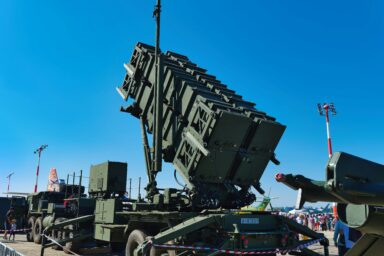
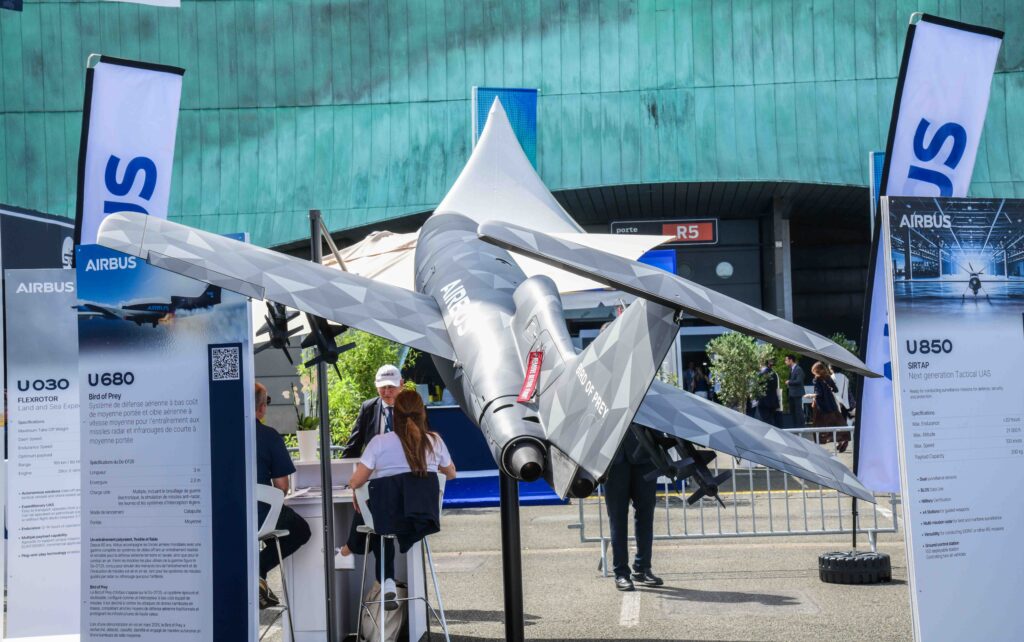
Herald Ruijters, Deputy Director General of DG DEFIS, put the stakes plainly. “It is absolutely clear from what all of us witnessed that the needs in the battlefield are obvious on drones, counter drones, missiles, air defense, but also long strike ammunition, so called extended range ammunition and deep strikes,” he said.
Reform conditions and the rule of law
The defence pillar of the USL allocates €28.3bn for 2026 alone, out of a total of €60bn across two years. The first product schedule, covering drones, was received in March. A reimbursement request covering around 255 contracts followed on 18 June. Mr Ruijters said payment was expected before the end of June.
The overall loan structure for 2026 allocates €45bn: €28.3bn for defence procurement and €16.7bn for budget support, split equally between Macro-Financial Assistance (MFA) and a top-up to the Ukraine Plan, at €8.75bn each. Maarten Verwey, Director General of DG ECFIN, confirmed that the Commission had agreed on 18 June to a first MFA disbursement of €3.2bn, timed for the Ukraine Recovery Conference on 25 and 26 June. Two further tranches follow: €3.7bn tentatively in September, and €1.45bn towards year-end, bringing the 2026 MFA total to €8.35bn.
The MFA disbursement rests on Ukraine meeting 32 reform measures, focused on public finance: broadening the tax base, improving public expenditure quality, and strengthening financial management systems. Ukraine has, for instance, extended its military levy, drafted legislation on income from digital platforms, and moved to remove VAT exemptions on low-value imported parcels.
Anna Jarosz-Friis, Director of the Ukraine Service at DG NEAR, reported broader progress. On 15 June, the EU opened its first cluster of accession negotiations with Ukraine, covering fundamentals. “Ukraine is receiving a very clear list of what to do next,” Ms Jarosz-Friis said. “These are so called interim benchmarks in the context of the rule of law.” Ukraine had also submitted a revised Ukraine Plan. The Commission last week adopted a proposal for a Council implementing decision to approve it. New reform conditions cover rule of law, energy, governance of state-owned companies, and social aspects of recovery.
The gap between need and supply
Ms Jarosz-Friis called on MEPs to keep pressing their counterparts in the Verkhovna Rada. “We would be incredibly grateful if the parliament continued engaging with your counterpart in the Verhovna Rada to pass the message and impress on them the importance of their legislative work,” she said. The homework, she added, was crystal clear.
There is a significant gap between what Ukraine needs and what the industry can deliver in the short term. — Herald Ruijters, Deputy Director General of DG DEFIS
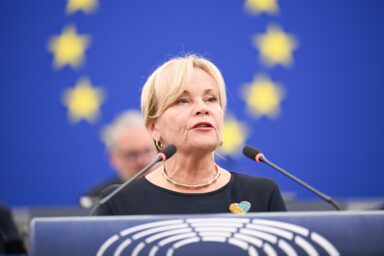
MEP Marie-Agnes Strack-Zimmermann (Renew/DEU), chair of the SEDE committee, set the tone early. “What matters is whether capabilities reach Ukraine when they are needed,” she said. She asked specifically whether derogations had been necessary in air and missile defence, and whether the cascade mechanism had caused delays. “In wartime,” she noted, “delays have consequences.”
Mr Ruijters did not dodge the question. There is, he acknowledged, “a significant gap between what Ukraine needs and what the industry can deliver in the short term.” The first drone product schedule drew exclusively on Ukrainian suppliers because EU production volume was simply not available in March. Future schedules will combine Ukrainian, European, and third-country sources. “There is sufficient products on the market only when we use the full extent of the regulation and go also in certain cases to third countries,” he said.
MEP Pekka Toveri (EPP/FIN) welcomed the flexibility but pressed for more. “The Commission must be prepared to apply the available derogation pragmatically and when necessary consider additional flexibility,” he said. “This is not all about European defence industry interest. This is about Ukraine’s survival.” Mr Ruijters agreed in substance. If Ukraine does not receive offers for critical products in time and at scale, procurement from non-EU sources remains an option. The Commission is already in contact with such sources via NATO and like-minded countries.
Who pays, and who should
The question of frozen Russian assets ran through the debate like a fault line. MEP Toveri called it “disappointing” that Russian assets had not been used more extensively in this financing round. “Many citizens understandably ask why European taxpayers are expected to shoulder the burden of the loan while Russian state assets remain largely untouched,” the Commission representative said. MEP Jörgen Warborn (EPP/SWE) was more direct: “The aggressor must pay. Our taxpayers are showing immense solidarity. But Russia’s immobilized assets must be the ones clearing the final bill.”
The Commission must be prepared to apply the available derogation pragmatically and when necessary consider additional flexibility. — MEP Pekka Toveri (EPP/FIN)
Mr Verwey offered a careful response. The December European Council statement remains in force, he said. It contains three elements: Ukraine repays the loan only upon receiving reparations from Russia; assets remain immobilised until then; and the EU reserves the right to use those assets to repay the loan.
He also pointed to a new Council regulation adopted under Article 122.1, grounding immobilisation in damages caused to the EU itself — “a double lock,” in his words. And the G7’s ERA loan initiative already uses interest generated by the frozen assets. “As we speak already, these revenues that are generated through the immobilization of the assets, they are already being used,” Mr Verwey said.
Budget, burden, and accountability
MEP Janusz Lewandowski (EPP/POL) raised a narrower but pointed concern. The Commission had chosen to finance €1.15bn in 2027 debt service costs from the general EU budget rather than from the USL itself. “This is reducing our flexibilities,” he said. The USL was specifically designed for such purposes. Using the general budget instead, he argued, risked crowding out other EU priorities.
Mr Toveri broadened the accountability argument. The loan amounts to roughly €200 per EU citizen. “This is a significant commitment and precisely because it is significant, European citizens deserve transparency, accountability and proper democratic scrutiny,” he said. He was candid about Parliament’s own shortcomings: “Our preparation for effective monitoring and scrutiny for this huge loan has not been enough.”
The aggressor must pay. Our taxpayers are showing immense solidarity. But Russia’s immobilized assets must be the ones clearing the final bill. — MEP Jörgen Warborn (EPP/SWE)
Mr Ruijters sought to reassure on oversight. The Commission conducts checks before, during, and after each product schedule. A special audit team within DG DEFIS handles ex-post verification. The Commission works with EU bodies and Ukrainian anti-corruption agencies. “We are doing all of these checks,” Mr Ruijters said. “We are making sure that this is as serious and as tight as it possibly can be.”
Delivering, not just committing
The meeting ended without resolution on the deeper questions—burden-sharing, repayment prospects, the pace of reform. But the Commission’s central message held firm throughout: the funding gap for 2026 is covered, the first disbursements are moving, and the regulation provides the flexibility Ukraine needs.
Ms Jarosz-Friis sounded candid about what lies beyond that. “There is a huge uncertainty around those needs,” she said, “because they are very much driven by the war.” For now, Europe is delivering. Whether it can keep up with the war’s demands is a question no loan facility can answer alone.