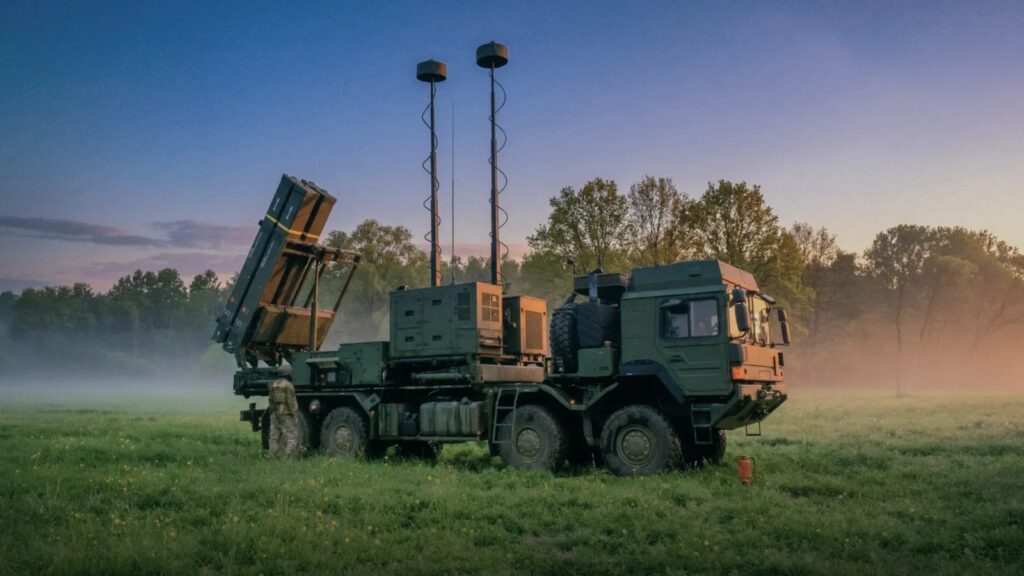
A new class of flying machine is reshaping air defence. It is cheap, fast, and increasingly self-guided. Ukraine is way ahead of the rest of the world. But today, its next proving ground is football.
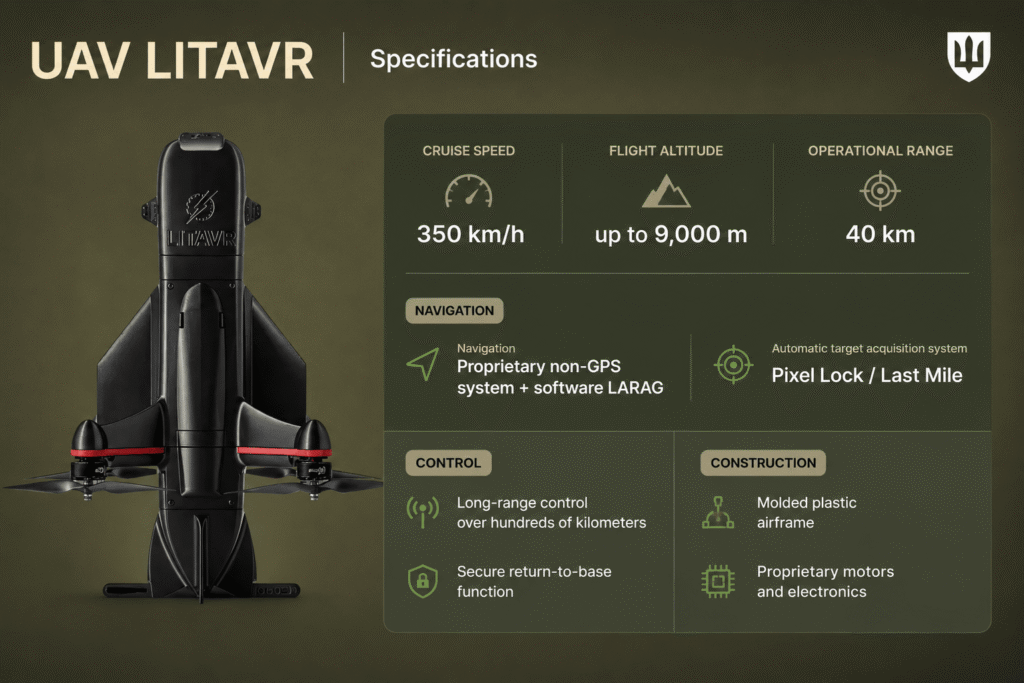
On a night earlier this month, a Ukrainian drone named LITAVR—after the traditional Cossack kettledrum—locked onto a Russian Shahed attack drone without any instruction from its operator. It closed the gap at 350 km/h, tracked the target through its own thermal camera, and destroyed it. The pilot’s only remaining job was to monitor the outcome. That moment, unremarkable by the standards of the current war, would have seemed extraordinary five years ago. Now, it is routine.
Interceptor drones—unmanned aircraft designed to hunt and destroy other drones—have become one of the most consequential defence technologies of the decade. They are cheap enough to mass-produce, smart enough to act alone, and versatile enough to protect a power grid or a football stadium. Governments, startups, and legacy arms manufacturers are all racing to build them. The war in Ukraine is both the reason and the laboratory.
The cost that changed everything
To understand why interceptor drones matter, start with the arithmetic. A Russian Shahed—a one-way attack drone, essentially a flying bomb—costs roughly $20,000 to $50,000 to produce. Ukraine was initially shooting them down with Patriot interceptor missiles, each of which costs at least $4m. That is a ruinous exchange rate.
The solution Ukraine found was to fight drones with drones. A Ukrainian interceptor costs roughly $2,500. By this past March, over 90 per cent of Russian Shaheds were being intercepted, and one-third of those kills were achieved by other drones rather than missiles.
Ukraine’s Defence Minister Mykhailo Fedorov reported that the share of Shaheds destroyed by interceptor drones had doubled over four months. Kyiv expanded its network of low-cost aerial defences to counter a 35 per cent increase in monthly Russian drone attacks.
The logic is simple and brutal. Missiles are scarce, expensive, and slow to replenish; drones are not. For a while, it appeared that Russia could bankrupt Ukraine’s air defences simply by launching enough cheap drones. Then the game changed; the saving in missile stockpiles has been enormous.
Ukraine’s startup war
What makes Ukraine’s achievement remarkable is not just the scale but the method. Ukraine has not relied on a handful of large defence contractors. It has mobilised dozens of small companies, each developing its own design, competing for battlefield contracts, and iterating in weeks rather than years.
Palmer Luckey, the founder of Anduril Industries—a leading American autonomous-systems company—puts it plainly: “Ukraine in particular has done extraordinary things, tens of thousands of units per month even if you only count in-country production.” Ukraine produced an estimated four million unmanned systems of various types in 2025 alone, according to figures presented by Deputy Defence Minister Mstyslav Banik at NATO Parliamentary Assembly discussions.
Quantity is a quality.
— Hadrien Canter, Alta Ares
The publicly known interceptor roster already runs to more than a dozen platforms: the Wild Hornet Wing-S, the OCAS KPL-88, the OctoAnt-500, the Teramis Bayonet, and others. That list covers only disclosed systems. The full inventory is larger.
The P1-SUN, made by the Ukrainian firm SkyFall, has downed over 3,500 Russian Shaheds in six months. A company representative described the next step to Ukrainian media: “The pilot will press launch, meaning approve the operation, and then the P1-SUN will take off on its own, find the target on its own and destroy it on its own. This system will allow a single pilot to manage missions involving 10 or more interceptors simultaneously.”
The government got out of the way
The LITAVR, developed by F-Drones, reaches 350 km/h, operates at altitudes of up to 9 kilometres, and carries both daytime and thermal cameras. Its navigation system does not depend on GPS—a deliberate choice in a war where GPS jamming is constant. Serial deliveries to the Ukrainian military began in the autumn of 2025, less than a year after development started.
Ukraine’s industrial surge did not happen by accident. In April, Ukraine’s Cabinet of Ministers approved a resolution greenlighting what already had, unofficially, become the norm. The resolution created a formal fast-track procurement path for defence innovation. The Ministry of Defence can now purchase innovative products, software, and technologies under a simplified procedure specifically for battlefield testing, without requiring them to first meet full procurement standards. Units evaluate solutions under combat conditions, and that assessment determines whether a product enters the formal supply chain. Anybody listening in Brussels?
We have to shoot down the jet-powered Gerans with our own jet-powered solution.
— Ihor Fedirko, Ukrainian Council of Defence Industry
A licensing mechanism introduced in October 2025 had already begun moving battlefield-developed technologies into manufacturing, with 30 licences issued by January 2026. The April resolution extended that logic to externally developed solutions, replacing committee approval with combat validation as the deciding factor. The result is a feedback loop that no traditional procurement system can match. A drone is tested at the front, assessed by the soldiers using it, and either scaled or discarded. All this happens within weeks.
Moscow’s slower race
Russia has not been idle. Its primary interceptor, the Yolka, is a lightweight, short-range system weighing 1.3 kg, capable of 230 km/h, with a range of up to 4 km. It uses an electro-optical camera to track a target’s outline, then switches to an infrared camera to lock onto heat-producing components such as engines or batteries. It destroys its target by ramming it; the absence of any explosive payload reduces cost and simplifies handling.
While the concept is sound, the execution has fallen short. The Yolka has not been fielded at scale. Many frontline videos shared by Russian soldiers show them still relying on rifles and shotguns to defend against small drones. The guidance system depends on optical sensors, infrared cameras, and AI-related computing hardware (components that Western sanctions have made harder to source). Even if those bottlenecks were resolved, Russia’s defence industry would struggle to match Ukraine’s production pace.
The contrast is structural. Ukraine’s decentralised startup model produces variety, volume, and speed. Russia’s centralised, prime-contractor approach produces technically sophisticated systems that arrive slowly and in insufficient numbers. Ihor Fedirko, chief executive of the Ukrainian Council of Defence Industry, told Jane’s Defence in June: “One of those companies shot down a Geran drone one week ago using a jet-powered interceptor.”
He was referring to an unnamed Ukrainian firm already testing jet-powered interceptors. This was a direct response to Russia’s shift toward faster, turbojet-powered Geran drones. “We have to shoot down the jet-powered Gerans with our own jet-powered solution,” Mr Fedirko said.
New fronts, new platforms
The technological arms race is accelerating on both sides. Russia plans for 50 per cent of its long-range one-way attack drones to be jet-powered, according to General Oleksandr Syrskyi, Commander-in-Chief of the Armed Forces of Ukraine. Jet-powered drones are faster and harder to intercept. Ukraine’s answer is to build faster interceptors.
In April, Ukraine’s 412th ‘Nemesis’ Brigade conducted the first recorded interception of a Russian Shahed drone by an interceptor launched from an unmanned surface vessel—a boat without a crew—marking a new level of integration between naval and aerial unmanned systems.
Ukraine in particular has done extraordinary things, tens of thousands of units per month even if you only count in-country production.
— Palmer Luckey, Anduril Industries
The approach enables interception over water, disrupting drone concentrations before an attack forms, while eliminating the risk of debris falling on populated areas. The capability remains experimental. If scaled, it would establish a maritime interception layer capable of engaging drones coming from temporarily occupied Crimea before they reach the Ukrainian coast.
Ukraine has also demonstrated the first public use of the Behemoth, a domestically developed strike drone capable of carrying up to 75 kg of explosives over 300 km. On 7 June, Behemoth drones struck the Chonhar bridge connecting occupied Kherson to occupied Crimea, a key Russian logistics corridor. The bridge was completely disabled by a second strike two days later.
The West catches up
The Behemoth is not an interceptor; it is a strike weapon. But its development reflects the same industrial logic—rapid iteration, domestic components, battlefield validation—that has driven Ukraine’s interceptor programme.
Western defence companies have taken note, though their approach differs sharply from Ukraine’s. Anduril’s Anvil interceptor—a ram-attack drone reaching roughly 320 km/h—was among the earliest examples of the concept entering practical use, first demonstrated in 2019.
Last March, Anduril received a $20bn contract from the United States Army for an AI-driven counter-drone ecosystem. Fortem Technologies’ DroneHunter 5.0 uses a different method. It physically captures hostile drones in a net and tows them away, avoiding falling debris. In February, Fortem secured an $18m US Army contract for global base defence.
A deadly Cobra
European companies are moving faster than before, though still not at Ukraine’s pace. French startup Alta Ares raised €50m in June to expand production of its AI-guided interceptors. Its X-Lock system targets Shahed-type drones within a 15-kilometre radius; its turbojet-powered Black Bird pursues faster targets, including cruise missiles, within 30 kilometres.
Alta Ares chief executive Hadrien Canter described his company’s philosophy in terms that echo Kyiv’s. “Quantity is a quality,” he said, arguing that production scale can offset imperfect reliability, much as Russia’s drone salvos rely on mass rather than flawless performance.
The pilot will press launch, meaning approve the operation, and then the P1-SUN will take off on its own, find the target on its own and destroy it on its own.
— SkyFall company representative
Germany’s Diehl Defence unveiled the Cobra 600 at the ILA Berlin airshow this month—a jet-powered drone that carries a standard IRIS-T air-defence missile, effectively turning a short-range ground-based system into a long-range one. With the missile fitted, the Cobra 600 has a range of around 400 km, compared to roughly 40 km for the ground-launched version.
The machine can loiter, waiting for threats to emerge, or fly combat air patrols to screen sectors. The system completed its first flight tests this spring.
Lives still matter
Munich startup Tytan Technologies is taking a different route. It has signed a memorandum with Mercedes-Benz to develop an air-defence system called Drone Defender, based on G-Class SUVs fitted with radar and interceptor-drone launchers. The launchers can be removed from the vehicles for stationary deployment.
Tytan plans to open a new factory in Munich this summer, aiming to reach production of 3,000 drones per month by year’s end. The company already holds a Bundeswehr—German armed forces—contract and supplies interceptors to Ukraine.
Airbus Helicopters and Quantum Systems announced at ILA Berlin a partnership to explore fitting the H145M military helicopter with counter-drone interceptors. Martin Karkour, Quantum Systems’ chief revenue officer, said: “Current developments show that aerial systems need answers to drone threats.”
No production contract or deployment timeline has been set. The initiative reflects a broader shift: aircraft manufacturers are searching for ways to ensure crewed platforms can survive in skies crowded with uncrewed threats.
From battlefield to stadium
The technology is crossing into civilian life faster than most expected. The US Department of Homeland Security selected Fortem’s net-capture DroneHunter as the sole kinetic counter-drone solution for all 11 host cities of this year’s FIFA World Cup, citing a zero-tolerance requirement for collateral damage. A net-capture system—which bags and tows a hostile drone rather than destroying it—produces no falling debris and causes no radio-frequency interference, making it suitable for crowded urban venues.
A game changer
The World Cup deployment will be the largest real-world demonstration of drone-on-drone security in a civilian setting to date. If it goes smoothly, it will accelerate regulatory acceptance in other countries. Fortem notes that DroneHunter is already the only drone-on-drone kinetic interceptor authorised in US airspace. That is a regulatory milestone that took years to achieve.
Beyond stadiums, Fortem has partnered with Southern States LLC to protect the US power grid, and with Lockheed Martin for airports and energy facilities. Germany’s ARGUS Interception markets its A1-Falke interceptor for rooftop deployment to guard hospitals, logistics hubs, and future urban air-mobility landing pads. Rohde & Schwarz and TRUMPF debuted THORIS LCS—a mobile high-energy-laser turret—at ILA 2026, marketed for both fixed-site and vehicle integration. A laser system destroys a drone by burning through it at the speed of light, with no projectile and no debris.
The market numbers reflect the shift. Analysts valued the global anti-drone market at a mere $3bn in 2025, but project it will reach $30bn–$31bn by 2035. That is an astounding compound annual growth rate of 26–27 per cent.
What comes next
Speculation here is unavoidable, but the direction of travel is clear. Three developments seem most likely over the next three to five years, even as none is certain.
The first is full autonomy. Ukraine’s Minister Fedorov has already described interceptors that automate 95 per cent of the interception process, from launch to kill. The remaining five per cent—a human operator confirming the target—is a legal and ethical requirement, not a technical one. As AI systems become more reliable and legal frameworks evolve, that human step may shrink further. A single pilot managing ten or more simultaneous interceptions, as SkyFall’s representative described, is already being tested.
Current developments show that aerial systems need answers to drone threats.
— Martin Karkour, Quantum Systems
The second is directed energy at scale. Laser systems such as THORIS LCS are currently at the demonstration stage. They offer a compelling economic argument—the cost per shot is essentially the cost of electricity—but they struggle in rain, fog, and dust. If those limitations are overcome, lasers could replace kinetic interceptors for many applications, particularly in fixed-site defence of infrastructure and urban areas.
Swarm on swarm
The third is swarm-versus-swarm warfare. Russia already launches drones in mass salvos, accumulating over the Black Sea before advancing. Ukraine is developing the capacity to meet those swarms with swarms of its own. The logical endpoint—autonomous interceptor swarms, cued by AI, engaging attacker swarms without human involvement in individual kills—is technically foreseeable. Whether it is legally or ethically permissible is a question that governments have barely begun to answer.
What is not speculative is the trajectory. “Autonomy is becoming one of the key areas of development in modern air defense, as it enables faster responses to large-scale attacks and increases the effectiveness of urban defense,” Mr Fedorov said. The drone that hunts other drones began as a Ukrainian improvisation. It has become a global industry. The window in which it was a niche technology has already closed.