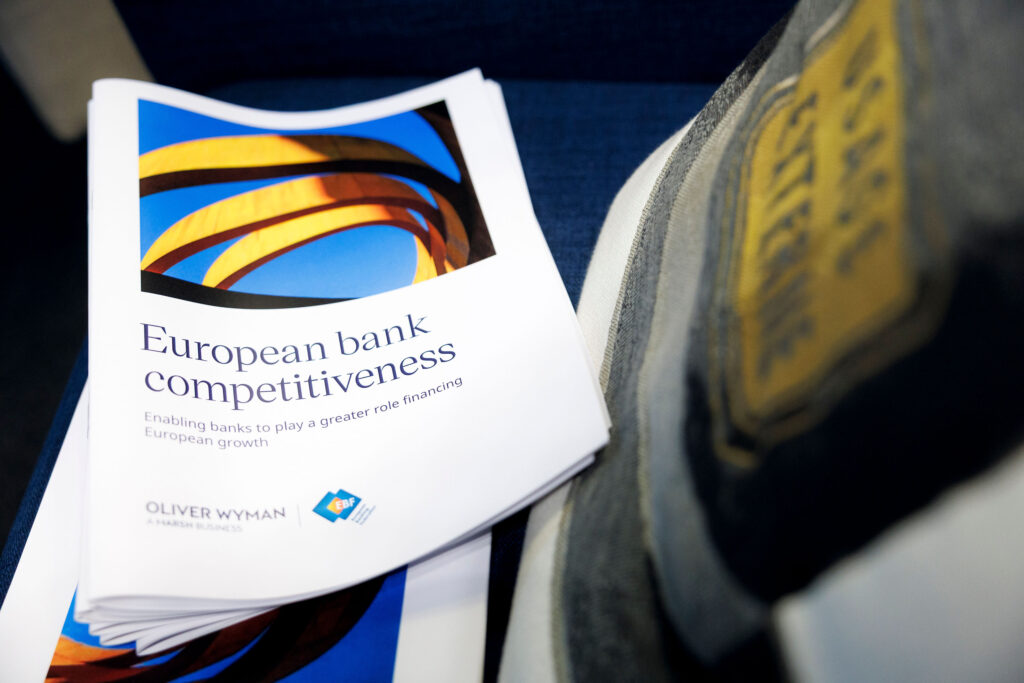
Europe’s banks say the bloc needs €1.4 trillion a year to remain competitive. And that post-crisis banking rules are preventing them from helping close the gap. To fix this, they propose seven reformes aimed at unlocking additional financing across the economy.
Unveiling a new industry-backed study alongside former Italian prime minister Enrico Letta on Tuesday, the European Banking Federation (EBF) called for a rethink of banking rules introduced after the financial crisis, arguing they now constrain the investment needed to strengthen Europe’s competitiveness, defence and technological ambitions.
“We are in a moment where we are all feeling things are happening, and we have to orient the direction to push and boost,” Letta said, referring to the strategic uncertainty that has unfolded since he authored the 2024 Much More Than a Market report, which pointed at the many ways the EU’s single market still suffers from fragmentation. “The turning point was Greenland,” he continued.

The new report penned by the Oliver Wyman consulting firm puts Europe’s additional annual investment need at around €1.4 trillion — up from the €800 billion in Mario Draghi’s 2024 competitiveness report and the European Central Bank’s €1.2 trillion estimate last year.
The challenge is where that investment burden resides. Banks supply roughly 65% of financing to the real economy, far more than in the United States, leaving them central to closing the gap. The problem, the report argues, is that post-financial-crisis rules now constrain them.
One speaker likened the situation to preventing car accidents by mandating 50 seatbelts — with the warning lights on and the airbags already deployed.
“The moment of truth is that the discussions we had the last two years are being confronted by the naked reality of the Multiannual Financial Framework.”
— Enrico Letta
“Much of the risk profile is in high-risk, capital-intensive assets,” said Oliver Wyman managing partner Elie Farah. He called for “a fully functioning financing continuum” — meaning capital that can reach everything from bank loans to equity, so projects across the risk spectrum get funded.
To do this, the report offers seven recommendations:
- Rationalise and recalibrate capital add-ons — capping the O-SII buffer at 1% (freeing an estimated €50bn), removing the Systemic Risk Buffer, and reassessing the Basel III output floor. In practice, this means reducing overlapping bank capital requirements so banks can use more of their balance sheets to finance businesses and investment projects.
- Embed growth and competitiveness in regulatory and supervisory objectives.
- Modernise the rulemaking framework. The report cites an average of 430 meetings with European Central Bank representatives and 220 open supervisory findings per significant bank in 2025.
- Unlock the Savings and Investment Union across public and private markets — create a more integrated European capital market so household savings can flow more easily into companies, infrastructure, and innovation across EU-27.
- Unclog securitisation to free up lending and fund infrastructure. This would make it easier for banks to package and sell loans to investors, freeing up capital for new lending.
- Review targeted prudential rules — adjust specific banking regulations that may unintentionally discourage lending to businesses or investment in technology.
- Remove barriers to integration, including completing the Banking Union.
Together, the report frames these as “better regulation,” not deregulation — though the capital asks have so far met resistance from the ECB, which in December offered simplification but refused to lower buffers.
“The moment of truth is that the discussions we had the last two years are being confronted by the naked reality of the MFF,” Letta said, tying the financing debate to the fraught negotiations over the EU’s next seven-year budget. The Commission’s headline answer to the Draghi and Letta reports — a €409 billion European Competitiveness Fund over 2028–2034 — is a fraction of the €800 billion a year Draghi prescribed, let alone the €1.4 trillion annual gap identified here. The solution, Letta said, is “a political question,” the same framing the European Parliament adopted in September.
€1.4 trillion. Or more?
A second ask ran through the event: widening regulators’ remit, so that financial stability is balanced against competitiveness and growth. The report makes the same case, noting the UK gave its regulators a growth and competitiveness objective in 2023, while the US broadened its definition of financial stability in 2025.
The gap may also be wider than €1.4 trillion. “The projections of the report are unlikely to reflect the latest financing news around AI and data centres,” said Oliver Wyman principal Elisa Haining — a caveat the report itself makes, calling its estimate likely conservative.
The report lands ahead of the Commission’s assessment of banking-sector competitiveness in July, with legislative proposal likely in 2027. Industry has now weighed in. The fight over how Europe finances itself is, as Letta put it, a political question.