The Ukraine and Iran wars have rewritten the rules of modern conflict. Yet despite the imminent Russian threat, Europe has been slow to absorb the lessons.
The lessons emerging from years of grinding, technology-saturated warfare are reshaping strategic thinking across the West. The core lesson is deceptively simple: distance no longer offers protection from enemy attacks. The classic idea has been that mere distance can protect national decision-makers, industry, and logistics. Retired Australian general Mick Ryan, a renowned analyst, argues that this is no longer the case. The 21st-century precision strike, drones, cyber intrusion, and space capabilities have eroded the notion.
Ukrainian President Volodymyr Zelensky made the same point at this week’s NATO’s Ankara summit. “For a long time, Russia believed it had a territorial advantage no one else possessed,” he said. “We have reached them.”
The collapse of the cost curve
The implications run in both directions. If Ukraine can strike deep into Russia, adversaries can strike deep into Europe. Every assumption about the safety of rear areas, industrial facilities, and logistics hubs now requires revision.
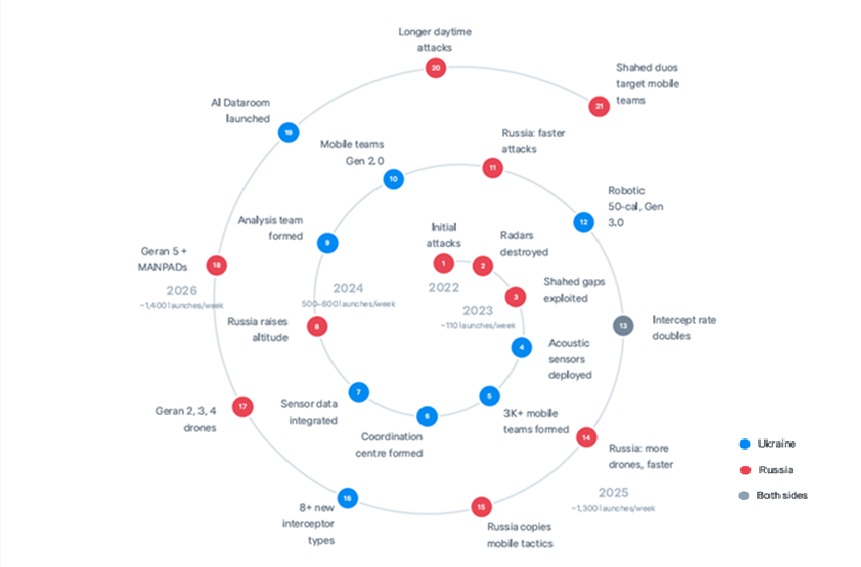
The most operationally significant development of the war has been the drone. Not the expensive, exquisite unmanned aircraft of pre-2022 doctrine. Cheap, mass-produced, rapidly iterable systems have inverted the economics of air defence. A Patriot interceptor costs over $3m. A Russian Shahed drone costs as little as $35,000 to manufacture. Ukraine answered this asymmetry with interceptor drones costing between $1,000 and $5,000 each. By March 2026, those interceptors achieved interception rates exceeding 90 per cent.
Australian Lowy Institute’s analysis of Western military learning identifies this as the defining failure of the past four years. “The economics of counter-drone warfare had been inverted,” the paper notes. “A cheap, locally manufactured, rapidly adaptable solution had fundamentally changed the cost calculus of strategic drone strikes.” Western institutions watched this unfold. They did not replicate it.
The Centre for Strategic and International Studies identifies a related shift. Ukraine has demonstrated the collapse of the binary between mass and precision. Cheap systems, fielded in enormous quantities and updated continuously, have proven more operationally decisive than small numbers of expensive platforms. That conclusion challenges the procurement philosophy of virtually every NATO member.
Learning fast, or not at all
Ukraine has built one of the world’s most consequential live battlefield AI learning platforms. The OCHI system centralises video feeds from more than 15,000 frontline drone crews. Since 2022, it has aggregated two million hours of drone footage. AI models train on that footage, covering combat tactics, target recognition, and weapons effectiveness. The integration of AI guidance into Ukrainian first-person-view drone operations has increased strike effectiveness from 30–50 per cent to 80 per cent.
Choosing not to learn is a strategic decision with grave consequences. — Ret Gen Mick Ryan
Again, watching this demonstration has not translated into replicating it. The Lowy Institute paper describes the gap between adversarial learning speed and Western institutional inertia as “one of the defining strategic facts of this decade.” China, Russia, Iran, and North Korea have built what it calls “an authoritarian knowledge market in which battlefield insights flow more rapidly than many Western institutions have acknowledged.”
The Carnegie Endowment for International Peace identifies the same structural problem. Its analysts argue that the war has exposed a fundamental mismatch between the pace of battlefield innovation and the pace of Western procurement and doctrine revision. Ukrainian drone units adapt their software daily. Tactics evolve every one to two weeks. Western procurement cycles run to years. Doctrine revision cycles run to decades.
Strategic depth is now a choice
General Ryan’s framework offers the clearest organising principle for what Europe must now do. Strategic depth can no longer be measured in kilometres. It must be manufactured through technology, alliances, and institutional resilience. The Oxford Changing Character of War programme frames this as a question of systemic adaptation. Modern war demands that states develop not just better weapons but better learning organisations. Ukraine built exactly such an organisation under fire. Europe, with time and resources Kyiv never had, has largely failed to do so.
The consequences are now visible. When the US and Israel commenced operations against Iran in early 2026, the US Secretary of War briefed Congress that American air defences could not intercept all of Iran’s Shahed-class drones. These were the same weapons Ukraine had been intercepting at scale for more than a year. The US then asked Ukraine for assistance with the very threat Ukraine had been managing for two years. The information was always available. The limiting factor was institutional willingness to act on it.
On the ground in Ukraine, the war has also produced new offensive methodologies. Ukrainian forces have developed a combined-arms approach built around massed drone employment. Each assault begins with a saturation strike of 200–300 drones hunting targets before ground troops move. Defending forces then face an impossible dilemma: remain in position and face destruction by artillery or bomber drones, or move and be hunted by nimbler first-person-view systems. No Western army currently possesses this capacity. Few are systematically developing it.
What Europe must build
The war has identified five areas where European states and the EU must act. Each carries specific implications for legislation. In several cases, the required legislation does not yet exist.
The first imperative is hardening critical infrastructure. Europe’s power grids, data centres, transport networks, and fuel storage now sit within range of long-range drones and missiles. The EU’s Network and Information Security Directive (NIS2), which entered into force in 2023, establishes baseline cybersecurity requirements for critical infrastructure operators.
The counterdrone learning spiral
Sadly, this does not address physical hardening against drone or missile attack, dispersal of production facilities, or wartime redundancy requirements. A revision or supplementary instrument is needed.
Integrate, integrate, integrate
The second imperative is mass counter-drone capability. No EU member state fields dedicated counter-drone units at operational scale. The EU’s European Defence Fund supports collaborative research and development, but its project cycles run to years. Its consortium requirements favour large incumbents over the small, innovative firms that have driven Ukraine’s drone revolution. The EDF’s framework regulation needs amendment. Fast-track funding mechanisms for counter-drone systems, modelled on Ukraine’s Brave1 defence technology ecosystem, are required.
The third imperative is defence industrial integration. The war has shown that industrial capacity is as decisive as the weapons themselves. The EU’s European Defence Industry Reinforcement through Common Procurement Act and the Act in Support of Ammunition Production represent first steps. They are insufficient.
Production remains fragmented across national lines. No EU-wide framework currently requires member states to certify one another’s production facilities, share design data, or coordinate surge capacity. A dedicated EU defence industrial base regulation—with binding interoperability and mutual certification requirements—does not exist and should be created.
Unleash the AI
The fourth imperative is AI-enabled military learning. Ukraine’s OCHI platform and the US Maven Smart System have demonstrated that AI can aggregate battlefield experience and translate it into institutional knowledge at a pace no human process can match. The EU’s AI Act, which came into force in 2024, classifies many military AI applications as high-risk and subjects them to stringent conformity requirements.
Those requirements were designed for peacetime civilian applications. They may impede the rapid iteration that operational military AI demands. A defence-specific framework, with appropriate oversight mechanisms, is needed.
In an authoritarian knowledge market, battlefield insights flow more rapidly than many Western institutions have acknowledged. — Lowy Institute
The fifth imperative is whole-of-society mobilisation. The war has shown that modern conflict places demands not just on armed forces but on civilian industry, logistics networks, and communications infrastructure.
The Baltic states have developed national resilience frameworks integrating civil and military planning. Most EU members have not. The EU has no framework directive on civil preparedness for high-intensity conflict. Creating one, modelled on Finland’s and Sweden’s total defence concepts and updated for the drone age, is a strategic necessity. No adequate legislation currently exists.
Policy recommendations
The following measures, compiled from the aforementioned papers, represent the minimum credible European response to what the war has demonstrated. Some recommendations address complete legislative vacuums, others address gaps within existing instruments.
- The EU should establish an emergency counter-drone procurement mechanism within the European Defence Fund. It needs a dedicated fast-track pathway for counter-UAS systems, funded at a minimum of €2bn over three years, with streamlined requirements allowing small and medium-sized enterprises to participate directly. This is a gap within an existing framework.
- The European Commission should propose something like a Critical Infrastructure Wartime Resilience Regulation, supplementing NIS2. It should require physical hardening, dispersal, and redundancy standards for energy, transport, and communications infrastructure against drone and missile attack. No such instrument currently exists.
- The EU should amend the EDIRPA framework to include binding mutual certification of defence production facilities across member states. The gap within an existing instrument is real. Plugging it would enable production to surge across national borders in a crisis without requiring new bilateral agreements each time.
- The Commission should propose a European Total Defence Framework Directive. It should require all member states to develop and regularly exercise civil-military mobilisation plans, including continuity-of-government arrangements and civilian industrial surge capacity. No EU-level instrument currently addresses this.
- The EU should create a defence-specific annex to the AI Act. It should establish an expedited conformity pathway for military AI applications used in counter-drone operations, battlefield learning platforms, and decision-support systems. Oversight should involve a joint civil-military review body. In its current form, the AI Act contains a partial exemption for national security applications, but it is broad and unstructured. A dedicated, operationally workable defence framework does not exist.
The cost of not learning
The Lowy Institute paper ends with a warning that applies as directly to Europe as to Australia (which it addresses specfically). “In an era when war has never been more visible,” it argues, “Choosing not to learn is a strategic decision with grave consequences.” The information has always been available. Ukraine has offered to share its experience, its data, and its operational knowledge with allied governments. The limiting factor has not been knowledge. It has been institutional willingness to act on it.
Europe faces a Russian military that, despite its catastrophic losses, has adapted. It has absorbed the lessons of its own failures and developed new offensive methodologies—the drone-saturated combined-arms approach, the glide-bomb dilemma for defenders, the systematic targeting of civilian infrastructure—that any future adversary of NATO will study and replicate.
Europe’s response must match that pace. The legislation, the procurement culture, and the institutional learning systems required to do so do not yet fully exist. Building them is not a long-term ambition. It is an immediate requirement.