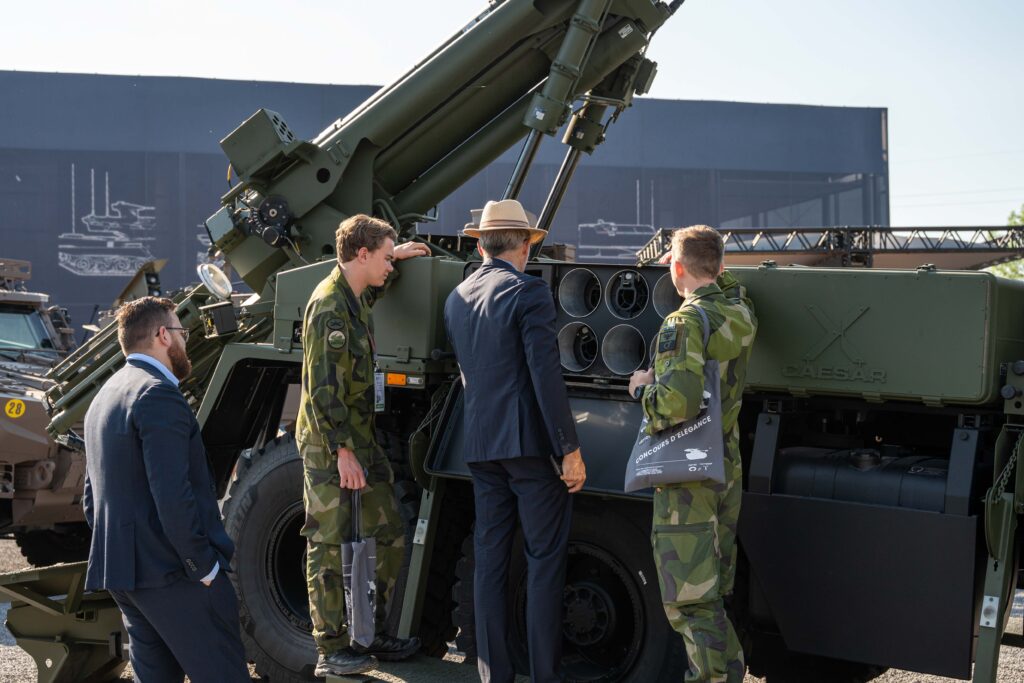
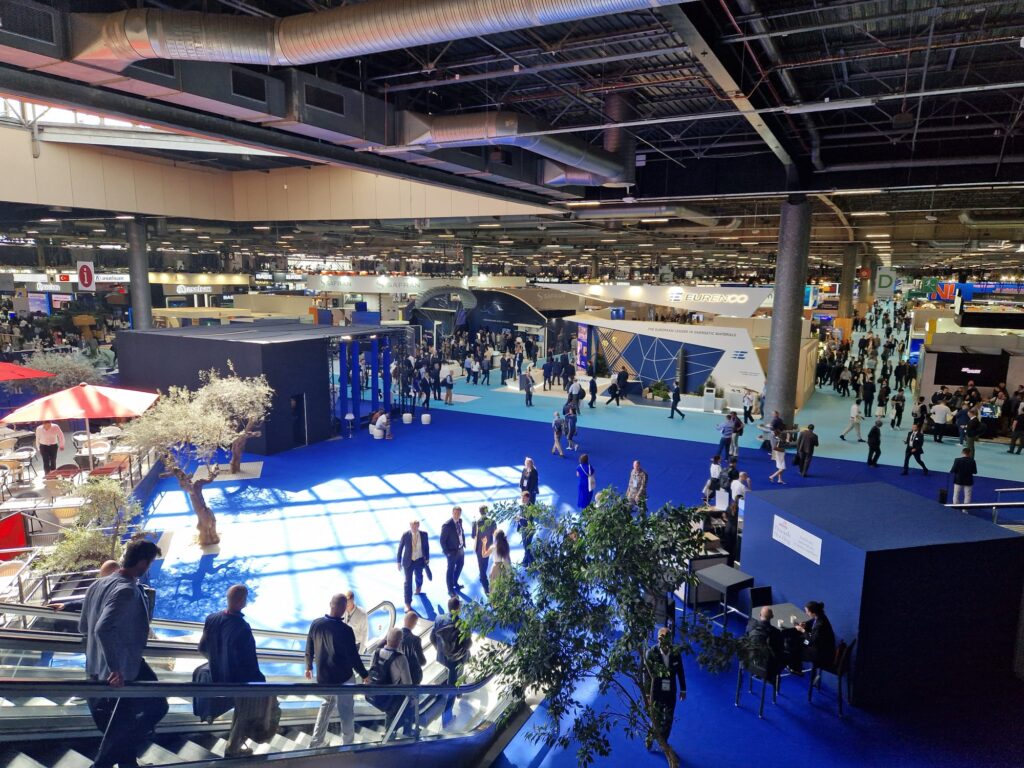
Deadly weapons and deep discussions: Eurosatory 2026, the world’s largest defence and security show, drew more than 2,100 exhibitors from 68 countries and some 50,000 visitors to Paris from 15 to 19 June.
The 185,000-square-metre floor space told its own story: Europe is rearming fast, and industry is scrambling to keep up. But a quieter argument ran beneath the noise of tracked vehicles and drone demonstrations. It concerned not hardware, but rules — and who writes them.
The latter was lost on the perennial feature of global defence events, the protesters. “Israël – l’assassin, Eurosatory — le complice,” they chanted on the show’s first morning at the entrance. “La guerre à la guerre” was another popular slogan. Asked whether “war to war” was a self-defeating concept, one of the leaders had a simple—if verbless—answer. “Eurosatory – le complice!” he offered, apparently by way of explanation.
Ukraine rewrites the rulebook
European Defence Commissioner Andrius Kubilius used his keynote address to set the terms of the show’s underlying debate. “Member states are in charge of defence and the European Union supports with EU added value, EU laws, EU coordination, EU scale, and EU money,” he said. The division of labour sounds tidy. In practice, it produces a thicket of contradictions that the surge in defence spending is now forcing into the open.
The war in Ukraine provided Mr Kubilius with his sharpest argument. Ukrainian companies numbered just ten at the previous Eurosatory edition two years ago. This year, 80 stood on the floor in Paris. They represent what the Commissioner called a “big bang”: Ukrainian defence production has grown from around €1bn in 2022 to roughly €50bn in 2026. That is not a regular procurement cycle. It is a transformation.
Ukrainian leaders had initially resisted drone warfare. “If we had listened to the Ukrainian generals from the very beginning of the full scale invasion, we would not have been able to create the drone army,” Ukrainian political and industry leaders told the Commissioner during informal talks last year.
Supply, in other words, changed demand, not the other way around. Transformation of supply and demand in Europe, however, goes very slowly by comparison. The reason, in Mr Kubilius’s view, is structural: no integrated market, no integrated incentives.
The drone economy
The numbers from Ukraine’s deep-strike drone programme illustrate the stakes. Ihor Fedirko, chief executive of the Ukrainian Council of Defence Industry, told a Eurosatory panel that Ukraine now operates 56 publicly known deep-strike uncrewed systems conducting strikes into Russia daily. Three years ago, there were none. The sector has grown from nothing into a market estimated at US$13.169bn, according to Shephard’s Defence Insight.
The economics are deliberately asymmetric. A Shahed-136 drone costs an estimated $20,000 to produce. It can destroy a high-value target outright, or force a defender to deploy expensive intercept systems. Either way, the attacker spends far less than the defender. Iyrna Terekh, chief executive and chief technology officer of Fire Point, whose Flamingo systems were on display in Paris, said that only 10 per cent of long-range deep-strike missions succeed. Volume is therefore everything. Low unit cost and mass production are not afterthoughts; they must be built into research and development from day one.

Mr Fedirko put a figure on the cumulative effect. Ukrainian deep-strike drones have damaged around 25 per cent of Russia’s total oil refining capacity. Halyna Yanchenko, chair of the Parliamentary Task Force on Investment in the Defence Industry, put the cost to Russia at $13bn, calling the damage “Ukrainian deep strike sanctions”. Even failed strikes force Russia to stretch its air defences across a vast area, creating gaps for future attacks.
Europe’s fragmented response
Europe has taken note, if slowly. In February 2026, Germany, France, Italy, Poland, Sweden and the United Kingdom signed a letter of intent to jointly develop a low-cost, long-range deep-strike loitering munition under the European Long-range Strike Approach (ELSA) initiative. Shephard estimates the six nations could ultimately spend $2.19bn on more than 10,000 such munitions, with Germany forecast to contribute the most at $600m.
If we had listened to the Ukrainian generals from the very beginning of the full scale invasion, we would not have been able to create the drone army. — Ukrainian leadership
France is also pursuing a sovereign option: the Chorus drone, produced by Renault and Turgis Gaillard, could attract up to €1bn from the Directorate General of Armaments (DGA) over ten years, depending on test results. The United Kingdom’s Project Brakestop calls for an effector capable of carrying a 200–300kg payload over 600km at roughly 600km/h, and is estimated to be worth more than $220m.
These are significant sums. But they remain national programmes sitting alongside, rather than inside, a common market. That is precisely the problem Mr Kubilius identified. Up to 80 per cent of European defence procurement uses an exemption under Article 346 of the Treaty on the Functioning of the European Union (TFEU), which allows governments to bypass competitive tendering on security grounds. “Direct awards can be necessary for security,” the Commissioner acknowledged. “But they have become the default. And this is out of balance.”
Tanks, artillery and the return of mass
The artillery numbers tell a similar story of demand outrunning industrial capacity. Shephard Defence Insight analyst Peter Magill described a full-scale “artillery renaissance” at Eurosatory. Germany cut its self-propelled howitzer fleet from around 1,200 systems in 1990 to approximately 100 by 2020. The United Kingdom fielded only 68 such self-propelled guns in 2022, with roughly half believed to be operational. Long-range fires were responsible for around 80 per cent of personnel and equipment losses on both sides in Ukraine during 2024.
Since 2022, European NATO members have contracted almost 1,400 self-propelled howitzers across 14 countries and more than 400 multiple-launch rocket systems (MLRS) across 11 countries. Total spending has reached US31.7bn; Poland alone accounts for roughly US10.2bn for MLRS. Hanwha Aerospace’s Thunder leads the self-propelled howitzer market with 698 systems ordered since 2022. South Korea’s Chunmoo leads the field, ahead of HIMARS and PULS.
The main battle tank (MBT) market is similarly buoyant. European MBT programmes are forecast to be worth approximately US$82bn over the next decade, covering more than 4,200 vehicles across 19 programmes, according to Shephard. Countries on NATO’s eastern flank are the most active buyers.
Poland is combining large purchases of Abrams and K2 Black Panther tanks with plans for domestic assembly, linking procurement explicitly to technology transfer and local manufacturing. The MARTE programme, backed by the European Defence Fund (EDF), brings together dozens of companies across Europe to develop technologies for future armoured systems.That is a model example of integration.
Collaboration as industrial policy
The TRACKX all-terrain vehicle programme, also EDF-backed, offers the clearest example of how collaborative procurement can work in practice. The programme has involved around 20 countries and more than 50 defence companies. It has received €79m in EDF funding as part of a wider €115m programme, with participating countries and industry contributing a further €20m.
At Eurosatory, Lt Gen Jari Mikkonen, chief of staff for armament and logistics of the Finnish Defence Forces, and Brig Gen Jonas Lotsne, director of the land systems department at the Swedish Defence Materiel Administration, signed an agreement enabling further technology cooperation on the programme’s pre-series development.
Patria and German drivetrain specialist RENK also unveiled a next-generation uncrewed ground vehicle (UGV) concept based on the TRACKX platform. “The transmission integrates steering, braking and propulsion functionalities within a digitally controlled drivetrain architecture and has been engineered and validated for military applications in under two years,” the firms explained. “The system provides the foundation for advanced functionalities. These include remote operation, platooning, crew-sharing concepts and future autonomous capabilities without requiring fundamental redesign of the vehicle platform.” Serial production of the TRACKX is scheduled to begin in 2027.
Regulation, red tape, and reform
The programme illustrates a broader shift. Manufacturers must now expand production capacity, not just develop new platforms. Analysts estimate Europe may need to produce hundreds of tanks annually, depending on procurement decisions. That requires the kind of long-term demand visibility that only a more integrated market can provide. As Mr Kubilius put it: “We need the power of a more integrated European defence market in order to outproduce Putin. Russia is still outproducing us. And that is a real threat.”
A concrete regulatory achievement can be singled out. A new rule capping the time to obtain a permit to build a production line or factory at 102 days, down from up to four years in some cases. That is progress; but the Commissioner argued it is far from sufficient. Components crossing borders between EU member states still face national transfer licences, causing delays and adding cost. Different certification standards multiply testing and audit requirements. These are, he said, the main obstacles to ramping up production. This is “especially a problem for start-ups and medium-sized companies”, he said.
Direct awards can be necessary for security. But they have become the default. — EU Defence and Space Commissioner Andrius Kubilius
The broader argument is about what kind of market Europe wants. Mr Kubilius offered four reasons for deeper integration: national security benefits from a larger industrial base; strategic autonomy depends on industrial competitiveness; defence readiness requires the scale to outproduce adversaries; and small firms need open markets to grow. “The integrated defence market is the best help for SMEs to grow, and innovate, to easily enter the market and in the end to transform the war doctrines of our countries,” he said. “Like it happened in Ukraine.”
The blurring of defence and security
He also pointed to the SAFE loan scheme as a concrete instrument. Mr Kubilius told the audience he would be signing a €15bn SAFE loan for France later that same day (Wednesday, 17 June), to support defence ramp-up in France and across Europe. The EU, he argued, can and must use its financial firepower to accelerate what fragmented national markets cannot achieve alone.
Eurosatory 2026 also signalled a structural shift in how Europe thinks about security more broadly. For the first time in the show’s history, a Minister of the Interior—Laurent Nuñez—addressed the international defence and security community, on 18 June. The boundary between homeland security and national defence, organisers noted, is fading. Cyber resilience, crisis management, border protection and urban security now sit alongside tank procurement and artillery contracts on the same exhibition floor.
That convergence has practical consequences for industry. The French Gendarmerie Nationale operates more than 650 uncrewed aerial systems (UAS). Frontex, the EU’s border and coast guard agency, runs a drone procurement plan with a ceiling value of approximately €190m. French authorities have launched a procurement programme worth more than €25m for ballistic plates for police, gendarmerie, customs and prison service personnel. These are not military budgets. But they draw on the same industrial base and, increasingly, the same regulatory frameworks.
The hardware on display in Paris showed that European industry can respond to surging demand. Whether European regulation can keep pace—and whether a genuinely integrated defence market emerges before the next Eurosatory, in June 2028—remains, for now, an open question. How long can Europe afford to keep it open, is another story.