As EU defence shifts from ambition to obligation, Paris becomes the place where industry must show—not just promise—that it can deliver.
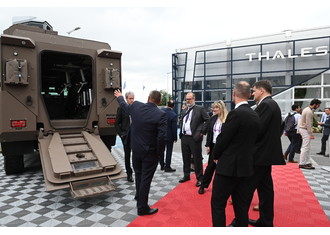
The world’s largest land and-air-land defence trade show last opened its doors in Paris, in June 2024. Eurosatory then reflected the EU’s defence-industrial ambitions as rather aspirational. Two years on, they have acquired legal form, funding lines, and compliance deadlines. Next week, Eurosatory is returning to Paris Nord-Villepinte (15-19 June) to reflect that shift. In several important respects, it may help determine what comes next. EU Perpectives will be present to keep tabs on the technology-meets-business feast.
The numbers alone tell part of the story. Global military spending reached $2.887tn in 2025, rise of 2.9 per cent over 2024. That year, it recorded a 9.4 per cent year-on-year increase. Together, this is the steepest growth since the end of the Cold War. European defence budgets have grown by more than 30 per cent since 2021. France’s defence budget for 2026 stands at €57.1bn. Against that backdrop, Eurosatory 2026 is shaping up to be the largest edition in its history. Over 2,600 exhibitors from 66 countries and 42 national pavilions take part.
From pledges to production lines
Charles Beaudouin, Eurosatory exhibition director, puts it simply. “Today more than ever, Eurosatory places defence at the crossroads of global geopolitics,” he wrote in a press release. The claim is less promotional than it sounds.
Since 2024, three pieces of EU legislation have moved the bloc from aspiration to obligation. The Act in Support of Ammunition Production deployed a €514m co-fund for powder, explosives, shell casings, and missile lines. It lifts annual EU output above two million artillery rounds. The European Defence Industry Programme (EDIP), formally adopted on 8 December 2025, added a €1.5bn budget for 2025-27 to de-risk new production lines and expand joint programmes.
The Cyber Resilience Act (CRA), in force since 10 December 2024, requires any product with digital elements—radios, command software, drones, sensors—sold to EU forces to meet mandatory secure-by-design standards, with full compliance due by 11 December 2027 and fines reaching €15m or 2.5 per cent of global turnover.
These are not framework documents. They carry budgets, timetables, and penalties. Exhibitors at this year’s show will feel their weight directly.
A compliance test
The European Defence Industrial Strategy (EDIS), unveiled in March 2024, set the targets that now govern procurement decisions across the bloc. Forty per cent of defence equipment is to come from collaborative procurement by 2030, 50 per cent bought from within the EU by the same date, and 60 per cent by 2035. Five cross-border projects selected under EDIRPA in November 2024—covering air and missile defence, ammunition, and platforms—have already begun translating those targets into actual order books.
Eurosatory 2026 will function, in part, as a live audit of how well industry has absorbed these obligations. Exhibitors showing software-defined radios, C2 platforms, or unmanned systems are expected to market hardware as CRA-ready, with ENISA reporting capability already in place ahead of the September 2026 vulnerability-disclosure deadline.
Today more than ever, Eurosatory places defence at the crossroads of global geopolitics.
— Charles Beaudouin, Eurosatory exhibition director
The five EDIRPA pilot consortia have reserved dedicated floor space to brief visiting defence ministries on programme status and future tranches. It is a visible sign that joint procurement has moved from policy paper to negotiating table.
The dual purpose
The show’s new Eurosatory LAB curates nearly 60 start-ups and technology companies from more than 15 countries. Their fields span embedded artificial intelligence, autonomous systems, resilient navigation, cybersecurity, advanced materials, optronics, space, and microsatellites. Emmanuel Levacher, CEO of Arquus, a military vehicle manufacturer, described the initiative’s purpose plainly: “Eurosatory LAB serves a dual purpose: as a technology showcase for the armed forces and institutional decision-makers, and as a platform that brings together start-ups, leading industry players, investors and operational users.”
Among the LAB’s exhibitors, the French start-up ORUS is developing an on-board hyperspectral imaging solution for microsatellites, with an initial launch scheduled for 2027. Its presence reflects the EU Space Strategy for Security and Defence, adopted by the Council in March 2025, which formally designated space as an operational domain and mandated a toolbox for joint responses to hostile acts in orbit.
ESA and SatCen are expected to announce their first joint responsive-launch service procurement at the show. The outcome will shape the delegated act the Commission must table by Q4 2026 to fund that toolbox under the EDF and EDIP umbrella.
What the show could change
The more consequential question is what Eurosatory will feed forward into legislation still being drafted. The Commission and Parliament rapporteurs working on the post-2027 multiannual financial framework are holding hearings on-site. The volume and nature of industrial commitments on display will inform the case for enlarging EDIP’s €1.5bn envelope into a substantially larger instrument for the 2028-34 period.
On 17 June, political heavyweights are expected on the floor. Industry intends to use the occasion to press for bond financing to fund large pre-orders. The proposal feeds directly into Parliament’s autumn-2026 debate on innovative defence-financing instruments referenced in EDIS and EDIP working documents. Whether that lobbying produces results will depend partly on how convincingly exhibitors can demonstrate production capacity rather than prototype capability.
Eurosatory LAB serves a dual purpose. It is a technology showcase for the armed forces and institutional decision-makers. (It is also) a platform that brings together start-ups, leading industry players, investors and operational users.
— Emmanuel Levacher, CEO of Arquus
A dedicated investor and banking hub appears at Eurosatory for the first time this year. It tells you that private capital is beginning to treat European defence as a credible asset class rather than a reputational liability. That shift matters for the legislative agenda: the Commission’s ability to mobilise the €800bn envisaged under the ReArm Europe plan depends on private finance supplementing public budgets.
The limits of the moment
Not everything on the floor will translate into policy. Europe still sources 58 per cent of NATO members’ arms imports from the US. The 50-per-cent-from-EU procurement target looks ambitious against that baseline. Eurosatory’s American pavilions will offer an informal measure of whether “buy European” is changing actual purchasing behaviour or merely conference rhetoric.
The CRA’s compliance timeline is tight. Full conformity is required by December 2027, yet ENISA and CEN/CENELEC working groups are still finalising the list of approved conformity-assessment bodies—a process they are using Eurosatory’s technical panels to complete. For smaller firms, the cost of redesigning digital components to meet secure-by-design requirements may prove prohibitive, concentrating the market among larger players in ways the legislation did not intend.
What the show will not resolve is the fundamental tension between the EU’s push for strategic autonomy and the interoperability requirements that bind European forces to American systems. That tension predates EDIS and will outlast it. No trade show can legislate the problem away; but few are better positioned to illuminate it than Eurosatory.