
The European Commission hopes it can build bigger banks without the shared deposit backstop — the very measure everyone once called a sine qua non precondition for the goal.
On Friday, the European Commission gave up on one of the longest-standing goals of Europe’s banking union. Its new Communication on the competitiveness of the banking sector scraps the 2015 proposal for a European deposit insurance scheme (EDIS)—meant to protect savers the same way in every member state—and replaces it with a plan that keeps each country’s deposits separate. “Getting capital flowing is how we will get Europe growing,” said Commission President Ursula von der Leyen in the announcement.
The Draghi and Letta reports diagnosed Europe’s banks as too fragmented and too timid to finance the continent’s investment needs. Ever since, a camp of economists and industry figures has argued that the post-2008 framework overcorrected. Supervisors, punished for every failure but never for the lending that never happened, have grown structurally risk-averse.
What made it in
Their prescription is “recalibration”, not deregulation. For two years, they made the case that Europe should keep its safety rules but stop punishing all risk-taking. It should also simplify overlapping requirements and integrate its banks without waiting for pooled deposit insurance. Friday’s Communication commits to exactly that list.
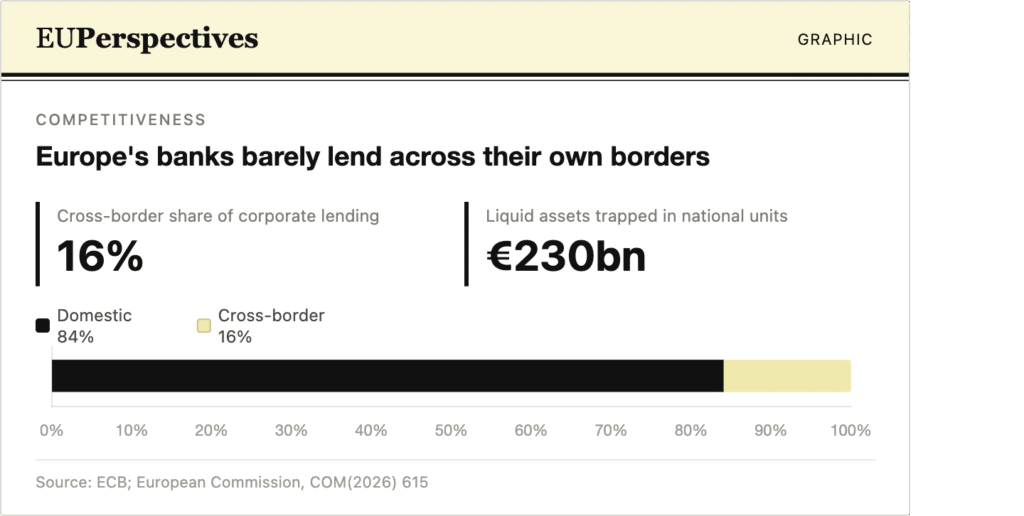
The Communication is structured around three objectives, each to be turned into legislation in the first quarter of 2027. First, the Commission wants to let banks operating across EU borders pool their financial reserves centrally. This is part of the effort to avoid locking up money in every country where the banks operate. The Commission asserts this would free up more than €230bn in high-quality liquid assets currently stranded along national lines.
Second, it adapts the global banking rules, known as Basel III, by re-examining how much capital banks must hold against mortgages and against loans to ordinary companies. Unlike big corporations, these have no credit rating. European businesses rely on bank loans far more than American ones do. Thus, the Commission argues, easing these requirements would free banks to finance more of the economy.
Third, simplification. Banks face overlapping safety requirements set by different authorities. This means extra capital cushions stacked on cushions plus heavy reporting duties. The Commission wants to remove the duplication and cut the data banks must report to regulators by half.
Whose safety net?
In place of EDIS, the Commission promises a “simpler” deposit-protection framework that ensures cross-border bank failures are “handled at European level”. This would build on the existing national deposit-guarantee schemes and the €81bn Single Resolution Fund rather than pooling deposit money across borders. In this way, banks will share the costs of a failure rather than countries.
For a decade, the rule of thumb was no integration without EDIS first. Countries wouldn’t release trapped bank capital until a common deposit fund reassured them. The Commission is now betting that other safeguards can do the job instead.
The same instinct is already being tested in the securitisation reform debate, which is now heading to trilogue. MEPs have backed the identical logic the Communication now embraces. It advocates for lighter capital against safer assets to free up mortgage lending. However, it leaves the decisive number, the capital floor, unresolved. The specifics will be the decider.
This Communication previews the legislative package due in the first quarter of 2027 after the Commission completes its stakeholder engagement. Then will be determined how far capital requirements actually fall, and whether banks will be pushed to diversify their sovereign holdings.