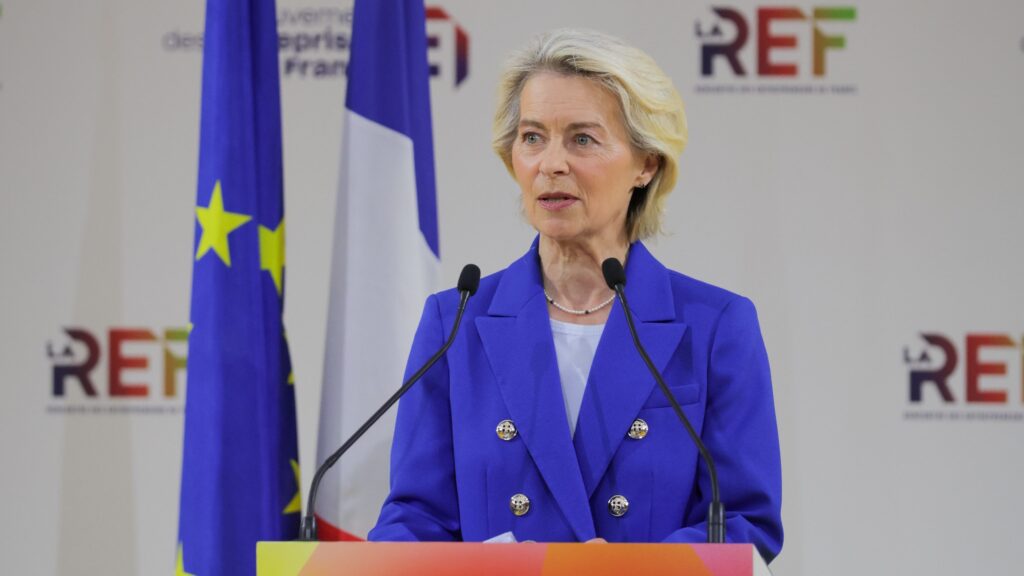
Cheap energy, open trade and American protection once underpinned Europe’s prosperity. The European Commission president says those days are over.
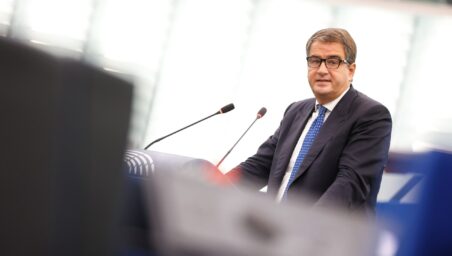
Speaking at the annual Rencontre des Entrepreneurs de France at Roland-Garros, European Commission President Ursula von der Leyen pointed to a mounting squeeze on European businesses. High energy prices, complex regulation, an incomplete single market and competition from companies operating under different conditions are all eroding the bloc’s competitiveness. She said the EU must become “a continent that produces, invests and protects”, placing industrial capacity at the centre of its economic policy.
“For a long time, the European economic model was based on a few clear assumptions. Cheap imported energy. Open global trade. Growing access to the Chinese market. American strategic protection. And Western technological progress,” Ms Von der Leyen said. “These have disappeared.”
China trade deficit approaches €1bn a day
Ms Von der Leyen said the EU wanted to reduce economic risks linked to China without breaking ties, but could not continue accepting major trade imbalances. Chinese imports into the EU have increased by 45 per cent over five years while European exports to China have declined.
The bloc’s trade deficit with China now approaches €1bn a day, she said, adding that every member state had recorded a deficit this year for the first time. Recent Eurostat data show that the EU’s quarterly goods deficit with China widened from €66bn in early 2024 to €103bn in the second quarter of 2026. However, it remains slightly below the quarterly peak of €107bn recorded in 2022.
Europe also relies on China for more than 80 per cent of several critical raw materials and up to 90 per cent of some rare earths. “Dialogue with China remains necessary. But it must produce results,” Ms Von der Leyen said. “When dialogue is not enough, we must be ready to make full use of our instruments.”
China responded to the ongoing debate, arguing that much of its export growth was driven by international demand, particularly for products supporting the green transition. Beijing also criticised the EU’s Industrial Accelerator Act, saying it introduced restrictive requirements for foreign investment in four emerging strategic sectors.
Energy limits European competitiveness
Energy remained the main factor limiting Europe’s competitiveness and independence, Ms von der Leyen said. She put European energy prices at two or three times those in the United States or China. Even before the current Middle East crisis, the International Energy Agency found that electricity prices for energy-intensive EU industries averaged more than twice US levels in 2025.
The latest disruption has intensified that pressure, with oil prices rising sharply after the conflict began. Higher fossil-fuel import costs since the beginning of the Middle East crisis have added more than €50bn to Europe’s energy bill without providing any additional energy, Ms Von der Leyen said.
For a long time, the European economic model was based on a few clear assumptions. These have disappeared. — Ursula von der Leyen, European Commission President
Although more than 70 per cent of EU electricity now comes from low-carbon sources, inadequate grids and storage are preventing some new capacity from being used. Last year, 10 terawatt-hours of renewable electricity were lost because of insufficient infrastructure, equivalent to the annual consumption of three million households.
Beyond energy, Ms Von der Leyen also called for European savings to be directed towards European companies. Around €10tn remains in household bank accounts, while a substantial share of the continent’s capital is invested abroad. She said proposals under the Savings and Investments Union could unlock up to €470bn in additional investment and called for an agreement by the end of the year.