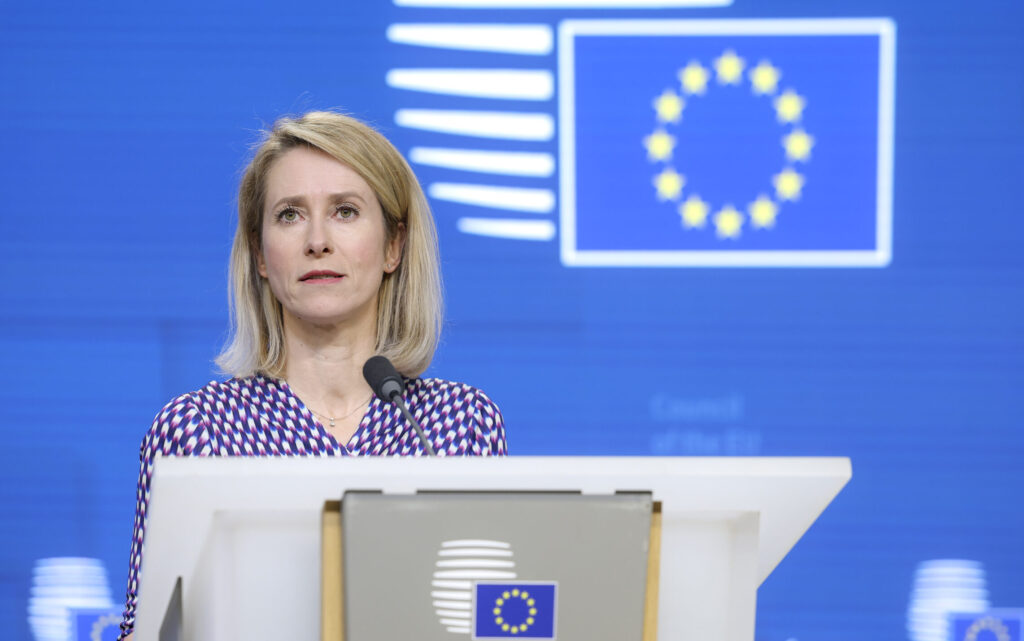
Two proposals were on the table, two proposals failed. The EU’s foreign ministers left Brussels on Monday without agreement on some of the bloc’s most politically sensitive issues: a new package of sanctions against Russia and possible trade restrictions targeting Israeli settlements in the occupied West Bank.
The twin deadlock once again exposed how difficult it is for the EU’s 27 member states to reach a common foreign policy when national interests diverge.
“I’m also disappointed that there’s no agreement on the 21st sanctions package, although I must say we’re very close,” the EU’s foreign policy chief Kaja Kallas said after the meeting.
Russia sanctions remain stuck
The proposed 21st sanctions package is intended to tighten economic pressure on Russia over its invasion of Ukraine. EU diplomats had hoped to approve it before existing energy-related exemptions begin expiring later this week, which could weaken parts of the sanctions regime if no replacement measures are agreed.
According to diplomatic sources, countries including the Baltic states, Belgium and Italy are pushing to conclude negotiations quickly. Still, capitals remain divided over the final shape of the package.
“We must see how to organize life in a post-war phase because (former Russian combatants) represent a danger.”
— High Representative Kaja Kallas
One of the most contentious proposals would introduce restrictions on those who served in the Russian military since February 2022. While details are still being negotiated, Kallas argued they could pose a security threat.
“Work will continue because they represent a risk to our security and we must not allow them to come to Europe: these are dangerous people. We must see how to organize life in a post-war phase because these people represent a danger”, she said.
Despite the lack of agreement on the broader package, ministers did approve a major expansion of the EU’s sanctions lists, adding around 250 individuals and entities. “This is our biggest round of individual designations since the beginning of the war,” Kallas said.
Israeli settlements divide member states
The discussions proved even more difficult when ministers turned to the Middle East.
For the first time, the European Commission presented member states with several options to restrict trade with Israeli settlements in the occupied West Bank. The proposals follow last year’s advisory opinion by the International Court of Justice, which found Israel’s occupation of Palestinian territories to be unlawful under international law.
“Everyone agrees that the situation in the West Bank is truly intolerable.”
— High Representative Kaja Kallas
“Let’s see if anyone changes their mind”, Kallas said afterwards, noting that “everyone agrees that the situation in the West Bank is truly intolerable”. She warned that the continued expansion of settlements is making a two-state solution “increasingly impossible.”
Dispute over how sanctions could be approved
The disagreement is no longer only about whether to introduce trade restrictions, but how they could legally be adopted. The Council’s legal service argues that measures restricting trade with settlements could fall under the EU’s common trade policy, allowing them to be approved by a qualified majority of member states rather than requiring unanimous support.
However, the European Commission maintains that unanimity is needed because of the political sensitivity of the issue.
Italy is among the countries backing that interpretation. Its Foreign Minister Antonio Tajani said Rome had carefully examined the Commission’s proposals but considers them “a political choice” that should require unanimous approval.
Spain, Belgium, Denmark, and Luxembourg, meanwhile, are calling for swift action. Madrid accused opponents of using a “delaying tactic”, while Belgium is preparing its own national ban on imports from Israeli settlements if the EU fails to act collectively.
Lawmakers urge the Commission to move ahead
Meanwhile, pressure is mounting from the European Parliament. A cross-party group of lawmakers from the EPP, Socialists & Democrats, Renew Europe, the Greens and The Left called on the Commission to use the EU’s trade powers to introduce the restrictions.
In a joint statement released on Monday, they argued that Article 207 of the Treaty on the Functioning of the European Union provides a legal basis for adopting such measures by qualified majority, pointing to previous EU trade restrictions covering conflict minerals, products made with forced labour and Russian energy.
The lawmakers warned that if Brussels fails to act, individual member states will increasingly adopt their own national measures, creating a fragmented system that is less effective than a coordinated EU approach. They also criticised the continuing humanitarian situation in Gaza, noting that the EU still faces severe restrictions in delivering humanitarian assistance on the ground.