Make sure that things work together under pressure. Technologically speaking, that is the domain of Captec Group, a specialist in ruggedised computing hardware. In a wider sense, the maxim applies to the entire continent’s market, long plagued by fragmentation, CEO Max Toti tells EU Perspectives.
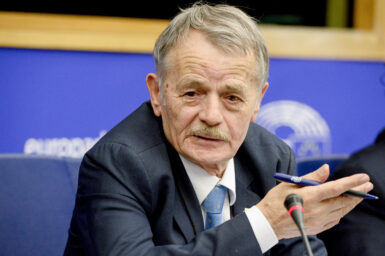
The halls of Eurosatory 2026, the biennial defence and security trade show held outside Paris, drew manufacturers, generals, and procurement officials from across the world. Captec Group designs and manufactures heavy-duty computers built to withstand the extreme conditions of military environments. EU Perspectives sat down with Max Toti, Captec’s founder and managing director, to discuss collaboration, fragmentation, and the urgent business of European defence.
Mr Toti is not a politician, and he says so more than once. But the ground he covers is unavoidably political. His central argument is simple: European countries cannot defend themselves alone, and the technology sector—computing in particular—is quietly building the foundations for a more integrated approach.
Green shoots
Europe’s defence market has long been criticised for its fragmentation. Dozens of national industries, each protective of its own champions, produce overlapping capabilities at considerable cost. Mr Toti sees change, even as he remains careful not to overstate it.
“Collaboration between companies, particularly in the SME space, is increasing quite significantly,” he says. Small and medium-sized enterprises—the backbone of most European defence supply chains—are beginning to avoid duplicating one another’s work. Instead, Mr Toti argues, individual firms and countries are starting to focus on areas where they can genuinely excel, becoming what he calls “centres of excellence”. Their specialised contributions then combine to provide shared capabilities.
Computing, he says, is the common thread. Every modern defence system—from drones to weapons platforms to satellite networks—runs on computers. That shared dependency creates a natural basis for collaboration. “I can see that there’s a lot more of that collaboration happening where people are not reinventing the wheel over and over again and are actually leveraging what other people are doing.”
He acknowledges, however, that this is early days. “I would say that there are definitely green shoots of evidence, but I think it’ll be a while before it really scales and grows substantially, simply because it is not the normal behaviour of countries and companies.” The instability of the current world, he suggests, will force the pace. “We stand far stronger when united in collaboration than divided. So that is going to be the driving force. In effect, it is the glue that is going to bring us all together with a common cause.”
Singapore’s model works
In many countries, governments shield domestic defence companies from outside competition, and the prevailing instinct is to demand homegrown solutions. “We want our own drones” resonates even when buying from a specialist partner would be faster and cheaper. Mr Toti recognises the pattern immediately.
He points to Singapore as a counterexample. A small country with a declining population has embraced collaboration as a strategic necessity rather than a compromise. He contrasts this with what he calls “the American philosophy”, the belief that everything must be invented domestically to be trusted. “You can’t travel very far if you travel alone,” Mr Toti says. “You have to travel with partners to get a lot further and also to get there quicker.”
People are not reinventing the wheel over and over again and are actually leveraging what other people are doing. — Max Toti, CEO of Captec Group
The urgency is real. China is arming at an unprecedented scale. Geopolitical tensions are rising. Mr Toti is blunt about the implications for Europe’s pace of adaptation: “I think that that should be enough of a stimulus to say we need to be a lot more agile.” The case for collaboration, he argues, is not merely economic; it is a matter of speed. “If people work in parallel through collaboration, that means you can do five things at the same speed that you would have otherwise done one thing.”
The technology stack
One practical mechanism for overcoming national resistance, Mr Toti argues, is the development of common standards — agreed technical specifications that allow equipment from different countries to work together. He uses radio communication as an illustration: two radios are useless to allies if they cannot talk to each other. Agreeing on how systems interoperate removes one layer of the problem.
Computing hardware, he notes, is already largely platform-agnostic — meaning it does not care which country it operates in or which application it runs. “The fundamentals of the hardware is exactly the same,” he says. That creates a shared technical foundation even where political will is lacking. Within that shared framework, competition among providers can still drive innovation. The best solutions, he argues, will become dominant naturally.
He offers a striking concrete example. At Eurosatory, one company’s turret—the rotating weapon mount fitted to a military vehicle—appeared on the unmanned vehicles of 17 different manufacturers. Seventeen separate companies had decided not to build their own. “It means that seventeen companies have decided, I’m not going to make my own turret. I’m going to choose the turret that is already an advanced player in that space.”
Europe’s highest common interest
For Mr Toti, this is the model: identify the best-in-class component, integrate it, and focus your own resources elsewhere. “That is probably the classic partnership example that I would say is going in the direction of travel.”
Mr Toti is optimistic about Europe’s capacity to learn this lesson, precisely because the EU’s founding logic already points in that direction. Europe, he notes, consists largely of smaller economies. Individually, they lack the scale to mount a credible defence. Collectively, they do not. “That’s what the whole EU is all about. Being a common bloc and doing things with common interest, as together as we possibly can.”
Defence, he argues, is not merely one common interest among many. “That is the highest. That is the highest because protecting our individual sovereignties is what we all agree on and it’s our fundamental principle for all our European democracies.” The Russian war in Ukraine sharpens the point. “That threat is in Europe. The Russian, Ukrainian situation is happening right now on our own doorstep.”
From Korea to Canada, demand is surging
Beyond Europe, Mr Toti describes a broader transformation in global defence markets. Countries that historically relied on the United States for their security are now investing in domestic capabilities. The shift follows a perception that Washington’s commitment to protecting its allies has become less certain.
Captec has felt the effect directly. “We started to do business, for example, for countries like Korea. In January this year, if you said shall we go and try and do business in Korea, we never would have thought about it. Whereas now we’re already doing quite significant business in the country.” The company’s reputation, he says, has spread; demand has come looking for it.
Seventeen companies have decided, I’m not going to make my own turret. I’m going to choose the turret that is already an advanced player in that space. — Max Toti
Canada offers a different but related story. Captec operates a subsidiary there. Canada historically outsourced its defence infrastructure almost entirely to the United States, building little of its own. That is now changing rapidly. “Now Canada is investing heavily and because we are a native Canadian company, as part of the group, we see a massive growth potential as Canada develops and evolves its own indigenous defence industry.”
One plus one equals three
The conversation returns to Europe. Mr Toti is asked whether a common European defence is realistic. His answer is unequivocal. “I think it goes beyond realistic. I think it’s a necessity simply because individually, European countries don’t have the power to be able to really defend themselves.”
The model he advocates is one of specialisation rather than replication. Every European country does not need to build every capability. What matters is that the pieces fit together. “What they ought to be doing is to think about, well, what part of the drone can I do so that we’ve got massive scale by combining — so, you know, one plus one equals three formula, as opposed to everybody does the same one thing,” he argues.
Europe, he notes, has a strong historical record of collaboration. The challenge now is to sustain that instinct against the friction of geopolitical tension and national interest. Mr Toti declines to speculate on the politics. But the direction of travel, he believes, is clear. The world has grown too unstable, and the threats too immediate, for European nations to keep travelling alone.