Member states are implementing fewer of the European Commission’s annual rule-of-law recommendations than ever before. The gap appears to be widening.
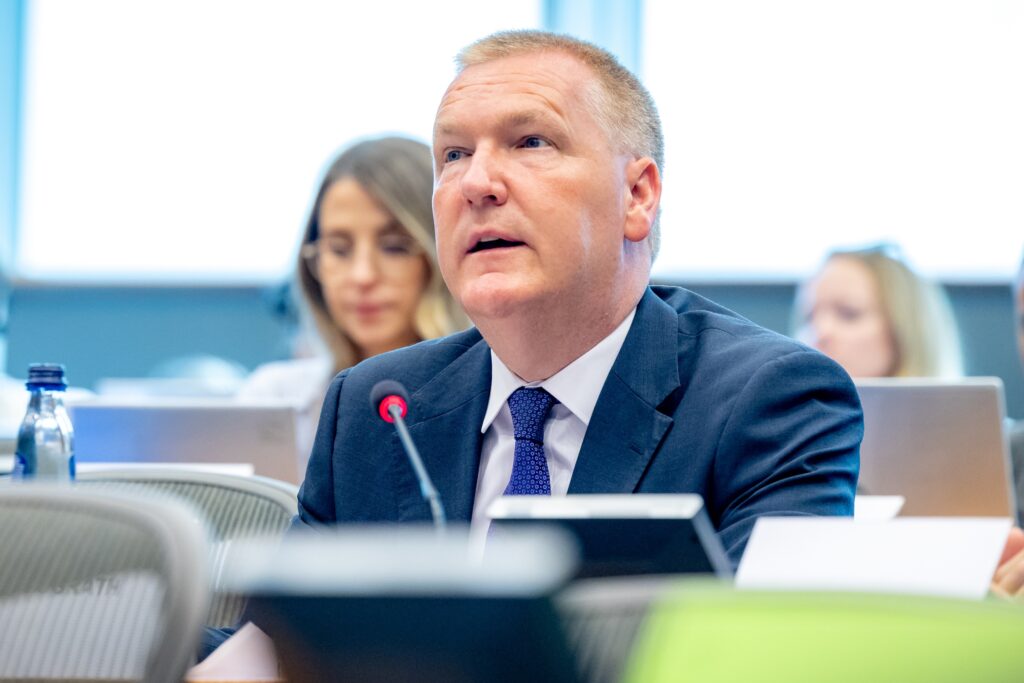
Both Commission Vice-President Henna Virkkunen and Commissioner for Justice Michael McGrath deflected every question that touched on a specific case or individual. Asked about former Hungarian Foreign Minister Péter Szíjjártó’s move to Chinese carmaker BYD, Mr McGrath said only that “We don’t comment on any individual case.” Asked whether the Greek prime minister was right to accuse the European Public Prosecutor’s Office of political interference, he offered institutional boilerplate in response.
On Romania’s judicial council sending what a journalist called a blacklist of investigative journalists to the Commission, he said he would not comment “on any particular case.” Ms Virkkunen followed the same pattern throughout, deferring to Mr McGrath on specifics and retreating to the language of dialogue, monitoring, and continued engagement.
A health check
The Commission examines justice systems, anti-corruption frameworks, media freedom, and institutional checks and balances across all 27 EU member states and four candidate countries. On Friday, it released the seventh edition of its annual Rule of Law Report which issues recommendations to each section. The findings are broadly positive, but the picture across the bloc remains uneven.
Ms Virkkunen set the tone. “With rising political polarisation, pressures on democratic institutions, on our economy and growing external threats, defending the rule of law is more than ever essential,” she said.
Mr McGrath framed the exercise differently. “The annual Rule of Law Report is, in a way for Europe, what a regular health check is for people,” he said. “It helps prevent problems from emerging in the first place or from deepening. Prevention is better than cure.”
Mr McGrath visited all 27 member states in preparation. His team held around 600 meetings with national authorities, judicial institutions, civil society organisations, and other stakeholders. He also visited Budapest after Hungary’s recent elections. “I saw with my own eyes what restoring the rule of law means to the people of Hungary,” he said. “They believed that the law cannot be a true love, but must be a check on power.”
Progress, but unevenly spread
Member states have addressed nearly one in two recommendations made in since 2025, either fully or partially. That figure drew scrutiny. A journalist noted it was the lowest follow-up rate since the report began — down from 68 per cent the previous year and 65 per cent the year before that.
Ms Virkkunen pushed back. “I think addressing 47 per cent of the recommendations in one year’s time has been quite a speedy process,” she said, “because the recommendations we are speaking about, of course, mean legislative actions, often from the governmental side, and of course the parliamentary procedures are also taking time.” She added that over a three-year horizon, 60 per cent of recommendations receive attention. (Which does not address the question, but hey, this is Brussels.)
Free and independent media are not a luxury of democracy. They are one of its very foundations. — Michael McGrath, EU commissioner for justice and rule of law
Mr McGrath agreed. “It stands to reason that some of the perhaps easier recommendations have been implemented in recent years,” he said. “Some of the recommendations are quite complex. They do involve legislative reform, they can involve the need for significant consultation with stakeholders within a member state.”
Hungary in the spotlight
Positive examples came from Bulgaria—where a reform preventing political influence in the Supreme Judicial Council was adopted last year—and from Romania. A new law on lobbying obliges members of Bucharest’s parliament to register meetings on laws with third parties. Hungary’s new government passed laws to increase transparency and create tools to fight corruption.
Hungary remains a central focus. The Commission criticised the absence of new lobbying and revolving-door rules, calling on Budapest to adopt comprehensive legislation to strengthen its integrity framework. It also found no progress in making the allocation of cases in lower courts more transparent, and no structured approach to pay rises for judges and court staff.
There will not be automaticity between the Rule of Law recommendation and access to EU funds. — Henna Virkkunen, European Commission vice-president
Mr McGrath acknowledged the new government’s early steps. “In the early weeks of the new government’s life, a lot has been done already and we welcome the progress so far,” he said. He noted that a joint parliamentary hearing had taken place earlier in the week on the possible release of EU funds to Hungary, tied to the achievement of reform milestones.
Madrid’s cold feet
Spain drew criticism for making only limited progress on conflict-of-interest rules and asset declarations for senior officials. Madrid has tabled a draft Public Integrity Law and adopted a State Anti-Corruption Plan, but the Commission said practical implementation of existing rules has not improved.
It called for an independent supervisory body with effective investigative and sanctioning powers, and urged parliament to complete lobbying legislation. This includes a mandatory public register of lobbyists. The findings land amid a string of corruption cases involving figures close to Prime Minister Pedro Sánchez.
Ms Virkkunen highlighted the European Media Freedom Act (EMFA), which came into force last August, as a turning point. Many recommendations previously issued through the Rule of Law Report on media independence are now legally binding obligations under that act. “We always speak about editorial independence, and also when we speak about public broadcasters,” she said.
A legal matter
Mr McGrath was a trifle more direct on enforcement. “Free and independent media are not a luxury of democracy,” he said. “They are one of its very foundations.” He also showed that the rules are about to get some teeth: “Some issues previously addressed through Rule of Law recommendations are now covered by the legally binding provisions of EMFA. Our approach has therefore evolved: where EMFA now provides the framework, we will no longer have recommendations in the Rule of Law Report, but we will follow up on those issues through the enforcement of EMFA.”
He confirmed the Commission supports the European Public Prosecutor’s Office. “The EPO is independent, they are governed by EU law, and it is a requirement across the European Union to cooperate and support the work of the EPO,” he said, rather predictably.
We don’t comment on any individual case. — Michael McGrath
Looking ahead, the Commission plans to present a series of anti-corruption initiatives before the end of the year. These include a review of the EU’s anti-fraud architecture, an EU anti-corruption strategy, and a strengthened mandate for the European Public Prosecutor’s Office.
The next long-term EU budget will also tighten the link between rule-of-law compliance and access to EU funds. Ms Virkkunen, however, was careful to add that “There will not be automaticity between the Rule of Law recommendation and access to EU funds.” Whether this helps boost the respect the report enjoys, remains to be seen.