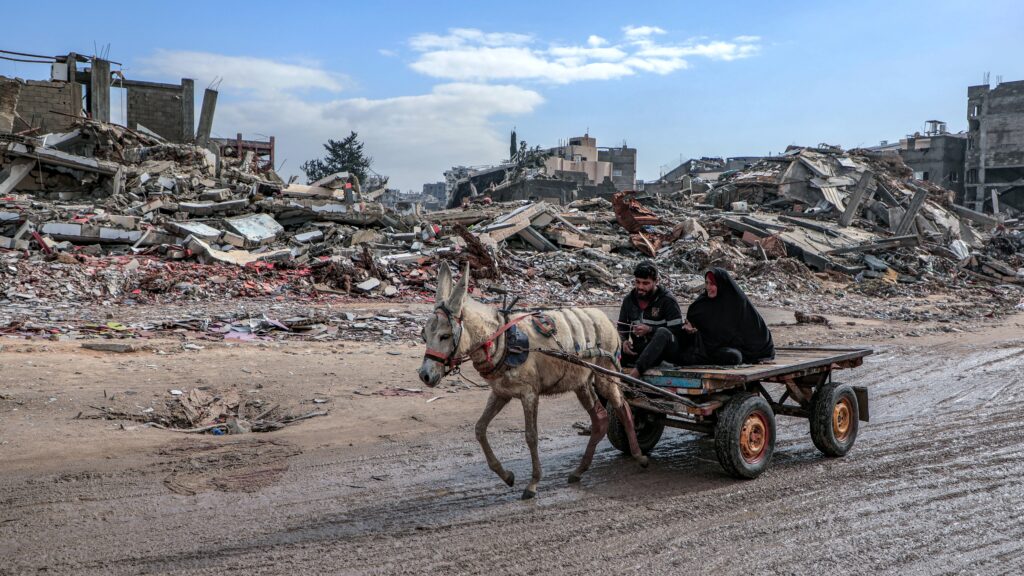
The reconstruction of war-ravaged Gaza is beginning to take more concrete shape, with €883.6 million earmarked for the first phase of recovery. The EU’s new Team Gaza Initiative aims to bring international partners together to support rebuilding efforts across the Strip.
The Team Gaza Initiative aims to coordinate projects to restore essential services, from water and sanitation infrastructure to waste management, energy, agriculture and food systems. Through the initiative, the EU hopes to launch “concrete projects that will restore essential services and improve people’s daily lives”, European Commissioner for the Mediterranean Dubravka Šuica explained. “Our objective is clear: to help build hope, resilience and a better future for the Palestinian people,” she said.
The initiative was presented on Monday during the second meeting of the Palestine Donor Group (PDG), co-chaired by Ms Šuica and Palestinian Authority Prime Minister Mohammad Mustafa.
In line with the Gaza Peace Plan and UN Security Council Resolution 2803, the initiative builds on the joint damage and needs assessment published in April 2026 by the European Union, the United Nations and the World Bank. The meeting also included an initial discussion of two water and waste management projects that Ms Šuica recently agreed with the Israeli authorities during her mission to Israel and Palestine.
More nations than the World Cup
The PDG was attended by 65 international delegations, including ministers, senior officials, international organisations, and financial institutions. First-time participants included Nikolay Mladenov, High Representative of the Board of Peace, the body established under US President Donald Trump’s Gaza peace initiative. Also attending for the first time was Ali Shaath, head of the National Committee for the Administration of Gaza.
Thirteen countries have joined the platform, alongside with the European Commission, the European Investment Bank, and the World Bank. An initial €883.6 million has been earmarked for the first phase reconstruction efforts. Italy, France, Germany, Spain, Belgium, the Netherlands, Denmark, Finland, Sweden, the United Kingdom, Japan, Norway, and Switzerland are participating. Australia and Canada have also expressed an interest in joining.
EU High Representative for Foreign Affairs Kaja Kallas reiterated that the European Union remains “the most reliable and credible partner for the Palestinian people, the largest donor, and the most committed supporter of the two-state solution”.
Ms Kallas emphasised that the Palestinian Authority “must advance reforms and strengthen its governance” while “the people of Gaza require continued financial support for reconstruction”. The construction of a Palestinian state, she added, must be “led by the Palestinian people, but with the support of the international community”.
Concerns on the humanitarian front
The European Commission, however, remains extremely concerned about the humanitarian situation in Gaza. Commissioner for Crisis Management and Humanitarian Aid, Hadja Lahbib, denounced the ongoing crisis in the Strip and the difficulties accessing it for international aid workers.
“I have no words to describe this situation: nine months after the so-called ceasefire, the bombings continue, diseases are spreading, people are dying, the humanitarian situation is unsustainable, and what remains of Gaza’s infrastructure is on the verge of collapse,” she declared.
Lahbib also accused Israel of blocking European aid access. “We, as the largest humanitarian donor, are being denied access to Gaza. We need to be able to reopen our office, but we’re receiving no response. There’s a clear lack of political will and commitment from the Israeli authorities,” she said, adding that hospitals and sewerage systems are “on the verge of collapse” while food, water, and medical supplies remain blocked at crossings.
The commissioner also drew attention to the situation in the West Bank, denouncing that “more and more violent settlers are seizing land with the support of the Israeli army” and the displacement of Palestinian families is now “a daily occurrence”.
Sidelines made more money
On the sidelines of the meeting, the EU and twelve member states and partners also signed new agreements for €41.7 million through the PEGASE mechanism, the instrument created in 2008 to channel aid to the Palestinian Authority through rigorous control and verification systems.
This amount is in addition to the €310 million that the European Commission has already committed for the 2026–2027 period: since its inception, PEGASE has mobilised a total of €3.8 billion for the Palestinian population.