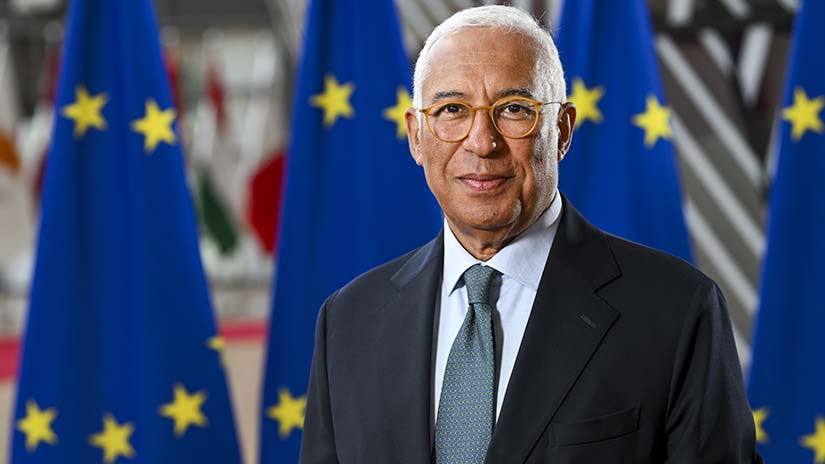
The €90bn keeping Ukrainian salaries and hospitals running nearly did not survive a Slovak veto. António Costa opens his EU capital tour with the man who nearly blocked it, then a Latvian premier who has attacked his outreach to Moscow. Both meetings will test how much unity remains behind the money.
The “Tour des capitales” has become an annual tradition since 2025, but this year’s edition carries real stakes. The European Council must find a general approach on the 2028 to 2034 Multiannual Financial Framework (MFF) before the current budget runs out at the end of 2027. That file is proving far harder to close than officials once hoped.
Mr Costa’s first stop, on 25 August, is Bratislava, followed the same day by Tallinn. Slovak Prime Minister Robert Fico spent the early part of the year threatening to block the EU’s €90bn loan for Ukraine, tying his objections to Kyiv’s decision to halt Russian oil transit through the Druzhba pipeline. He dropped his opposition once the pipeline reopened, and the EU formally approved the loan in April.
€30bn of that loan pays salaries, pensions, and healthcare. The other €60bn feeds Ukraine’s defence industry, including support for war veterans whose numbers are expected to grow from around 1.2 million today to as many as five or six million as the fighting continues.
An awkward welcome in Bratislava
The truce has not made Mr Fico an easy guest. In July, he suggested that Ukraine’s own biggest backers might balk at the cost of its EU membership, and in May he was the only EU leader to attend Victory Day events in Moscow, calling himself the bloc’s “black sheep”.
Mr Costa’s second day takes him to Riga on 26 August, then on to Vilnius the same afternoon. In Riga, he meets Latvian Prime Minister Andris Kulbergs, who took office on 28 May with the backing of a four-party coalition and leads only until the 3 October election.
Mr Kulbergs has already clashed with the man he is about to host. Earlier this month, he criticised Mr Costa’s decision to open a communication channel with the Kremlin and objected to the EU’s latest sanctions package for not fully barring visas for Russian military personnel.
In Tallinn, he meets Estonian Prime Minister Kristen Michal, and in Vilnius, Lithuanian President Gitanas Nausėda. The week closes on 27 August with Czech Prime Minister Andrej Babiš in Prague, before the tour continues to most other capitals through mid September.
The budget fight waiting at home
Money is what makes the timing awkward. The Commission’s original proposal, published in July last year, put the seven-year budget at €1.76tn. The Cypriot presidency’s negotiating framework, unveiled in June, trims that to €1.73tn, with roughly €32.8bn in cuts. The European Parliament wants the opposite: it is pushing for close to €200bn more than the Commission’s figure, a demand that collides head-on with the EU’s 1.26 per cent gross national income spending cap.
Net beneficiaries of cohesion and agricultural funding are resisting the Commission’s parallel push to redirect money towards competitiveness. Mr Babiš has said the Cypriot compromise suits Czechia better than the Commission’s original plan, though Prague still does not consider it good enough. The Irish presidency, which took over the Council’s rotating chair on 1 July, is due to present a revised negotiating framework at October’s summit, aiming to convert months of technical wrangling into an overall political agreement on the numbers by the end of the year.
These exchanges provide a vital 360-degree view of member states’ priorities and expectations.
— António Costa, President of the European Council
“These exchanges provide a vital 360-degree view of member states’ priorities and expectations, ensuring that the work of the European Council continues to reflect Europe’s realities,” Mr Costa said ahead of the trip.
Whether that view holds up will become clear in October, when the European Council makes its first attempt at an overall political agreement on the budget. Mr Fico and Mr Kulbergs, for very different reasons, are unlikely to make that agreement any easier.