The Alliance’s highest-ranking soldier warns European lawmakers that Brussels should not try to emulate NATO’s decades-long achievements.
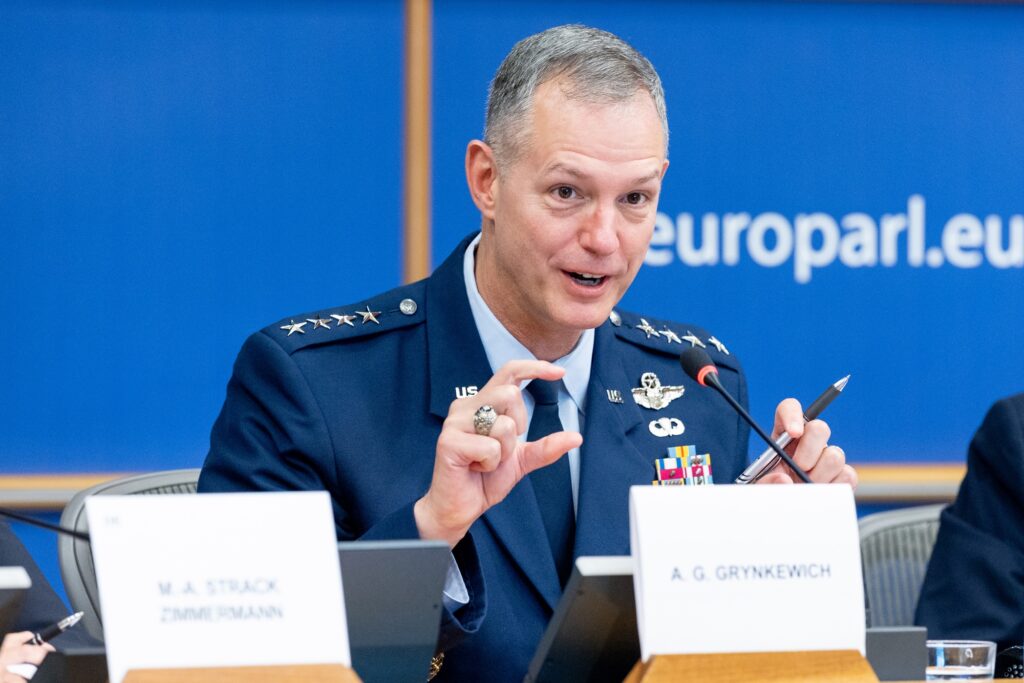
The first visit by a Supreme Allied Commander Europe to the European Parliament was always going to be heavy with symbolism. When General Alexus Grynkewich, NATO’s SACEUR and commander of American troops in Europe, addressed the Committee on Security and Defence (SEDE) on Monday, 28 September, the substance matched the symbolism full well.
What followed was one of the most candid exchanges between a senior American military officer and European political bodies in recent memory. Three themes dominated: how far Europe can still count on the US, how the alliance should respond to Russia’s escalating hybrid campaign, and whether the European Union can use its regulatory muscle to enforce NATO standards.
State-directed sabotage is growing increasingly brazen. — US Gen Alexus Grynkewich, SACEUR
The reliability question hung over the room before a single question was asked. General Grynkewich framed it carefully in his opening remarks, describing a strategic pivot that Washington has chosen to call NATO 3.0. “European and Canadian allies are assuming more responsibility for the conventional defence of Europe, while the US remains committed to providing critical but more limited support,” he said.
Recalibration in the offing
The formulation was deliberate. “Critical but more limited” is not the language of an unconditional guarantor. It is the language of a partner recalibrating its terms.
The general was careful not to alarm. He pointed to the Ankara summit declaration, where every head of state and government signed a commitment to Article 5. “I was in the room and I can tell you that the feeling of solidarity and collective responsibility for each other’s defence and working together to secure the North Atlantic was evident from every single head of state and government that was in that room,” he said. Yet the very need to invoke the mood of a room as evidence of American reliability tells its own story.
MEP Wouter Beke (EPP/BEL) pressed directly on the point, asking whether Europe could count on American solidarity if a member state invoked Article 5 in response to a hybrid attack. General Grynkewich referred him to the Ankara declaration and declined to go further.
On the Allied Reaction Force, he offered a clarification that will have registered in several capitals: “The US has, of course, troops in Europe that are ready to react and participate in other ways, like the forward land forces in Poland, but not part of that Allied Reaction Force.” American troops, in other words, are not embedded in NATO’s most immediately deployable contingency instrument.
A commitment redefined
On the ongoing American force-posture review, he was studiously uninformative. “The process is ongoing. There’s been no decision made. There’s no predetermined outcomes.” European defence planners, who have been told by experts that replacing American capabilities in Germany and Poland alone could take years, will find little comfort in that formulation.
What General Grynkewich offered instead was a vision of complementarity. “NATO brings the command structures, the operational and military expertise that we need to deter high-end conflict or to fight that high-end conflict in defence of our territory and our peoples,” he said. The European Union, he argued, brings “powerful economic, regulatory and financial instruments that can build societal resilience, fund dual-use infrastructure and protect our critical supply chains”.
The US remains committed to providing critical but more limited support. — Alexus Grynkewich
Whether the division of labour holds under pressure is the question European governments are quietly asking. And if the reliability of the US is the slow-burning anxiety, Russia’s hybrid campaign is the immediate emergency. General Grynkewich described a qualitative and quantitative shift. “State-directed sabotage is growing increasingly brazen,” he told MEPs, citing the discovery of drones carrying military-grade explosives near a large cargo aircraft in Leipzig, Germany, and the incident in which a Russian frigate fired flares at a Danish helicopter.
Hybrid war, escalating brazenness
“These are clear examples of attempts to instill fear and fracture our unified support to Ukraine,” he said. “It isn’t working.” The Danish response, he argued, offered a template. After the flare incident, Copenhagen fast-tracked a military aid package worth DKK 1.8bn to Kyiv.
General Grynkewich commended the approach explicitly: “If there is a hybrid attack on your country, reinforcing the will to support Ukraine will show the Russians that their strategy isn’t working and maybe have them back off that strategy.”
His recommendations on responding to hybrid attacks structured around three steps: share intelligence to build a common operating picture, attribute attacks publicly once confidence is established, and coordinate national responses before acting. On attribution, he was emphatic. “Once we have confidence in the attribution, we do need to make that public. The bringing of that attribution out publicly will let state sponsors know that we understand what they’re doing, and that increases costs on them.”
On coordination, he warned that if several nations each chose a sovereign response to a cluster of attacks without consulting each other, “we could find ourselves presenting a different picture to the state sponsor, the adversary, than we would want”.
The airspace question
MEP Pekka Toveri (EPP/SUO), a former head of Finnish defence intelligence, raised the question of delegated authority to use force. He argued that long chains of command, ending with politicians reluctant to act, were an invitation to Russian provocation. General Grynkewich’s answer was direct.
He described how, following a mass drone incursion into Polish airspace last September, Dutch F-35 pilots were given authority to engage without calling up the chain of command. “Those pilots knew what their task was, and they were able to take out those drones at the moment,” he said.
The subsequent Eastern Sentry programme replicated those authorities across nearly every air-defence sector on the eastern flank. Russia has since been “much more careful to avoid coming across the border with drones in the Baltics or into Poland.” The deterrent effect, General Grynkewich argued, has been measurable.
The broader lesson he drew from Ukraine was that the alliance must resist the temptation to simply copy what Kyiv has done. “If I came to you with a plan for long-term high-attrition, drawn-out warfare as SACEUR, you should all fire me,” he said. The alliance has asymmetric advantages. The task is to project where technology will be in the next conflict — not to re-fight this one.
Enforcing standards, closing gaps
MEP Tobias Cremer (S&D/DEU) identified a structural gap: the EU has financial and regulatory power but no mechanism to enforce NATO standards, partly because no formal NATO-EU cooperation agreement exists. He asked whether General Grynkewich favoured creating one. The general was supportive in spirit but cautious on specifics. “I think stronger EU and NATO cooperation is always going to be a good thing,” he said, adding that he would take the question back to the office of the Secretary General.
MEP Michael Gahler (EPP/DEU) sharpened the point. NATO has agreed standards but no treaty-violation mechanism to enforce them. His proposal: make those standards binding EU technical regulations, applicable to all member states. General Grynkewich’s response was unambiguous in direction if not in detail.
I can tell you that the feeling of solidarity and collective responsibility for each other’s defence (…) was evident from every single head of state and government that was in that room. — Alexus Grynkewich
“I am certain that the EU could do a lot to encourage nations, whether it was mandatory or there were certain incentive structures that you put in place for that. Anything that you all can do to encourage nations to adhere to those NATO standards is helpful for our interoperability,” he said.
That answer matters. It amounts to a serving SACEUR telling the European Parliament that it should use its regulatory authority to do what NATO cannot: compel compliance. The alliance sets the standards; the EU, with its legislative reach, has the tools to enforce them. The logic is clean. The politics, inside both institutions, are considerably messier.
Europe’s own pillar
MEP Lucia Annunziata (S&D/ITA) put the political problem plainly: if the EU remains purely a financial and regulatory actor while NATO provides the military muscle, public opinion will eventually demand clarity on whether the alliance is truly Europe’s ally. General Grynkewich acknowledged the risk.
“I do think it is very important that we explain to our publics what the threat situation is, what the challenges are that we’re facing, and then what the most effective way to meet those challenges is,” he said. He did not think the EU should try to replicate what NATO has built over 77 years. “Replicating that in the near term based on the current threat is probably much more disruptive than it is helpful,” he said. But driving collaboration and mutual reinforcement, he insisted, is essential. Messaging must be consistent.
On Ukraine’s future, General Grynkewich supported mutual—not one-directional—security guarantees. “Ukraine, once this war is over, will have one of the largest battle-hardened militaries in Europe that knows how to fight in this new environment of autonomy and electronic warfare. And we will want them to be a security contributor to European security, Euro-Atlantic security.”
That reframing (with Ukraine as a future security provider, not merely a recipient) was one of the session’s more striking formulations. What the visit made plain is that the architecture of European security is being renegotiated in real time. General Grynkewich left MEPs with a clear message: NATO is ready, Europe must do more, and the EU’s most underused instrument may be the one it already holds; i.e., the power to regulate.