Rabat and Madrid used tear gas and mass arrests to stop a second Ceuta push. The first wave’s chaos had taught both sides what to expect — but not how to deal with the crisis’ causes.
The Spanish enclave of Ceuta made global headlines in late July, when some 70,000 people crossed the border by swimming around the breakwater separating the city from Morocco. At least 88 died. The enclave, whose population is about 85,000, was overwhelmed. The crisis sent shockwaves through the European Union and the Schengen zone.
Six weeks later, it did not happen again, Bloomberg reports. Calls spread across social media for a repeat crossing on 15 August, a Spanish national holiday. Bogus posts on Facebook and WhatsApp promoted the claim that Spain would open its border. This time, authorities were ready.
Organised, ergo stopped?
“This Aug. 15 call for an invasion is a hoax. Nothing will happen,” said a Moroccan interior ministry official who identified himself as Salheddine, speaking at the entrance to the border post with Ceuta on Saturday. “The army is combing all the forests and hills surrounding Fnideq. Everything is under control.”
The contrast with July is instructive. Research into the original crossing suggests the first wave was not centrally directed. It was, instead, a digitally enabled collective movement. “This latest crossing may have been driven by peer-to-peer communication while at the same time being digitally coordinated and algorithmically amplified,” according to researchers who analysed social-media activity around both events.
In July, false messages claiming the border was open spread rapidly during the crossing’s early stages. Images of successful crossings created a cascade. Each visible success made the next attempt appear more achievable, encouraging others to follow. The Associated Press found that claims of smuggler coordination and deliberate Moroccan orchestration had not been publicly substantiated.
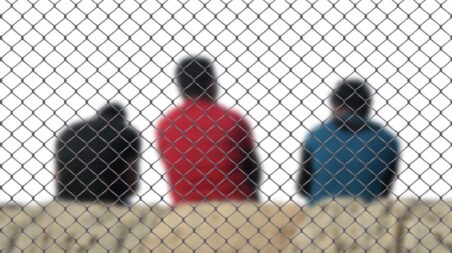
The August attempt had a different character. The date was pre-announced. The call to cross circulated via named platforms, on a named day, around a named pretext. That made it legible to authorities, and therefore far easier to defeat. Hundreds of sub-Saharan African migrants gathered in Fnideq, a Moroccan Mediterranean town, watched by a military helicopter hovering over a nearby hillside. They tried to force their way past security forces on foot. Moroccan forces fired tear gas, charged the crowd, and arrested 111 people. State media reported those unable to escape were marshalled into buses and vans parked nearby.
A fractured Europe
The EU moved quickly on the information front. Henna Virkkunen, executive vice-president of the European Commission for tech sovereignty, security, and democracy, said that both Meta and TikTok had “activated crisis protocols” to vet posts about Ceuta. “Earlier this week we met again with Meta and TikTok to advance our cooperation on the Ceuta situation,” Ms Virkkunen said on Saturday. “Both platforms have ramped up enforcement against human smuggling and disinformation.”
The political fallout from July, however, proved harder to contain. Spanish Prime Minister Pedro Sánchez, Europe’s most progressive leader on migration, found himself isolated and under fire. Leaders including Denmark’s Prime Minister Mette Frederiksen, Italy’s Prime Minister Giorgia Meloni, and German Chancellor Friedrich Merz signed a letter with 22 member states calling for immediate EU action. “The bloc cannot allow uncontrolled mass crossings, the instrumentalization of migration or other hybrid threats to create the perception that illegal entry into the European Union is possible,” they wrote.
Both platforms have ramped up enforcement against human smuggling and disinformation. — Henna Virkkunen, European Commission executive vice-president
Ms Frederiksen (a centre-left socialist like Mr Sánchez) went further. “It goes without saying that the EU must immediately take all necessary steps and consider all options, including a suspension of Schengen cooperation,” she said. “Uncontrolled immigration is a threat to Europe and Denmark.”
The politics of a pile-on
Mr Sánchez hit back. In a letter to the EU’s leadership, he expressed his “serious concern” about attitudes he said were “driven by prejudice, fake news, ignorance, or political interest”, condemning what he called a “selfish, polarizing and unlawful” reaction. He noted that more unauthorised entries occur through Italy, Greece, and the Western Balkans than through Spain. “Solidarity and empathy are optional,” he wrote on X. “Respect for European treaties and the data is not.”
The pile-on extended beyond Europe. US President Donald Trump, who has sparred with Mr Sánchez over NATO spending, weighed in during a Cabinet meeting. “It looks like an invasion of a country by hundreds of thousands of people,” Mr Trump said with his trademark fact-checking scrupulousness, coherence, and grasp of grammar. “And that same thing is going to happen to us if the Republicans don’t get elected, except worse, much bigger, much easier to get into.”
Italy imposed temporary border checks on non-EU citizens arriving from Spain. Polish Prime Minister Donald Tusk was blunt. “Poland has tightened asylum laws, border procedures, and has built effective barriers on its border with Belarus, which is the eastern border of the EU,” Mr Tusk said. “Spain must follow our example if Schengen is to survive.”
Barriers and their limits
The August failure should not be mistaken for a solution. Spain installed a 500-metre floating barrier at the Tarajal border crossing after July’s events. Morocco deployed a heavy military presence near the border and along major highways further south. This time around, both measures worked.
But the underlying conditions have not changed. Morocco’s statistics agency reports that roughly one in three people aged 15 to 29 is not in employment, education, or training. Participants in the July crossing spoke of low wages, scarce jobs, family pressure, and the belief that Spain might offer a viable future. The crossing, researchers argue, was not simply a migration event. It was a digitally enabled collective action, in which migration became a language of frustration, aspiration and political discontent, they say.
The bloc cannot allow uncontrolled mass crossings, the instrumentalization of migration or other hybrid threats to create the perception that illegal entry into the European Union is possible. — 22 EU members state leaders (in a letter to Brussels)
The vast majority of July’s arrivals have since returned to Morocco, according to Spain’s government. None are believed to have travelled on to the European mainland. But the forces that produced the first wave one remain entirely intact.