Western Europe endured its hottest summer on record in 2026, but the heat left more than temperature records behind. Rivers across the continent fell to their lowest flows in more than three decades, disrupting shipping, straining energy production and putting water supplies under pressure, according to a new Copernicus assessment.
The European summer assessment puts Western Europe’s average temperature at 21.7°C, 2.5°C above the 1991–2020 average and surpassing the previous record set in 2003. Europe as a whole recorded its third-warmest summer, with a record 52% of the continent reaching “very strong” heat stress at some point during the season.
“The consequences extended far beyond temperature records, affecting water availability, energy systems, transport, ecosystems and human health,” said Samantha Burgess, strategic lead for climate at the European Centre for Medium-Range Weather Forecasts, which operates the Copernicus Climate Change Service.
Low rivers put energy and transport under pressure
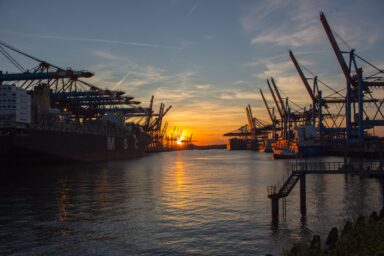
Prolonged dry conditions and repeated heatwaves left several major rivers with record or near-record low flows in July and August. They included the Rhine, Danube, Po, Loire, Rhône and Seine. The Copernicus findings connect those conditions to disruption of cargo transport and supply chains.
The Central Commission for the Navigation of the Rhine warned on 10 September that vessels were carrying significantly reduced loads, although navigation had continued throughout the low-water period. It said chemical, steel and oil industries depend on the river for supplies that rail or road often cannot deliver as efficiently. Better forecasting and vessels designed for shallower water had helped operators cope, but further investment would be needed to strengthen resilience.
The consequences extended far beyond temperature records, affecting water availability, energy systems, transport, ecosystems and human health.
— Samantha Burgess, Copernicus climate expert
Water shortages also put pressure on irrigation, hydropower generation, nuclear reactor cooling and freshwater availability. Rivers carry goods, supply farms and support electricity production, so reduced flows create problems well beyond the places experiencing the highest temperatures.
Heat stress spreads across Europe
Western Europe’s heat stood out for its persistence as well as its intensity. On 17 days, at least 60% of the region experienced air temperatures above 30°C, compared with 11 days in 2003. Exceptional warmth also extended beyond the core summer months into May and September.
The review’s heat-stress maps show that 52% of Europe’s land area reached at least “very strong” heat stress at some point during the summer. That is a measure of the area affected, rather than the number of people exposed or the duration of the conditions.
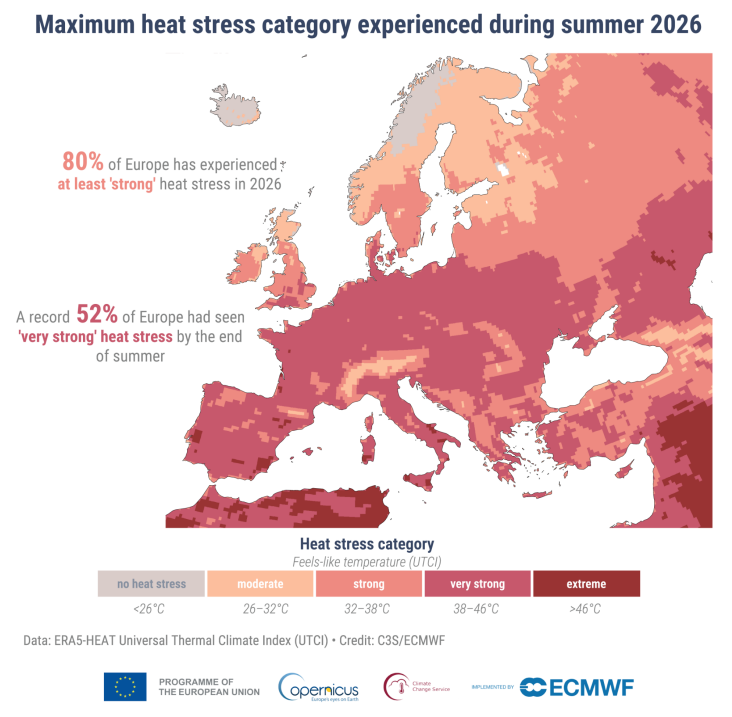
Copernicus measures heat stress using the Universal Thermal Climate Index. It combines air temperature with humidity, wind and radiation to assess the body’s response to its surroundings. The “very strong” category begins at a feels-like temperature of 38°C.
The summer’s records show why preparations must extend beyond heat warnings. Keeping goods moving on shallower rivers, maintaining electricity production and securing water supplies are increasingly part of Europe’s response to extreme heat.