The British defence giant is embedding itself in European supply chains, one small- or medium-sized company at a time. The numbers suggest the strategy is working.
Matthew Knowles is standing in front of an armoured vehicle at a prestigious spot in June’s Paris Eurosatory trade show. To the head of BAE Systems’ communications for Europe and the Americas, the deadly, mammoth-sized M109-52 Self-Propelled Howitzer is a ‘she’. It is also a case study in trans-European collaboration.
It is, he says, simply how the business works. “Take this vehicle for example. It’s a Dutch vehicle; the chassis were welded and assembled in Sweden. The turret and the complete assembly of the turret was done in the Netherlands.” The vehicle behind him is, in miniature, a portrait of what BAE Systems has become: a company that is British by origin and transatlantic by structure, but increasingly European by production.
Inside the tent
That matters because the question hanging over every non-EU defence contractor right now is whether the bloc’s ‘Made in Europe’ push will squeeze them out. The European Commission has made industrial sovereignty a condition of its rearmament agenda, and the European Defence Fund is designed, at least in part, to keep money circulating within EU borders. For a company headquartered in London, the concern is obvious.
BAE’s answer, delivered through Mr Knowles and amplified by its first-half 2026 results, is that it was already inside the tent before the argument began. The company counts around 2,200 suppliers in continental Europe, supporting what it says are approximately 90,000 jobs on the continent.
“We work with those small and medium-sized businesses in our supply chain,” Mr Knowles says. “Some of them may be several layers down in that supply chain working with our subcontractors.”
The model is not a British prime contractor dropping finished kit into European markets. It is a deeply embedded industrial network that happens to be managed from London. “Alternatively, some of the SMEs may well provide a really important niche capability working directly with us.”
Ramping up
The network is also growing. At Hägglunds in Sweden, BAE expects a 400 per cent increase in production capacity. At Bofors, production rates have already risen three- to fourfold across several product lines. The company has recently acquired a Swedish supplier of precision mechanics and component machining and is integrating it into Bofors to strengthen the supply chain.
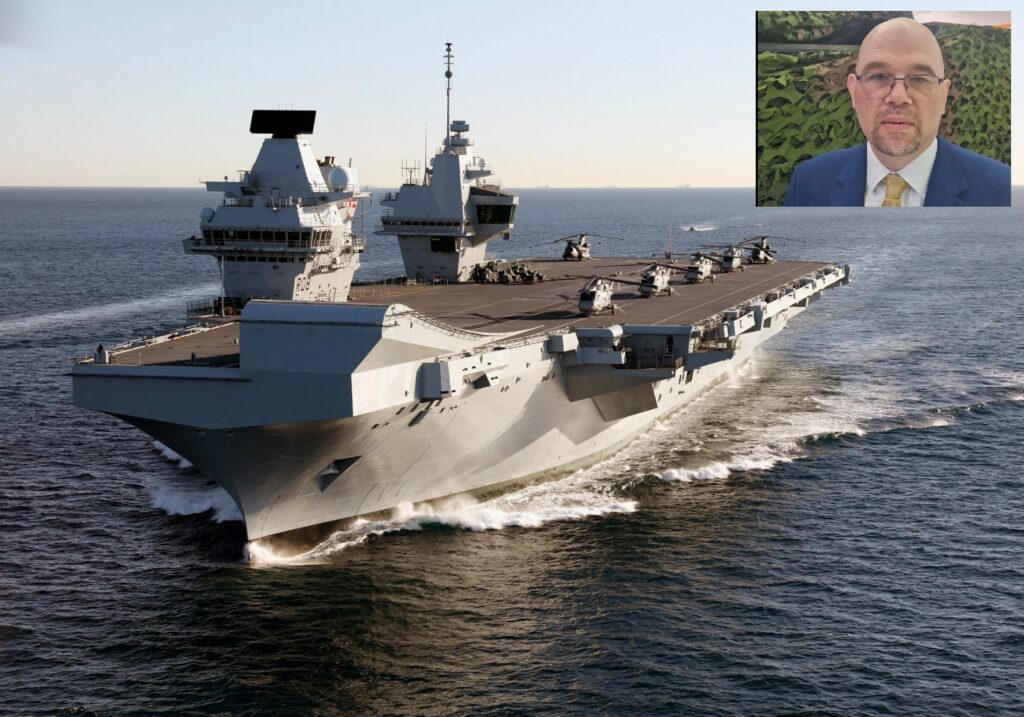
In the Czech Republic and Slovakia, Mr Knowles notes, “a lot is already done in-house, in-country. All of our customers do that, which means you have ten user nations that have production lines within the country. And that allows us to actually ramp up and keep up with the speed of the huge demand of the market of today.”
That demand is not subtle. “(It) has grown enormously,” Mr Knowles says, “mainly because of the war in Ukraine. That’s no secret to anyone.” He is direct about what preceded it: European governments had been, in his words, “skimpy,” cutting defence budgets for years before February 2022 shook the continent into a different posture.
The backlog economy
Now, he says, “that shook up Europe, woke up Europe.” The result is a procurement surge running across land systems, munitions, air defence and electronic warfare simultaneously. BAE’s financials reflect that surge with unusual clarity. The group ended 2025 with sales of £30.7bn (€35.87bn) and a record order backlog of £83.6bn.
By the middle of 2026 the backlog had edged higher still, to £84.0bn. European order intake in 2025 reached £7.5bn, roughly 20 per cent of the group total, and European sales rose 26 per cent year on year to £3.6bn. The company is guiding for 2026 sales growth of seven to nine per cent and operating profit growth of nine to 11 per cent, with management signalling that even those figures may prove conservative.
To turn that backlog into delivered equipment, BAE is spending heavily. Capital expenditure reached £400m in the first half of 2026 alone. Chief Financial Officer Brad Greve has been explicit about the logic: “Our priority is investing internally, you’re seeing higher CapEx, you’re seeing higher R&D.” Management has concluded that accelerating organic growth tied to the existing backlog offers better returns than acquisitions at current market valuations.
Missiles and machines
The most striking single number in the investment programme belongs to MBDA, the missile business in which BAE holds a 37.5 per cent stake alongside Airbus and Leonardo. MBDA plans to invest €5bn across its European manufacturing base between 2026 and 2030, covering sites and buildings, machining capacity, tooling, test equipment and the digitalisation of internal systems.
Its order book stood at €48bn at the end of June 2026, almost eight times annual revenue. “Obviously, the €48bn backlog that MBDA has, it requires a lot of investment to deliver,” Mr Greve said on the earnings call. The ambition is to build the industrial capacity needed to work through it as fast as possible.
You have ten user nations that have production lines within (a single) country. That allows us to actually ramp up and keep up with the speed of the huge demand. — Matthew Knowles, BAE Systems
The acquisition of the Prague-based training technology company Bohemia Interactive Simulations, now part of BAE Systems, illustrates a quieter dimension of the same strategy. The firm develops virtual simulation systems, including a first-person-view drone training platform called Flow State. “There are many different ways of working with SMEs,” Mr Knowles says, “and we find all of those ways useful.”
Useful ambiguity
Sometimes a supplier sits deep in the sub-tier chain. Sometimes it offers a niche capability worth acquiring outright. The drone training system is a case in point: in an era when first-person-view drones have become a defining feature of the war in Ukraine, the ability to train operators at scale and at low cost is, as Mr Knowles puts it, “clearly important right at the moment.”
What emerges from the numbers and from Mr Knowles’s account is a company that has, perhaps more by design than accident, positioned itself well for the European rearmament moment. It is not trying to be a European champion in the political sense. It remains British, transatlantic and unapologetically commercial.
But it has built enough industrial presence on the continent, through joint production, distributed supply chains and targeted acquisitions, that the ‘Made in Europe’ question is harder to answer than it first appears. The chassis may say Sweden, the turret may say Netherlands, and the programme management may say London. But the jobs, the suppliers and the delivered capability are spread across the map in ways that make a clean distinction between European and non-European production increasingly difficult to draw.
For many a player such ambiguity would be a problem. For BAE Systems, it is the strategy.