Mark Carney proposed deep cooperation on critical raw materials, energy, artificial intelligence, and defence to build mutual resilience against economic coercion.
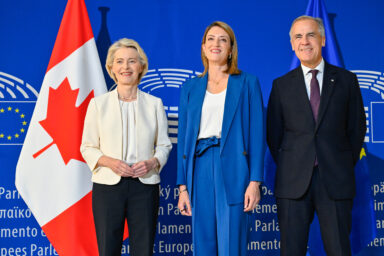
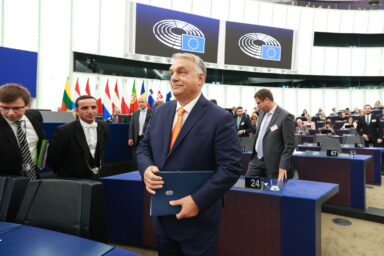
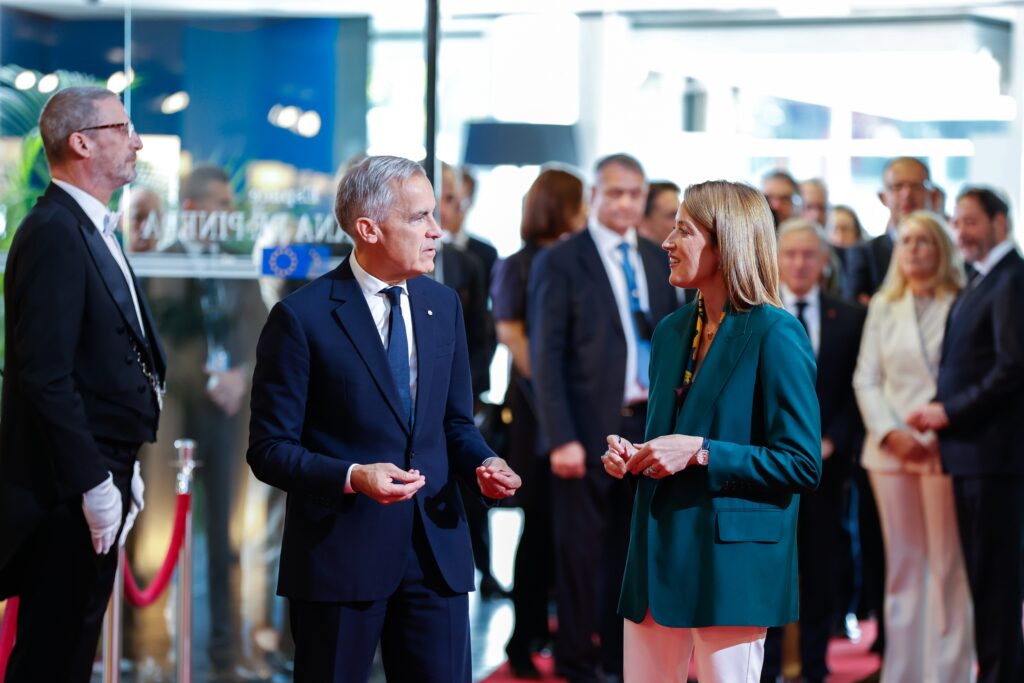
European lawmakers gave Mark Carney a rupturous welcome in Strasbourg’s Hemicycle. Upon arrival, the Canadian Prime Minister appeared to shake dozens of hands at a time while selfies abounded; some lawmakers even chose Canada’s iconic Maple Leaf hockey jerseys to mark the occasion.
Then it came to business, albeit heavy on symbolism. Mr Carney opened his address by speaking about shared values. He used the story of Goethe’s oak at Buchenwald as a symbol of ideals that must be actively defended. He quoted Goethe’s Faust—”freedom in life must be earned every single day”—to argue that democratic values are never permanently secured.
Mr Carney linked this to the story of a WWI Canadian lieutenant. He carried acorns from Vimy Ridge home to Ontario in 1917. A century later, grafts from those trees are growing in France. Mr Carney offered this as a metaphor for the Canada-EU relationship. Values and people carried back and forth across the Atlantic for generations.
Countering a ferocious storm
He then turned to the present. The international order, he argued, faces a ferocious storm. Climate disruption, the erosion of democratic norms, the weaponisation of trade, weakened multilateral institutions, and technology platforms that seek to set their own rules and “steal our children’s childhoods”. No single country can weather this alone. A forest, he said, survives where a single tree falls, because its roots intertwine.
Let us now deepen those roots, widen this canopy, and grow a transatlantic forest under which our citizens can flourish as free people on free ground every single day.
— Mark Carney, Canada’s prime minister
The core of his speech was a proposal for a deep Canada-EU strategic alliance. He welcomed President von der Leyen’s suggestion of Canada becoming the EU’s first associate member. He outlined specific areas for cooperation: critical minerals, defence, artificial intelligence, energy security, space, payments, and digital trade. The PM proposed Canadian membership of Erasmus Plus and the Horizon research programme.
He was explicit that this was not about forming a rival power bloc, but about building resilience so that no outside actor could “impair our sovereignty, threaten our territorial integrity or undermine our freedoms”.
He closed by returning to the Vimy oaks. “Let us now deepen those roots, widen this canopy, and grow a transatlantic forest under which our citizens can flourish as free people on free ground every single day,” he said.