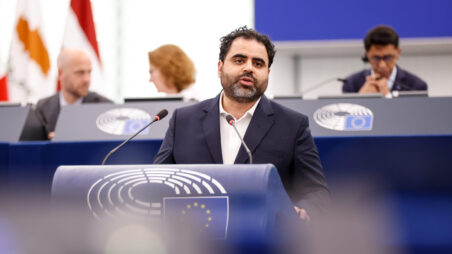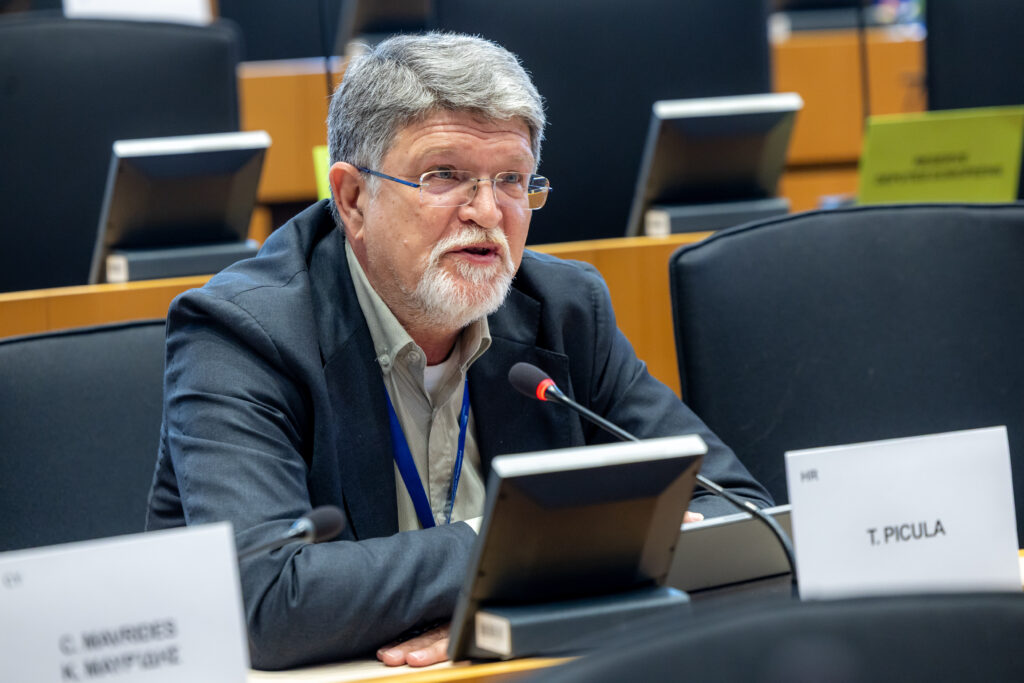
€115 million for small and medium-sized innovative defence companies is approved and ready to go where Europe most needs it. According to its co-rapporteur Tonino Picula (S&D/HR), the new programme won’t end its reliance on foreign technology. But it is a step in to right direction to help prevent the next European defence breakthrough from being developed, owned or controlled elsewhere, he says in an interview.
The European Parliament has approved the AGILE programme on 6 November, member states gave its final green light in a week later. Do you believe it can realistically address Europe’s technological and industrial dependencies, or is it primarily a political experiment ahead of the EU’s next long-term budget (MFF)?
No one should pretend that €115 million will end Europe’s technological dependencies. It will not, and it was never designed to. But calling AGILE a political experiment misses the whole point. It is a practical test of whether the European Union can fund defence innovation at the speed the technology now demands.
That is a question we have never been able to answer, because our instruments were simply not built for it.
Dependencies are rarely created by one big decision. They build up quietly. Every time a promising European company runs out of money, it is bought by a non-European investor, or takes its engineers and patents where it is more welcome. AGILE targets exactly that moment. By keeping innovative firms, their know-how and their supply chains in Europe, it tackles dependency where it starts, rather than trying to buy our way out of it later at a much higher price.
On its own, it is a small step. But it points in the right direction, and it gives us something concrete to build on.
Every time a promising European company runs out of money, it is bought by a non-European investor, or takes its engineers and patents where it is more welcome.
— MEP Tonino Picula (S&D/HR)
What level of investment would actually be needed to make a structural difference?
The order of magnitude is already on the table. The Commission has proposed around €131 billion for defence, security and space within the European Competitiveness Fund for the next long-term budget, roughly five times what we spend today.
That is the right ambition, but money alone will not do it. Without joint procurement and a genuine single market for defence, we would simply be financing twenty-seven fragmented markets more generously. Structural change comes from scale, coordination and the political will to buy European.
Can Europe build an independent defence industry while remaining dependent on foreign technology?
Not fully, and we should be honest about that. No country in the world, not even the largest powers, produces every component of its weapons on its own territory. Complete self-sufficiency is neither realistic nor necessary. The real question is not whether Europe depends on others, but on whom, for what, and whether someone else can decide when our equipment works and when it does not.
There is a big difference between buying screws from a partner and depending on a foreign government for the software that runs a fighter jet, the satellite signal that guides a missile or the licence needed to export a system we helped to build.
The real question is not whether Europe depends on others, but on whom, for what, and whether someone else can decide when our equipment works and when it does not.
— MEP Tonino Picula (S&D/HR)
The first is ordinary trade. The second is a strategic vulnerability.
The war in Ukraine has shown how quickly such vulnerabilities become real, when access to a communications network or a supply of critical parts can depend on a political decision taken far away.
So independence for Europe should mean control over what really matters: the critical technologies, the key components and the ability to maintain, upgrade and produce our own systems without asking permission. That is why we insisted in AGILE on firm safeguards against strategic dependencies and on European control over the companies receiving funding.
At the same time, Europe should not close itself off. Cooperation with trusted partners will remain essential, including with Ukraine, whose industry is learning faster than anyone. But partnership works best between equals, and today Europe is too often a customer rather than a partner. Changing that is the whole point.
Less administration, more cooperation
Could AGILE genuinely change the structure of Europe’s defence industry or will it ultimately reinforce the existing concentration of market power?
The concern is legitimate. Europe’s defence market has long been dominated by a small number of large companies, often closely tied to their national governments. Any new source of money risks flowing to those who already know how to apply for it, have the lawyers to prepare the paperwork and the contacts to win the contracts.
AGILE was designed precisely to avoid that. It is aimed at small and medium-sized companies and start-ups, which can apply on their own, with simple procedures and without the administrative weight that usually favours established players. It also opens the door to firms that have never worked in defence before, and to countries and regions outside Europe’s traditional defence hubs.
For a member state like Croatia, which has capable engineers and innovative companies but no large defence conglomerate, that matters a great deal. This does not mean the big companies have no role. A start-up with a good idea usually needs a larger partner to integrate its product into complex systems and deliver it at scale.
The goal is cooperation, not absorption. A healthy industry is one where small innovators can grow alongside the large players, keeping control of their technology, rather than being swallowed the moment they become interesting.
Setting defence against social policy is a false choice. The answer is a larger budget, financed in a fairer way.
— MEP Tonino Picula (S&D/HR)
How can the EU guarantee that speed will not come at the expense of transparency and human rights, particularly when technologies developed for civilian purposes are adapted for military applications?
Speed in AGILE comes from cutting paperwork, not principles. A shorter application or a simpler way of reporting costs does not mean fewer ethical checks. Every project funded with European money still has to respect European law, international humanitarian law and fundamental rights. During the negotiations, Parliament made sure the programme comes with stronger oversight, clear transparency obligations and rules on the ethical use of artificial intelligence. A fast programme needs firm guardrails precisely because it moves money quickly.
Transparency is also in our own interest. European citizens are being asked to accept higher defence spending at a difficult time. They will only support it if they can trust that their money is used to protect them, not to build tools that could one day be turned against the very values we are defending.
Should the EU establish clear guarantees that additional defence spending will not reduce funding for its social priorities?
Yes, and those guarantees should be written into the next MFF, not left to good intentions. Europe needs to spend more on its security, but it would be a serious mistake to pay for it by taking money from schools, hospitals, regional development or support for workers. A society that feels left behind is not a secure society. It is fertile ground for those who want to divide us, including from outside.
The risk is not theoretical: in the current negotiations on the next budget, some of the wealthiest member states are already calling for deep cuts, including to cohesion policy and agriculture. At the same time, the Commission’s proposal merges many of these funds into national plans, which makes it easier to quietly shift money from one priority to another. That is why the European Parliament, and my political group in particular, insists on clearly protected funding for social and regional policy, including a standalone European Social Fund with its own dedicated resources.
Setting defence against social policy is a false choice. The answer is a larger budget, financed in a fairer way.