The plan is to guard the European Union’s border with Russia and Belarus by 2036. It may stall over fragmentation, both in mismatched systems and bickering over funds.
The year is 2036. At a level crossing near the Polish-Belarusian border, a young farmer waits less than two minutes for a freight train. He recalls his father telling him decade-old stories about long-range drones flying overhead; each of them would have meant an hour of alerts. Now his phone stays silent.
The train carries Finnish-made components to a depot in Romania. It runs on a rail corridor certified to NATO standards and crosses four borders without stopping for paperwork. Beside the tracks, a grey tower turns its radar slowly. Locals call it “the lighthouse”.
Further north, a Latvian conscript trains on a battle-management screen. It shows the same picture as screens in Helsinki, Bucharest, and Kyiv. Ukrainian engineers designed the system. Her instructor says its greatest success is that it feels dull.
In Brussels, the quarterly review takes eleven minutes. The budget came in within the €60-€100bn range. Arguments over cohesion money are a footnote. On the Finnish side, a sign on a new earthwork reads “Cycling route, 14 km”. Families picnic on the fortifications.
A best case, not a bet
Now, let us wake up from the sweet dream. The above is the best possible outcome, a hypothetical. Every detail is imagined — as things stand in October 2026, the project is young, its budget is provisional, and the obstacles are many. A bleaker scenario is likely.
Eastern Flank Watch is the most expensive out of five so-far announced European Defence Project of Common Interest. It aims to harden and defend the EU’s eastern land and maritime borders. It spans ground forces, air and missile defence, command networks, obstacles to enemy movement, and supply routes.
Finland is ready to take the lead with Poland … (but) Eastern Flank Watch must be backed by EU money.
— Petteri Orpo, Finland’s prime minister
Its price tag is an indicative €60bn to €100bn through 2036. The plan—so far unpublished in line-item form—rests on slide decks circulated to the Parliament’s security and defence committee (SEDE). The figures remain provisional.
The money, needless to say, depends on talks over the EU’s long-term budget. Non-participating members may see less cohesion funding as security takes a bigger share. Some may perceive an ‘East-first’ bias. That tension runs through the whole project.
How it began
The project took shape at the Helsinki Eastern-Flank Summit. Eight member states declared support there: Finland, Sweden, Estonia, Latvia, Lithuania, Poland, Bulgaria, and Romania.
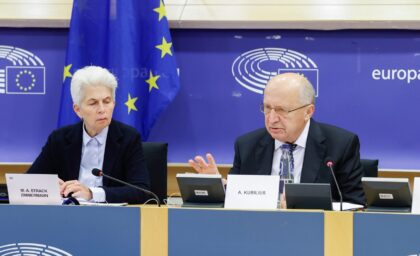
Finland and Poland co-lead. That gives the Nordic-Baltic states and the Visegrád and Black Sea groups equal weight. Finnish Prime Minister Petteri Orpo set out the Finnish position at the summit. “Finland is ready to take the lead with Poland … (but) Eastern Flank Watch must be backed by EU money,” he said.
Money was also on the mind of Polish Prime Minister Donald Tusk. His objective is to “use effectively EU funds and … tough and united argumentation” to secure financing. Both leaders know that a flagship without funding is only a slogan.
Who is in
The circle has grown. Later Commission briefings cite “13 member states plus Norway and Ukraine” as full participants. They have not yet named additional five member states which are said to have expressed interest in the project. The door, however, stays open. The Commission’s factsheet says the flagship “remains open to additional EU and associated partners”.
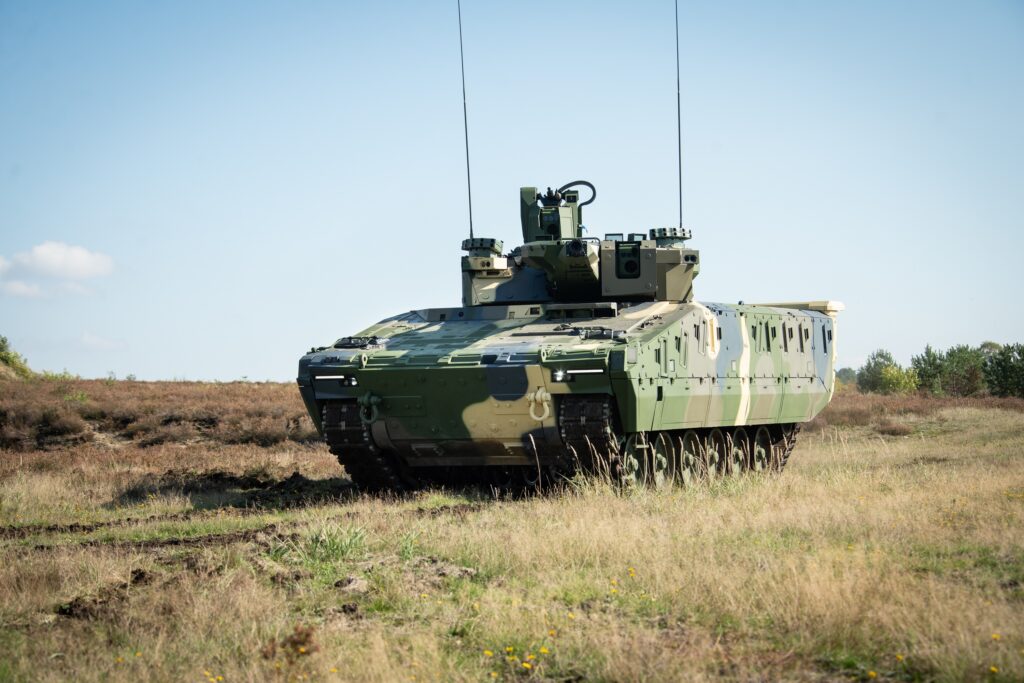
Industry is already moving. The German contractor Rheinmetall plans a big expansion in Romania. It would build armoured vehicles, including Lynx infantry fighting vehicles, plus air-defence systems, medium-calibre ammunition, and equipment for the navy and air force.
Rheinmetall says its €5.7bn Romanian Skyranger and Lynx deal will “strengthen NATO’s eastern flank” and create 2,500 local jobs. Separately, Romania runs a programme worth about €3bn to buy infantry fighting vehicles.
Where the money goes
The biggest pillar is ground and air defence equipment, with 35 to 40 per cent of the money. It covers infantry fighting vehicles, short-range air defence (known as SHORAD), counter-drone systems, and missile batteries. The plan calls for 26 composite “border modules”. Each combines layered sensors with short-range air defence. Lynx vehicles, Skyranger 35 air-defence systems, and national systems feature in the design.
The second pillar takes 20 to 25 per cent. It covers C4ISTAR, an acronym for command, control, communications, computers, intelligence, surveillance, target acquisition, and reconnaissance. In plain terms, it is the network that lets sensors, commanders, and weapons share one picture.
The planned system is a federated battle-management system based on Ukraine’s DELTA architecture. ‘Federated’ means each country keeps its own system, but all of them connect. This should, in theory, smoothen the edges of fragmentation, Europe’s defence long-time scourge. The command backbone is due online in the fourth quarter of 2026.
Walls, roads, and stockpiles
The third pillar, border fortifications nicknamed the Ground Wall, takes 10 to 15 per cent. Its aim is counter-mobility, which means slowing an enemy’s movement. It comprises anti-tank obstacles, minefields linked to sensors, and deep earthworks along a 3,200km stretch of the EU’s eastern frontier. Sector templates are due for validation in 2027. Continuous building follows from 2028 to 2033. The wall is meant to be built in stages, not in one push.
The fourth pillar, military mobility, takes 15 to 20 per cent. Its deliverables include hard-surface rail and road upgrades, work on Danube and Baltic ports, and modular depots, i.e., storage sites that can be assembled in sections. The first north-south corridor should reach NATO standards in 2030.
The fifth pillar covers training, research, stockpiles, and cyber defence, with 10 to 15 per cent. It includes a joint munitions reserve, testbeds for counter-space systems, and cyber-ranges. Together, equipment and networks take at least 55 per cent of the money.
The clock
The Commission’s official Q&A material sets ambitious dates. The capability coalition was established and financed in the first quarter of 2026. Initial border modules, meaning drone, radar, and SHORAD clusters, are to reach basic operating capability by the end of 2026. The project is still on track, at the policy level, for initial operational capability by the end of the year. However, available public information indicates that it is still in the establishment and coordination phase rather than being a fully deployed border system.
European Commission spokesman Thomas Regnier said recently that Eastern Flank Watch was to “begin the launch … in the first quarter of 2026 and achieve initial operational capabilities by the end of the same year”. (He said that holds regardless of any US troop redeployments.) A networked string of modules on all critical crossings follows by 2028. Full theatre coverage comes by 2036.
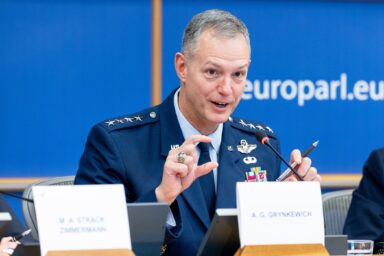
SEDE’s briefing notes call the project “essential to deter hybrid, cyber, maritime and conventional threats”. They also stress tight coordination with NATO. Brussels thus presents the project as a complement to the alliance, not a rival.
The stakeholders
The cast is wide. Helsinki and Warsaw lead. Brussels coordinates and, it hopes, pays. Norway and Ukraine take part as partners outside the EU. Industry supplies the kit, and Romania hosts much of the production.
Saab expects higher eastern-flank demand for air-defence sensors and counter-drone systems. Market commentary says “accelerating European procurement decisions” could add “low-to-mid single-digit percentage upside” to its revenues in 2026 and 2027.
(Eastern Flank Watch) is essential to deter hybrid, cyber, maritime and conventional threats.
— SEDE briefing notes
General Dynamics European Land Systems and Lockheed Martin appear in Commission non-papers, or informal discussion documents, as “potential contributors”. No formal contract announcements were on record at time of writing in early October 2026.
Analysts at the Eastern Flank Institute see two sides to local production. Rheinmetall’s Romanian plant shows economic opportunity, they argue, but also the danger of national cost overruns if coordination falters.
A cautionary tale
Rheinmetall’s Romanian record is mixed. Its infantry fighting vehicle contract has drawn controversy over cost overruns. Romania’s defence minister has publicly expressed dissatisfaction. The company has stepped up its communications since.
Yet the expansion plan reaches wide. Rheinmetall says it will bring over 100 Romanian companies into its supply chain. The expansion is part of a broader regional trend towards defence autonomy and shorter supply chains.
Every big programme has losers. The first group comprises defence firms whose products overlap with the winners’, such as non-selected SHORAD providers. One speculative example is MBDA, a European missile maker. If the project faltered, MBDA could market its Aster missile system as an alternative (even as nothing has suggested so far that the company has acted).
Who loses
The second group of losers is non-participating members. France is a speculative example. It has historically been cautious about EU defence initiatives that might dilute its national industry. It could object if cohesion money tilts eastwards. Again, nothing on record shows it doing so.
The third group is civil society. Parts of it—worried about militarisation and the environmental impact of fortifications—may resist. The European Network Against Arms Trade is a speculative example. It might campaign through petitions and demonstrations.
The border in question
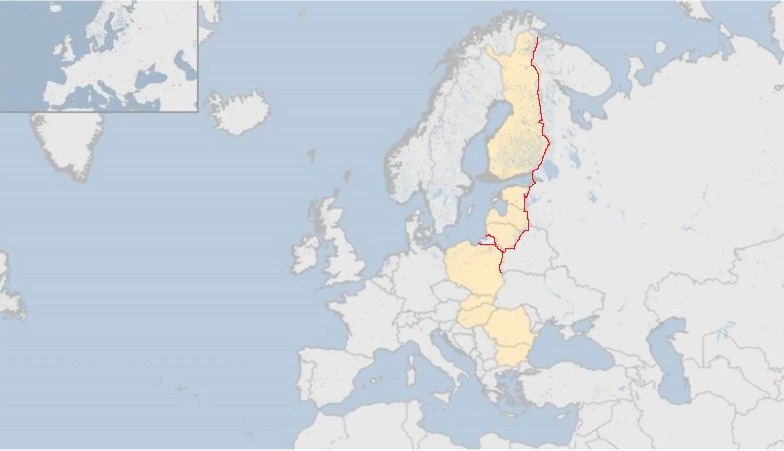
The fourth group is Russia and Belarus. Their freedom of action along the border shrinks. Moscow-linked logistics operators could also suffer under new infrastructure security rules. Moscow is unlikely to accept that quietly.
A new Russian tool deserves attention. Investigations by Der Spiegel and The Insider describe “Center 795”, formally Military Unit No. 75127, as a sabotage structure of about 500 personnel under Kremlin control. The comment attached to those reports calls it a body combining kinetic, cyber, and influence operations in one planning cycle.
What can go wrong
Several risks are already visible. Requirements may fragment. Thirteen or more member states must reconcile national industrial interests. Similar Franco-German air-combat projects have stalled. Eastern Flank Watch has more partners and fewer shared habits.
Politics may bite. Central European states demand priority funding. Southern and western members may contest that. Cohesion money, once again, sits at the centre of the quarrel.
Technology may disappoint. Stitching together different radars, electronic-warfare tools, and command-and-control systems across NATO and EU lines is a hard engineering task. Commission technologists stressed that in SEDE briefings.
Costs may balloon. The Romanian vehicle contract is the warning. If a single national contract can overrun, a pan-European programme worth up to €100bn has more room to do so.
The nightmare
What would the worst case look like? The following paragraphs aim to sketch out such a situation: the year is 2030, and the project has stalled.
In a Brussels committee room, a Polish official counts the empty chairs. Paris has sent no delegate to the last three meetings. In this fiction, French President Marine Le Pen has called the project “an eastern luxury” and ordered her ministers to block its financing in the Council. The budget talks reach a dead point.
Outside, the lobbying is relentless. Firms that lost the air-defence contracts fund studies that question the selected systems. Their lawyers challenge every tender. Each challenge adds months. Online, thousands of accounts share a photograph of a half-built fortification, captioned “Your taxes, buried in mud”.
The Skyranger-and-Lynx deal will strengthen NATO’s eastern flank, creating 2,500 local jobs.
— Rheinmetall statement
Investigators later trace some of the money to intermediaries linked to Moscow. Few voters read the findings. Polls shift. In Lisbon, Madrid, and Rome, majorities say the money should go to hospitals and schools. At the border, the lighthouse towers number six, not 26. Finland and Poland still build, waiting for funds that never arrive.
The verdict
Reality will land somewhere between the two. Eastern Flank Watch has moved from concept to EU-backed flagship. It has an ambitious budget, over a half of EU member states as participants, and an aggressive timeline for its first capabilities.
Two things decide the outcome. One is whether funding cohesion holds; the other is whether engineers can make mismatched systems work together. If both hold, the project promises a step-change in deterrence and mobility along the EU-NATO frontier.
If not, it risks becoming another reminder of Europe’s defence-industrial fragmentation — a flagship that sailed without a crew. The test will not be signing ceremonies. It will be money that arrives, modules built on time, and networks that talk to each other. In the best case, success looks dull.