
Euro area businesses face higher borrowing costs and falling profits, yet investment continues to grow, albeit modestly. The ECB’s latest survey also flags a caveat: changes in respondents complicate its findings on price and inflation expectations.
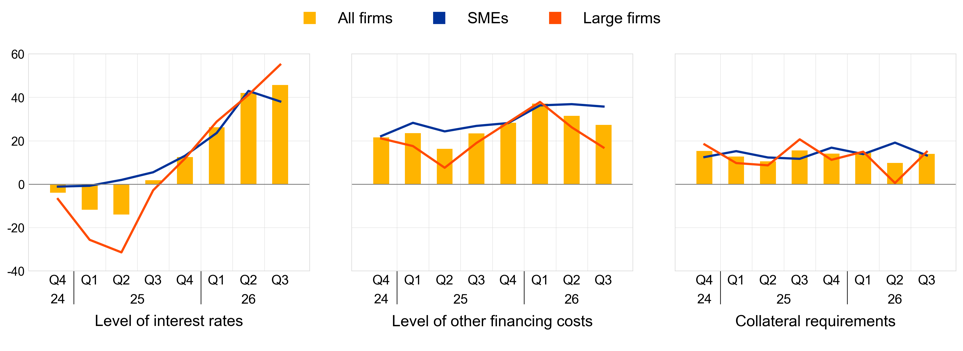
The ECB’s survey, published on 26 October, found that a net 46 per cent of firms reported rising bank-loan interest rates, up from 42 per cent in the previous quarter. The figures are balances: the share reporting an increase minus the share reporting a decrease. They do not measure how much interest rates rose.
Higher borrowing costs as profits weaken
Large companies reported rising loan rates more widely, with the net balance increasing from 41 per cent to 55 per cent. Among small and medium-sized enterprises, it fell from 43 per cent to 38 per cent, although the balance still pointed towards higher costs. Collateral requirements also tightened more widely, while pressure from fees and commissions eased.
Firms continued to perceive the general economic outlook as the main factor constraining the availability of external financing. — The ECB report
The ECB identified the economic outlook as the “main factor constraining the availability of external financing”. Loan availability deteriorated, and more firms expected access to external funding to worsen over the following three months.
The underlying report shows pressure extending beyond borrowing. A net 21 per cent of firms reported falling profits, compared with 16 per cent previously. Turnover improved only slightly overall, with smaller businesses reporting broadly unchanged sales.
Nevertheless, investment continued to increase. A net 8 per cent reported higher spending on fixed assets, up from 6 per cent. Financing obstacles affected 7 per cent of businesses that considered bank loans relevant, compared with 5 per cent previously. The findings therefore point to mounting pressure rather than a general halt in business investment or access to credit.
Warning over apparent jumps in price expectations
The survey’s forecasts require particular care. First-time respondents formed most of the latest sample, which the ECB said “makes it challenging to interpret the responses to the numerical questions”. Its release therefore compares the full sample with businesses interviewed in both rounds.
Among repeat respondents, expected selling-price increases averaged 3.6 per cent over the next year, compared with 7.1 per cent across the full sample. Expected wage increases were also lower among returning firms. The difference matters: changes in who answers can affect the headline result alongside changes in businesses’ expectations.
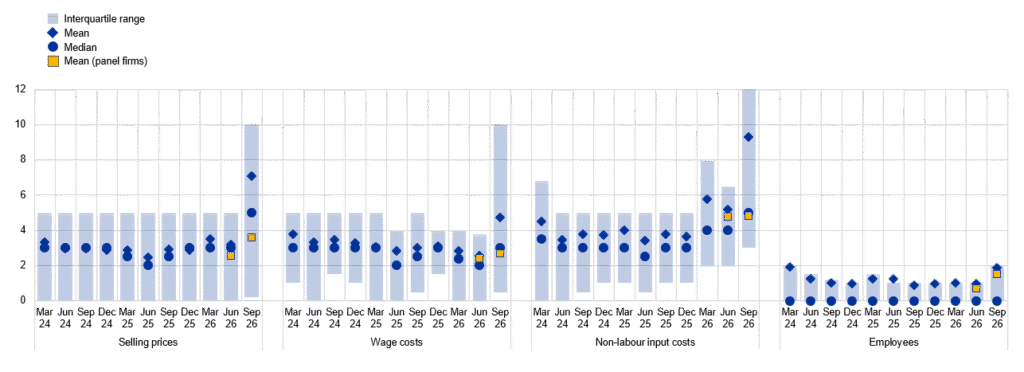
Returning firms’ median expectation for inflation one year ahead remained at 3 per cent. Across all respondents, it rose to 4 per cent. The contrast argues against treating the full-sample increase as a straightforward shift in sentiment: the clearer message is tougher financing and weaker profits, with businesses still planning investment.