Frontex, the EU agency for the control of European borders, has allocated over €1bn for aerial surveillance in 2018–2028. The funding is growing rapidly: from €12m in 2018 to over €330m for next year.
Aerial surveillance is crucial for interceptions. According to LIMINAL, at least 33,000 migrants faced return to Libya and Tunisia between 2018 and 2024. The returns, by the security forces of those two countries, enjoyed the support of Frontex. (LIMINAL is a laboratory of the University of Bologna that investigates intersectional mobility and border violence.)
Lorenzo Pezzani, the mastermind of LIMINAL, told EU Perspectives that Frontex’s reform “comes as absolutely no surprise”. However, one of the main concerns is how Frontex “is playing a significant role in pushing for or enabling the use of drones within European civilian space”. The hotspot is the Central Mediterranean sea.
In light of the recent reform, as well as the increase in resources and investments directed toward sky surveillance, what are your primary concerns?
The increase in the budget comes as no surprise. The same goes for the expansion of the agency’s functions. The process is entirely consistent with what we have observed thus far both in terms of financial resources and in terms of the functions, activities, and powers granted to the agency. What we are witnessing, however, is becoming increasingly troubling. Frontex is perhaps one of the few public agencies, not just in Europe, but globally, that continues to secure more resources, despite the failure to meet its stated objectives.
You might be interested
If the goal was to make borders more secure and reduce irregular arrivals, it is clear that this has failed. In recent years, arrivals have actually increased, notwithstanding some fluctuations and occasional, slight dips. Yet, in the face of these outcomes, Frontex continues to expand its budget, its mandate, and the assets at its disposal. This creates a kind of self-fulfilling prophecy: the failure to reach its objectives becomes, in itself, an argument to justify the need for even more resources and tools. All of this is taking place against a backdrop where it is plain to see that the agency contributes significantly to human rights violations and operates with a very high degree of opacity.
What do you mean by ‘opacity’?
We ourselves encountered numerous difficulties in accessing the data that forms the basis of our research, and we have observed a progressive deterioration in the information made available. Our report and the accompanying database are based on JORA (Joint Operations Reporting Application) — the system in which Frontex employees record information on so-called border incidents, essentially significant events occurring at the external and internal borders of the European Union. The database is not public, but the Freedom of Information procedures can secure access to it. Initial requests were generally successful: we were provided with complete data, organized into a large Excel spreadsheet containing numerous columns and highly precise information.
Our project, which we have been working on for about three years, building upon previous research into aerial surveillance, utilizes data collected over several years. The first set of JORA data we used had originally been subject to requests by other journalists around 2020. Even in our first request, there was less information available than what had been provided to the journalist who submitted the original request. We subsequently filed two more requests, and each time, the data provided was even less detailed culminating in our most recent request, for which we were denied access to any usable information whatsoever. Frontex consistently justifies its refusal to release data by citing security concerns.
This lack of transparency is, therefore, a central concern for us. On the one hand, it is unclear how financial resources are actually being used. On the other, the agency explicitly resists attempts at independent scrutiny. Consequently, it becomes very difficult to understand what it is concretely doing with the funds at its disposal. This is taking place against a backdrop where it is already clear—I am thinking in particular of the Leggeri case and the pushbacks in the Aegean—that the agency at the very least, aware of human rights violations, yet it failed to intervene.
On the operational dimension, in the Mediterranean, there are various actors. How does the relationship between aerial surveillance and border control at sea work?
I have been working on migration in the Mediterranean for over fifteen years. I founded a project called Forensic Oceanography, through which we reconstructed various incidents—shipwrecks and pushbacks—and analyzed the accusations leveled against NGOs engaged in search-and-rescue operations in the Mediterranean. This has allowed me to observe the transformations that have taken place over a significant period of time. One aspect that has struck me most in recent years is what we refer to in our report as a ‘shift from sea to sky’.
On the one hand, European authorities have progressively withdrawn their own naval assets, reducing their physical presence at sea while simultaneously attempting to prevent other European actors, particularly NGOs, from operating in those same waters. On the other hand, they have significantly expanded their aerial presence.
Aerial surveillance allows for the monitoring of events in the central Mediterranean on a very broad and precise scale, a task that is far more complex to carry out using naval vessels. At the same time, it enables European authorities to circumvent the search-and-rescue obligations that would otherwise apply to naval units. It is clear that neither Frontex nor European authorities have ever intended to systematically organize search-and-rescue operations. Yet the mere presence of a vessel can trigger legal obligations to rescue people at sea and facilitate their disembarkation in Europe.
However, these coast guards lack the independent means to locate migrant vessels or to monitor the Mediterranean in a systematic way. This surveillance capability is provided, to a large extent though not exclusively through aerial operations, most notably those conducted by Frontex.
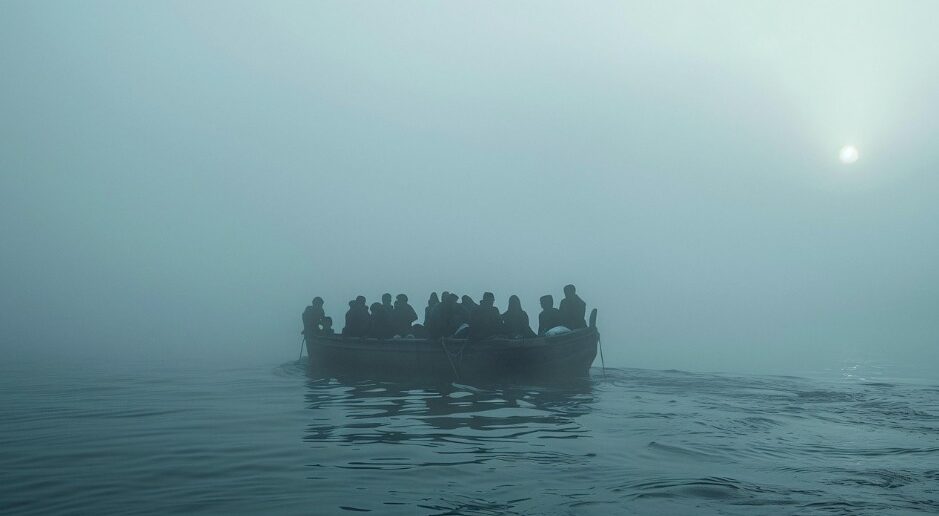
The agency has undoubtedly played a fundamental role in setting this process in motion. In the report, we therefore describe a shift occurring across two levels: at sea, we see a withdrawal by European authorities, coupled with an expansion in the operational reach of the Libyan and Tunisian coast guards. This system, however, could not function without the expansion of aerial surveillance activities. In essence, aerial surveillance allows for constant monitoring of the central Mediterranean, enabling the detection of migrant vessels as soon as they depart from the Libyan coast and the transmission of this information to Libyan and Tunisian authorities, so that they can take direct action to intercept the boats and bring them back.
How does the MAS (Multipurpose Aerial Surveillance) fit into this system?
MAS is a rather generic term, as is often the case with European institutional language. Specifically, it refers to an aerial surveillance capability that also encompasses an administrative and institutional framework, involving a series of framework contracts and public tenders that fall under this umbrella.
From an operational standpoint, the key innovation compared to previous forms of aerial surveillance, introduced via MAS, is the ability for aircraft and drones to transmit real-time imagery from the central Mediterranean to the Frontex headquarters in Warsaw. This is home to the Situation Centre, where the Agency’s technical staff (working alongside representatives from various national authorities) monitor imagery and decide how to respond to reported situations.
How have you observed aerial surveillance contributing to these pushbacks? In essence, how do these ‘pushbacks from above’ actually occur?
What is interesting is how the aerial surveillance apparatus expands the entire decision-making architecture. It is no longer just a case of a single Frontex officer aboard a vessel spotting a group of migrants and making a decision. The distance involved, the number of actors participating, and the complexity of the technological infrastructure required to link two widely separated locations, such as Warsaw and the Central Mediterranean, all increase.
This is particularly significant in terms of responsibility and accountability. The decision-making process becomes increasingly fragmented and distributed; there are more actors involved, and information passes through a greater number of stages. This also raises important questions regarding the role of the private companies that provide aerial surveillance services to Frontex. These firms often claim that they merely transmit information, positioning themselves as neutral observers who do not intervene directly in operations.
For one thing, pilots themselves bear legal responsibilities – for instance, the obligation not to leave people in distress without providing assistance. Furthermore, by reconstructing specific episodes, we show how the fragmentation of the decision-making process within a much larger apparatus makes it difficult to pinpoint exactly any decision and, consequently, to determine who is responsible for what occurs in the Central Mediterranean.
It is clear that ultimate responsibility lies with Frontex, yet even this aspect is complex to unravel. Within the Situation Room, for instance, there are representatives from various police forces and national authorities participating in the joint operations.
In the case of drones, the process is even more intricate. There is no pilot on board the drone; instead, images are transmitted to a container located in Malta operated by Airbus which then forwards them to Warsaw. There, they are analyzed by representatives from Frontex and national authorities (including Italy’s Guardia di Finanza), alongside experts whose participation varies depending on the specific operation.
Who is conducting the aerial surveillance on behalf of Frontex?
Another crucial element is the increasingly significant role of private actors. Frontex does not conduct aerial surveillance operations directly; rather, it procures these services from private companies active in the surveillance and defence sectors. They provide the drones, aircraft, and pilots. This raises further questions regarding responsibility and accountability: who is truly responsible when private actors also exert significant influence over what takes place?
Then there is the issue of the budget. In the report, we show how the resources allocated to aerial surveillance are expanding rapidly. The latest call for tenders amounts to 500 million euros, a figure equivalent to the total amount Frontex spent over the preceding five years. We are, therefore, talking about a massive increase in scale. A substantial portion of these public funds, contributed by European taxpayers, ends up in the hands of private companies that have built an entire business model around these partnerships.
Two of the most significant players in this sector are Israel Aerospace Industries (IAI) and Elbit, both of which are Israeli firms. In the current historical context, this introduces an additional, highly critical dimension. We found it particularly telling to read statements from the president of IAI, who emphasized that the contract with Frontex served as a crucial instrument for enabling the company to gain access to European civil airspace. The fact that drones like those used by Frontex are permitted to fly within civil airspace is by no means a given. It took years of regulatory and legislative changes, as well as complex administrative work, were required to make this use possible. Until quite recently, in fact, operations of this kind were not permitted.
Frontex has also played a significant role in this process, helping to push for and enable the deployment of drones within European civil airspace. This has directly benefited a company that manufactures drones—which are also used in military contexts—and which, according to our assessment, has a particularly problematic connection to Israeli military operations and genocide in Gaza. This represents an additional critical issue that warrants attention, beyond the broader aspects we have discussed thus far.