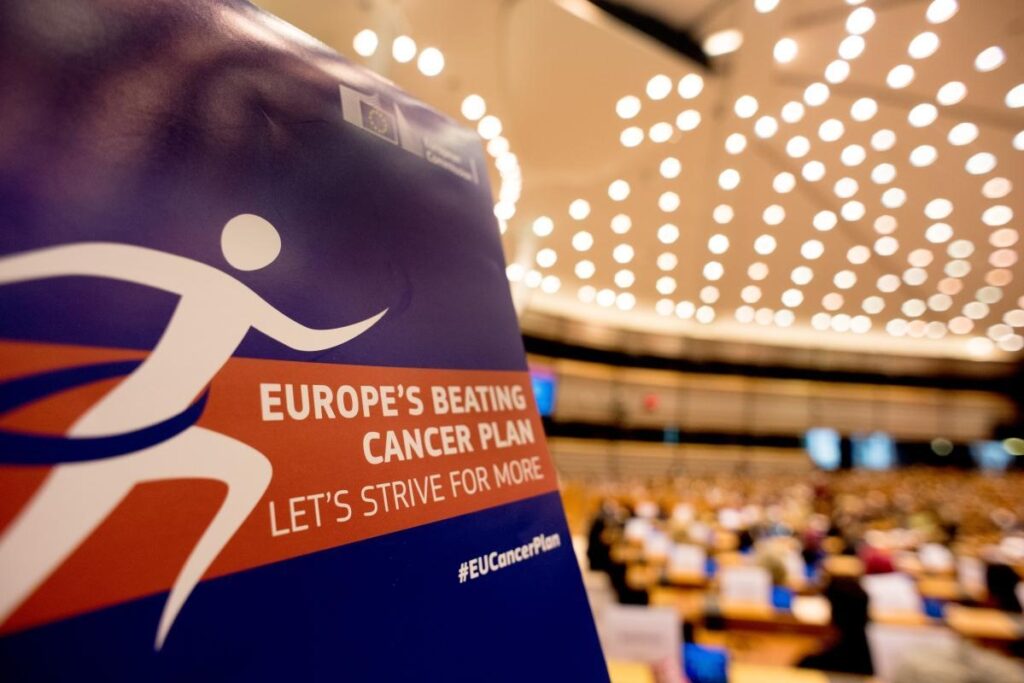
Europe’s Beating Cancer Plan (EBCP) risks outliving the budget that finances it. That is the central warning from the European Court of Auditors.
The EU’s flagship cancer strategy runs to 2030, and in some cases to 2040. Funding certainty ends in 2027. On Monday, presenting the Special Report Europe’s Beating Cancer Plan: A wide-ranging plan facing an uncertain future to Parliament’s health committee, Joelle Elvinger, Dean of Chamber I at the European Court of Auditors, put it plainly: “We do not know anything about financing after 2027.” The auditors have warned that these uncertainties “could undermine the EBCP’s ability to achieve its objectives within the proposed timeframe.”
In February 2026, Parliament adopted a resolution with 427 votes in favour. MEPs called on the EU to renew its political commitment, funding and coordination. They demanded a dedicated EU health programme in the 2028–2034 long-term budget to guarantee predictable investment.
We don’t know anything about financing after 2027. – Joelle Elvinger, Dean of Chamber I, Court of Auditors
A €4bn envelope, without a detailed allocation
The Commission launched the cancer plan in 2021 with an initial €4 billion budget under the 2021–2027 Multiannual Financial Framework. Mrs Elvinger reminded MEPs: “The Commission announced a 4 billion budget. More than a quarter of that would come from EU4Health.” The Court confirms that “the EBCP had an initial budget of €4 billion to finance its implementation.”
However, the Commission did not break that amount down across the plan’s seven objectives and 42 actions. The report states that “the Commission did not specify how this amount was to be distributed across the 7 objectives and 42 actions.” It adds that “for reasons of complexity (multiple actions financed from a range of EU sources under different management modes), only indicative budgets could be calculated at the design stage.”
The plan draws funding from several EU programmes. The auditors clarify that they “included projects funded by EU4Health, Horizon Europe and Digital Europe, which together contributed €3.5 billion to the EBCP budget.” By October 2025, “more than €2.7bn had been committed.” The €4bn envelope signalled political ambition. The report shows that its operational allocation remained unclear.
Mid-term budget revision deepens uncertainty
The mid-term revision of the EU’s long-term budget exposed the plan’s financial fragility. Mrs Elvinger told MEPs: “EU4Health’s budget for 2025-2027 got cut by more than 35% following the mid-term revision of the plan.”
She added: “We do not know what impact that might have on Europe’s beating cancer plan.”
The uncertainty extends beyond the immediate cut.
Mrs Elvinger warned that the plan “has no defined end date and many activities stretch well beyond 2027.” She continued: “This creates uncertainty about financing of long-term activities as well as future support for the plan.”
And again: “We do not know anything about financing after 2027.”
The report echoes this concern. It states that financing under the next Multiannual Financial Framework remains unclear.
The message is direct: the EU designed a long-term health strategy inside a short-term budget framework.
Do we really believe that this billion will reappear in the new MFF, or will it just disappear? – MEP Vytenis Andriukaitis
MEP Andriukaitis: the MFF is the real battleground
MEP Vytenis Andriukaitis (S&D, Lithuania), former European Commissioner for Health, argued that the next EU budget will decide the plan’s fate.
“If the European Commission says that the Europe’s Beating Cancer Plan is a priority programme, and all of a sudden one billion euros are cut from funding, a very reasonable question arises,” he said.
“Is this really the programme that can be touched in this crisis situation?”
He linked the issue directly to the next MFF. “Do we really believe that this billion will reappear in the new MFF, or will it just disappear?”
If the EU treats cancer policy as a priority, it must anchor it structurally in the 2028–2034 Multiannual Financial Framework.
A strategy that runs beyond its funding horizon
The structural problem goes beyond the size of the envelope. Most actions run until 2030. Some prevention targets, including the tobacco-free generation goal, run until 2040.
The current MFF ends in 2027. Mrs Elvinger told MEPs: “At the same time, Europe’s Beating Cancer Plan has no defined end date and many activities stretch well beyond 2027.” She added: “While actions generally run until 2030, some targets are for 2040.” She concluded: “This creates uncertainty about financing of long-term activities as well as future support for the plan.”
She also noted that the different timeframes of actions, targets and funding “mean that we do not know when the overall performance can be meaningfully assessed.” The EU has committed to a 15–20 year health ambition with only six years of secured financing.
No clear moment of evaluation
The timeline gap also affects evaluation. An implementation roadmap tracks milestones until 2025. Many actions continue beyond that date. “It is not clear how the Commission will assess the plan’s overall impact,” Mrs Elvinger said.
Only around one-third of the plan’s sub-objectives have measurable targets. Without a monitoring framework aligned with the budget cycle, the EU risks entering the next MFF negotiations without robust evidence of impact.
Financial fragmentation and sustainability risks
The Court also highlights financial fragmentation. The cancer plan draws funding from multiple EU programmes. No single protected budget line anchors it.
The auditors warn that overlaps and weak prioritisation could limit efficient use of resources. They also stress that many initiatives depend on follow-up funding or national integration once EU support ends. Launching projects is easier than sustaining them.
The Court’s recommendations: concentrate, measure, secure
The auditors issued two formal recommendations. According to Mrs Elvinger the Commission accepted both. First, the Court calls for stronger coherence. It urges the Commission to identify overlaps, strengthen synergies, prioritise a core set of EU actions and work with Member States on sustainability planning. Second, it calls for a comprehensive monitoring and evaluation framework to measure results and the plan’s contribution to reducing inequalities.
The decisive moment will come during negotiations on the 2028–2034 Multiannual Financial Framework. Europe committed to beating cancer.