Medical devices are disappearing from the European market — not over safety concerns, but paperwork. Brussels now wants to overhaul the system and turn medtech into its main trump card in the global AI race. The reform promises approvals three times faster and savings of over €3bn a year.
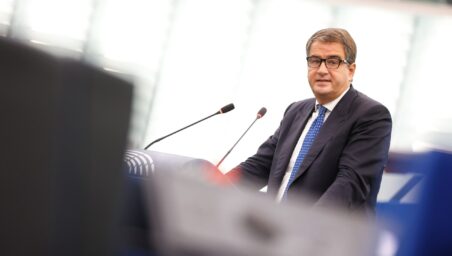
Rather than competing head-on with US tech giants or matching China’s scale, the Commission is doubling down on a sector where it believes Europe still holds a genuine edge: highly regulated, highly specialised medical technology. On Tuesday, Commissioner for Health and Animal Welfare Olivér Várhelyi presented MEPs with a sweeping overhaul of the EU’s medical devices framework, pitched not just as a fix for a system under strain, but as a launchpad for European AI.
“We want to have the most state-of-the-art set of rules that facilitates the use of artificial intelligence and that should put us ahead of our competition, including the US and China,” Mr Várhelyi told MEPs. The reform aims to cut red tape, ease pressure on companies and make the system fit for faster-moving innovation, including artificial intelligence embedded in medical devices and diagnostics.
A system under strain
Yet the parliamentary debate exposed deep structural weaknesses in the current system. Mr Várhelyi acknowledged the pressure on the sector: “The medtech sector is facing comparatively high administrative burden… absorbing hundreds of thousands of euros for repetitive procedures that do not add to patient safety… and they are suffering, if not already about closing their businesses.” New ideas, he warned, “face great risks of ending up in a regulatory labyrinth or find markets elsewhere.”
Every single day we… are losing medical devices in the treatment of patients.
— Andreas Glück, MEP (Renew/DEU)
MEP Andreas Glück (Renew/DEU) said devices are already disappearing from the market “due to bureaucratic burdens and not to safety concerns.” “Every single day we… are losing medical devices in the treatment of patients,” he said. “Time is of the essence.” Mr Várhelyi was equally blunt: “We are in the last moment to save this unique industry where Europe is strongest still at the global level.”
European Parliament rapporteur Oliver Schenk (EPP/DEU) warned that without regulatory advances, “this becomes a problem for all of our patients.”
Despite the push for simplification, several MEPs cautioned against weakening safeguards, citing past scandals involving faulty implants. Mr Várhelyi insisted the proposal does not lower standards, but targets inefficiencies that “do not add to patient safety.”
Healthcare: Europe’s AI edge
The EU’s medical devices framework is already “ready for artificial intelligence”, Mr Várhelyi argued. It should be allowed to evolve without being slowed down by overlapping rules under the AI Act.
“If there is one area where the use of artificial intelligence is moving forward the fastest, it is actually the medical sector,” he said. “And it is in this sector where we have most standards already established.” More than 70 standards have already been established for algorithms, he added, a level he described as unique, with no other AI domain coming close.
“This is why it was so important to make sure that this sector can go ahead regardless of the legislative proposals related to general AI rules,” he said. “We want to maintain this edge of the medical devices sector… because the medical devices regulations are ready for AI.”
One rulebook for AI devices
To support this approach, the Commission proposes to amend the AI Act and create a single regulatory pathway for AI-enabled medical devices, avoiding duplication between sectoral rules and horizontal AI legislation. “We have proposed to amend the EU Artificial Intelligence Act to remove duplication and overlap… [and] provide one single regulatory framework for artificial intelligence systems that qualify as medical devices,” he told MEPs.
At the same time, the Commission draws a clear red line: AI in healthcare will remain under human control. “It will always be a doctor’s responsibility,” Mr Várhelyi said.
Racing the world
The reform is a direct response to intensifying global competition in medical technology and AI-enabled healthcare, and Mr Várhelyi stressed that regulation must enable innovation while remaining adaptable as technology evolves.
“We want to be able to follow up any evolution of this area and react fast to any changes,” he said. The framework should remain “future proof… 5, 10, 20 years from now.” The overhaul could deliver the “shortest [approval timelines] in the world,” with devices assessed within 110 days. This compares to up to 18 months under the current system.
The Commission estimates that simplifying procedures could save the sector more than €3bn annually. “It means economic operators remaining in Europe… [and] innovators are more likely to develop and scale the next generation of breakthrough technologies here in Europe,” Mr Várhelyi said.
Savings and scale
The reform also aims to safeguard a sector where Europe remains a global leader. The medical devices industry employs close to one million people, largely in SMEs, and represents a market worth around €170bn. It counts 38,000 medtech companies, 90 per cent of them SMEs, and nearly six million healthcare professionals across 15,000 hospitals rely on these technologies daily.
Alongside simplification, the proposal strengthens the role of the European Medicines Agency in coordinating expertise, monitoring shortages and supporting companies. It introduces clearer timelines and more digitalised procedures, and in the second quarter of 2026 the EMA will launch a pilot programme to support breakthrough medical devices and in vitro diagnostics.
The push builds on earlier efforts to accelerate access to high-impact innovation. As previously reported, the Commission is working on a fast-track pathway for breakthrough medical devices, aimed at giving “preferential treatment” to technologies with significant clinical benefit.
Europe’s high-stakes bet
At its core, the Commission’s strategy reflects a broader wager: that Europe can carve out a competitive position in AI not by competing with big tech, but by building the most trusted and regulated applications in sectors like healthcare. Medical technology becomes the testing ground for that model.
We are in the last moment to save this unique industry where Europe is strongest still at the global level.
— Olivér Várhelyi, Commissioner for Health and Animal Welfare
But the parliamentary debate exposed a central tension: while Brussels presents medtech as one of its most advanced AI sectors, the same system is struggling with slow approvals, high costs and declining availability of devices. Whether AI can reinforce Europe’s medtech industry, or whether regulatory bottlenecks will continue to push innovation elsewhere, may determine whether that bet holds.