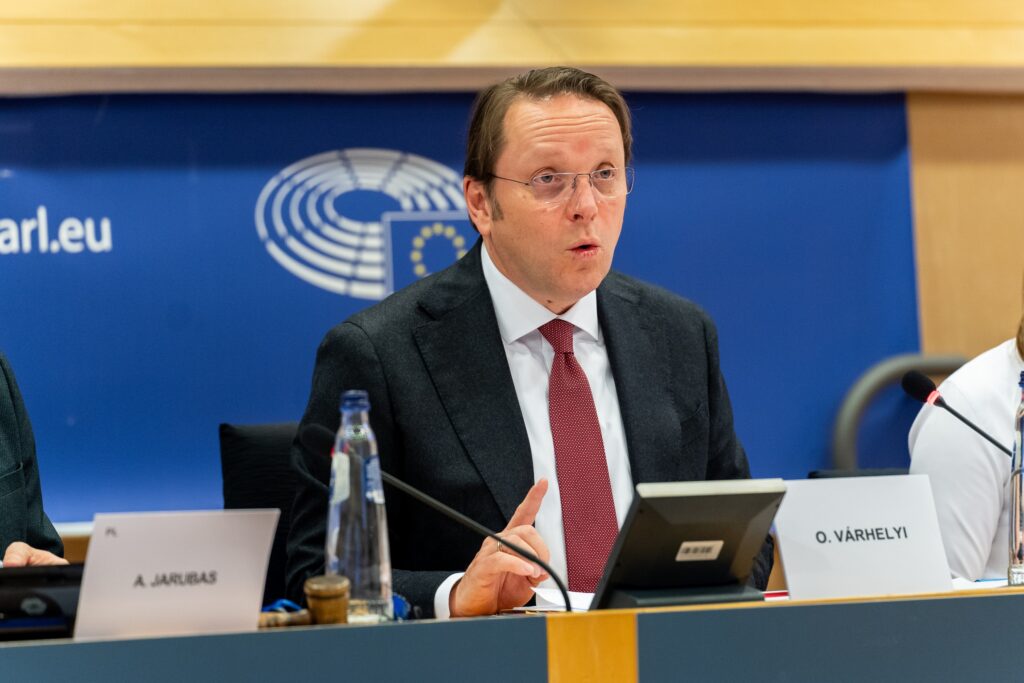
Misinformation that could cost the lives of thousands of Europeans — 23 independent European scientists and public policy experts on tobacco and nicotine describe statements by Olivér Várhelyi, European health commissioner, on the risks of nicotine alternatives. The experts say so in a letter they addressed to Ursula von der Leyen, European Commission president.
The statements constitute the spread of misinformation. We urge you to take steps to prevent further loss of trust in the European Union,” the letter reads. The experts have also sent it to the College of Commissioners, representatives of the European Council, and European Parliament stakeholders.
The letter cites an interview the commissioner gave the Euractiv portal as an example. Mr Várhelyi said that he is convinced that alternatives to tobacco products are just as harmful as regular cigarettes. Last May, he told the Parliament’s ENVI committee that “Vaping has created entirely new health risks comparable to or even greater than smoking itself. Just read a few articles about ‘popcorn lung‘, a completely new phenomenon that is affecting the younger generation in a breathtaking way.”
In their response, the experts emphasise in a letter to the Commission president that there are no known cases of popcorn lung—a rare, irreversible disease known as bronchiolitis obliterans—caused by vaping. The EU bans the presence of diacetyl, the compound that caused the condition in American popcorn factory workers, in e-cigarettes, otherwise legally sold throughout the Union
Commission premieres a blunder of this magnitude
Similarly, the letter’s signatories underscore that the risks of nicotine alternatives are by no means comparable to those of smoking conventional cigarettes. This is in stark contradiction with Mr Várhelyi’s last July statement on X. “For the first time in history, we acknowledge that new tobacco and nicotine products pose health risks comparable to the regular ones,” the commissioner wrote. When the European Parliament later asked for the basis of this opinion, Mr Várhelyi replied that it was the Commission’s official position.
“This is the first time a European Commission official has committed such a blunder,” the experts respond. They argue that nobody seriously disputes the idea that vaping, nicotine pouches, and other forms of non-combustible tobacco and nicotine products are markedly less harmful than smoking. The letter references a wide range of evidence in support of the experts‘ position.
For example, the 2016 Royal College of Physicians report ‘Nicotine without smoke: Tobacco harm reduction‘ states that the health risk of e-cigarettes is unlikely to exceed five percent of the risk of conventional smoking. Similarly, the British government agency Public Health England (since replaced by the UK Health Security Agency) concluded in its 2015 evidence report—and subsequent updates—that vaping is approximately 95 per cent less harmful than smoking.
Not harmless, but less risky than cigarettes
The signatories of the letter further point out that the commissioner’s claims contradict a vast body of scientific evidence published by other prestigious institutions such as the Cochrane Reviews. These institutions—including the Royal College of Physicians and the UK Health Security Agency—have long stated that the primary health risks caused by smoking arise from the combustion of tobacco and the inhalation of toxic combustion products, not from nicotine itself.
The fact that tobacco smoke contains around 7,000 chemical substances, at least 158 of which are toxic or carcinogenic, speaks volumes. The e-cigarettes aerosol, by contrast, contains an amount of substances two orders of magnitude lower. Furthermore, the heated liquid and turns into droplets of vapor and air, allowing the user to avoid most carcinogenic substances while vaping.
Biomarker studies, e.g., that of University College London researchers, demonstrate that people who switch from traditional cigarettes to e-cigarettes or other smoke-free products show significantly lower levels of carcinogens, both in their blood and urine. These include tobacco-specific nitrosamines or carbon monoxide.
Far-reaching consequences
The misinformation spread by the European Commissioner could have far-reaching consequences. In the EU, nearly one in four adults still smokes, and more than 700,000 Europeans die prematurely each year from smoking-related diseases. According to the letter’s signatories, miscommunication of relative risk could lead smokers to stick with the most harmful form of nicotine use, i.e., conventional cigarettes.
Failing to account for the lower risks of nicotine alternatives has already caused harm in the past. The EU, for instance, has banned the Swedish snus in 1992. In Sweden itself, however, this product won an exemption; as a result, about 3,000 smoking-related deaths per year have been prevented.
Without changes, the Commission’s approach could further remove policy from scientific evidence. This year, a revision of the Tobacco Products Directive is planned. This could also affect, for example, the implementation of the Europe’s Beating Cancer Plan.
Thousands of lives at stake
As reported by Euractiv, the European Commission launched internal consultations among its directorates-general on 10 March concerning the upcoming revision of the Tobacco Products Directive. The Directorate-General for Health and Food Safety (DG SANTE), which is in charge of the revision, has called on other Commission departments to submit their comments by 24 March.
The current directive was last updated in 2014. By that time, certain new products—e-cigarettes, heated tobacco, and nicotine pouches—had not yet appeared on the European market. It is precisely these products that the Commission now seeks to regulate under the upcoming revision.
“Commissioner Várhelyi risks leading the Commission toward harmful prohibitionist regulation based on flawed reasoning, which would disrupt the internal market, cause thousands of preventable deaths among Europeans, and fuel a massive unregulated black market for safer alternatives to cigarettes,” the experts emphasise.
Commission leaders must act, experts exhort
“The Commission leadership or other institutions must act urgently to correct Commissioner Várhelyi’s dangerous, false, and misleading statements and ensure that policymaking is based on reliable scientific evidence,” the experts conclude.