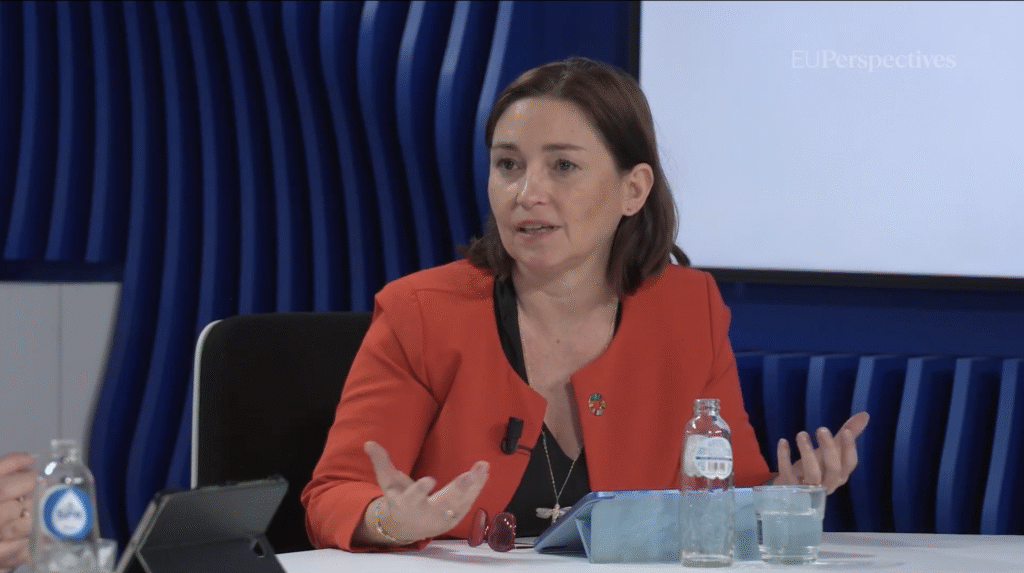
A quiet revolution in medicine packaging is brewing in Brussels, Ines Windisch of Medicines for Europe and pharmaceutical company Zentiva told the EU Perspectives podcast, where she appeared together with MEP Alessandra Moretti (S&D) and FT’s Brussels correspondent Andrew Bounds. The humble paper leaflet, tucked inside every box of pills, may soon become a relic of the past. Its proposed replacement—a digital alternative—has emerged as a rare point of optimism within the European Union’s contentious pharmaceutical reforms.
For Ines Windisch, Head of Corporate Affairs and Sustainability at Zentiva Group and Chair of the Sustainability Committee at Medicines for Europe, the change cannot come soon enough. Speaking on the EU Perspectives podcast in March, she championed the innovation. It is a critical tool for accessibility in a modern, mobile Europe.
Ms Windisch framed the digital leaflet within a much broader challenge. It spearheads the modernisation of a regulatory framework that is itself three decades old.
The executive described a sector navigating relentless geopolitical tension, disrupted supply chains and intense pricing pressure across 27 member states. She welcomed the intention behind new legislation like the “omnibus” review. She noted it created a climate of uncertainty, forcing “start and stop actions in compliance preparedness” for the industry. Her call for the digital leaflet echoes earlier views of Steffan Saltofte, CEO of Zentiva and Medicines for Europe’s President. “Greater flexibility in pricing, modernized procurement practices, and innovations such as digital leaflets — which would make it easier to move stock across borders — could make a real difference,” he told EU Perspectives last November
The core problem, she argued, is that the industry must operate within an antiquated system. “Our framework doesn’t even reflect environmental standards,” Ms Windisch noted. She then highlighted the delicate and often unlegislated balance between ecological goals and health needs. Her solution is a call for courage. “I think we need to take the courage also to look at old frameworks, renew it, adjust it, simplify it and also harmonise it because the patient doesn’t care in which country he or she is traveling or living,” she said.
The moderator, EU Perspectives’ Jennifer Baker, then asked about the interplay of geopolitics and competitiveness. “What’s your assessment of how that affects the pharmaceutical sector?” In response, Ms Windisch turned to the proposed Critical Medicines Act (CMA). She saw it as a “good start” for addressing long-standing structural problems, particularly its move “beyond price with meet criteria”.
One of the biggest challenges we face as the off‑patent medicines industry is the Urban Wastewater Treatment Directive. In its current form, implementation of this environmental regulation risks medicine shortages and undermines access to affordable healthcare.
— Ines Windisch, Zentiva Group; Sustainability Committee at Medicines for Europe
However, she issued a strong caveat. The CMA focuses on a list of some 290 critical molecules, but “the rest of the portfolio is huge”. She warned that the introduction of new environmental policies piles administrative burdens and costs onto these essential medicines. “We need to be careful that not all of the product portfolio ending up as critical,” she stated, emphasising the need for a framework that secures the entire business for the years to come for the millions who rely on these drugs.
Ms Windisch also brought up a crucial pain point for the industry. “One of the biggest challenges we face as the off‑patent medicines industry is the Urban Wastewater Treatment Directive. In its current form, implementation of this environmental regulation risks medicine shortages and undermines access to affordable healthcare,” she warned, calling a pause, repair, and relaunch of the directive at EU level “before irreversible damage in member states occurs”.
A good compromise
Later, Ms Baker posed a broader question about the legislative package: “Is it true about EU policy that it’s successful if it makes everyone equally unhappy?” Ms Windisch, representing the off-patent medicines sector, offered a measured assessment. “So actually I think overall we have a good compromise,” she said.
For her segment of the industry, the primary goals were patient access, affordability and broadening therapy availability—objectives she believes the package advances. She acknowledged the immense effort behind the hundreds of pages of legislation. Yet, she identified a significant drawback. “I think there is still potential to simplify less bureaucratic, less administrative burden on our side, so that we can really focus on production and delivery.”
It was in this context that Ms Windisch returned to the digital leaflet with palpable enthusiasm, highlighting its benefits far beyond simple administrative relief. “Just mentioning the digital leaflet which could open so much for people,” she said. She painted a picture of a mobile Europe where language barriers fall to technology. “Like we have migration happening in Europe, people not speaking the same language. Imagine you have one pack you can share. Across Europe, people have access to the information and can also search, right?”
The uphill battle for funding
For the Zentiva comms head, this innovation is a cornerstone of practical accessibility. “So the digital leaflet will bring a lot of new opportunities. I think we should take it as soon as possible. This is about accessibility and we can also help really taking the medicines in the right way, understanding the principles. So we are very happy about this piece,” she said.
I think we need to take the courage also to look at old frameworks, renew it, adjust it, simplify it and also harmonise it. The patient doesn’t care in which country he or she is traveling or living.
— Ines Windisch, Zentiva Group; Sustainability Committee at Medicines for Europe
The conversation concluded with a focus on finance. Ms Baker asked: “Well, simplification is obviously always a big topic. Another is of course, finance and the future financial budget, Multiannual Financial Framework, as it’s called. What sort of financial support does the pharmaceutical industry need from the EU and are you optimistic about getting it?”
Ms Windisch’s answer was blunt. The political rhetoric focuses on bringing manufacturing back to Europe to boost competitiveness. Yet the reality of accessing funding is a different matter. “So sometimes the incentives are connected with very difficult criteria to meet and we don’t have easy access to that,” she explained.
Access is everything
According to her, the industry needs simpler and more accessible funding mechanisms, with less administrative burden.
The goal is to make it realistic for companies to actually obtain funding and implement new projects on European soil. For Ms Windisch, the entire endeavour boils down to one principle: “So for me it’s just everything about accessibility and simple bureaucratic way behind that.” The success of the EU’s pharmaceutical strategy may depend on whether policymakers can finally deliver it.