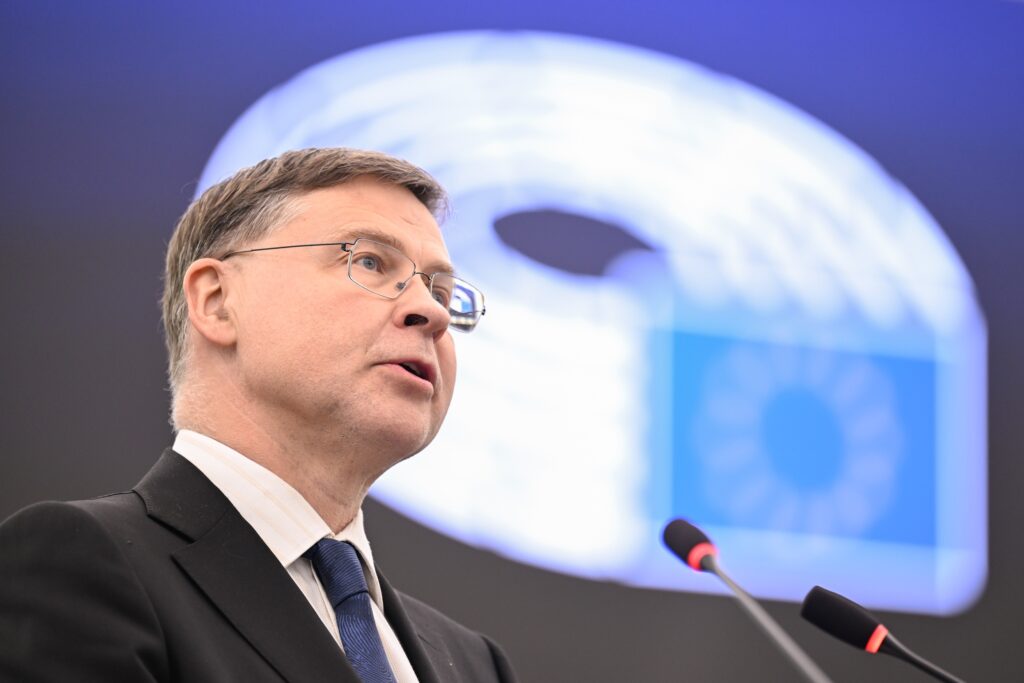
After years of piling up new rules, the European Union is trying to bring more order to its legislative playbook. On Tuesday, Commissioner Valdis Dombrovskis presented a simplification plan aimed at making EU laws clearer, more practical and easier to enforce.
Commissioner for Simplification Valdis Dombrovskis strode into the European Parliament’s Strasbourg press room on 28 April with a clear message: Brussels needs fewer rules, but better ones. “I will now move to the main topic of this press conference, namely the Commission’s proposal to modernize EU lawmaking, ensuring it is better aligned with the needs of citizens and businesses,” he began. Europe’s regulatory machine, he said, must swap volume for value. “Brussels must deliver results, not just rules.” The dense communication he, ironically, unveiled sets out to do exactly that.
The Latvian commisioner thinks the Union’s rulebook has grown barnacled over the decades. A carmaker juggling 27 slightly different labelling schemes, or a fintech forced to file identical data in half a dozen formats, would agree. The Commission’s answer is a five-pillar programme that promises leaner laws from the start, deeper house-cleaning of old ones, and sharper teeth when governments drag their feet. The rhetoric may sound familiar; the detail, this time, is bolder.
Red tape, meet red pen
Mr Dombrovskis insists the Commission legislate only where the single market truly needs it. “Our legislative activity must focus on areas where action is really needed and can make a real difference,” he said. In practice that means full harmonisation for digital payments but a lighter touch on, say, cultural subsidies. To keep future measures trim, every proposal will carry a clear-out date unless Parliament renews it. Think of it as a ‘use by’ stamp for directives.
The second pillar beefs up the Union’s vaunted better-regulation system. More dossiers will now face impact assessments, even in a hurry. Officials promise to consult once per file, not three times, and to deliver studies ordinary citizens can parse. The hope is that lobbyists will find it harder to slip in favours at the last minute.
Third comes a ‘regulatory deep clean’ across 12 sprawling sectors, from transport to taxation. Here the Commission borrows from corporate housekeeping: review what you own, scrap what clutters, merge what overlaps. A single set of rules on venture-capital funds, for instance, could replace the current tangle and cut compliance costs for start-ups hunting cash. If all goes well, businesses will notice by 2027.
National governments, though, often undo Brussels’s streamlining by ladling on extras, a habit known as gold-plating. Mr Dombrovskis’ message was uncharacteristically blunt here: “Gold plating creates barriers, raises costs and fragments a single market.” The Commission will publish a toolbox showing capitals how to transpose EU law without embellishment. Where gentle nudges fail, infringement letters will fly.
Enforcers with deadlines
The fifth pillar matters most: discipline. Rules only bite when someone enforces them, and the Berlaymont plans to act faster. “This communication sets out a revamped enforcement approach based on faster procedures, more automaticity, higher decisive penalties and a focus of reducing long standing cases across all areas of of EU law,” Mr Dombrovskis declared.
Officials will now issue a formal rebuke within six months if a directive lies unimplemented, and they will be stingier with deadline extensions. Eleven focus areas—late payments by public bodies among them—will top the watch-list.
This communication (calls for) faster procedures, more automaticity, higher decisive penalties and a focus of reducing long standing cases across all areas of of EU law.
— Valdis Dombrovskis, European Commissioner for Economy and Productivity, and Commissioner for Implementation and Simplification
Consider a small Italian plumbing firm that installs bathrooms in Austria. Under current rules, it may wait months for Vienna to accept its certificates, while unpaid invoices at home starve it of cash. If the Commission’s crackdown works, certificates will travel as smoothly as the plumbers, and Austrian ministries that dawdle on payment will face swifter legal action. For entrepreneurs, that is regulation as a service, not a hurdle.
A political sell, again
None of this lands in a vacuum. Germany’s centre-right bloc has urged even deeper pruning, including shrinking the Commission’s workforce. Asked about that gambit, Mr Dombrovskis mused that many of the group’s demands tally with his plan—sunset clauses, subsidiarity, proportionality—but he drew a line on enforcement. EU rules, he said, must be policed at EU level.
Convincing the European Parliament and the Council to adopt sunset clauses, or to resist ornamental additions of their own, will prove tricky. Committees cherish the leverage that complexity confers. National ministers like to brag that they ‘gold-plate’ for safety or consumer protection. Yet the Commission senses the geopolitical winds. Supply-chain shocks, American subsidies and Chinese industrial heft have pushed competitiveness up the agenda. “Europe must play to its strengths and sharpen its competitive edge,” Mr Dombrovskis reminded listeners.
Pressure also comes from the street. Farmers complain that overlapping environmental audits steal half a day each month. Lorry drivers fume at paper carnets still demanded on some borders. Shoppers wonder why a phone bought in Lisbon cannot be serviced in Kraków because warranty forms differ. The plan’s promise—one form, one fee, one deadline—will resonate if Brussels can deliver.
Results, not promises
Success will hinge on stamina. The deep clean runs through 2027. National elections might breed fresh varieties of gold-plate. Even the Commission’s own directorates, fond of pet schemes, may baulk when the bonfire nears their files.
Gold plating creates barriers, raises costs and fragments a single market.
— Valdis Dombrovskis
Still, the machinery has started to turn. Draft legislation on energy taxation already trims 300 pages to 60. A forthcoming ‘digital fitness check’ aims to halve overlapping reporting duties. Early wins will buy credibility — and cajole lawmakers to keep the blade sharp.
Mr Dombrovskis closed the briefing with a flourish of determination rather than detail. “We are also determined to continue delivering on our ambitious implementation and simplification agenda,” he said. If the Union’s sprawling acquis finally slims down, Europe’s plumbers, coders and consumers may, for once, be thankful. Or so the hope goes.