Berlin claims it will not under-resource its European obligations again. It promises deterrence of Russia; reassurance of allies; autonomy within alliances; mastery of new technology, and an economic revival. If it delivers, Europe has a future.
Over the past 100 years, hardly any statement coming from Berlin about German responsibility for Europe’s future would arrive in the continent’s numerous capitals as good news. Vladimir Putin has changed that, prompting the rise of a new German defence doctrine.
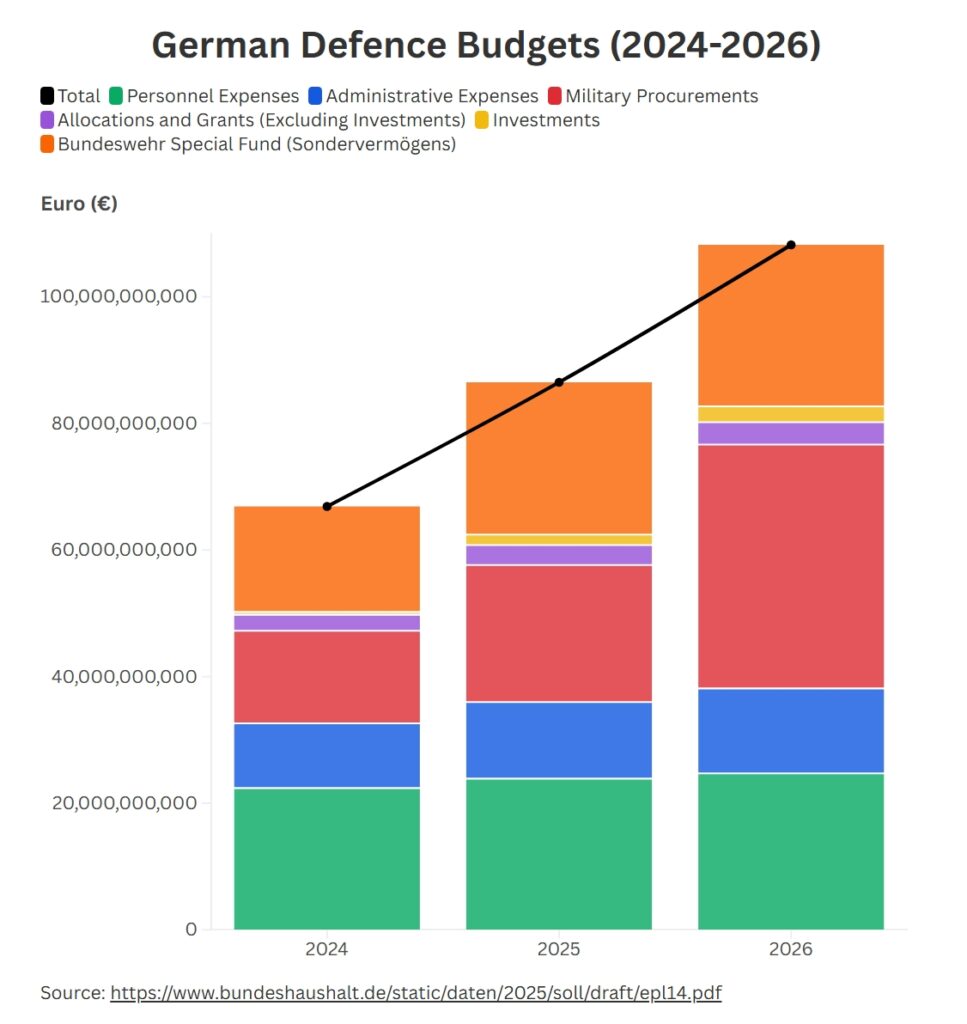
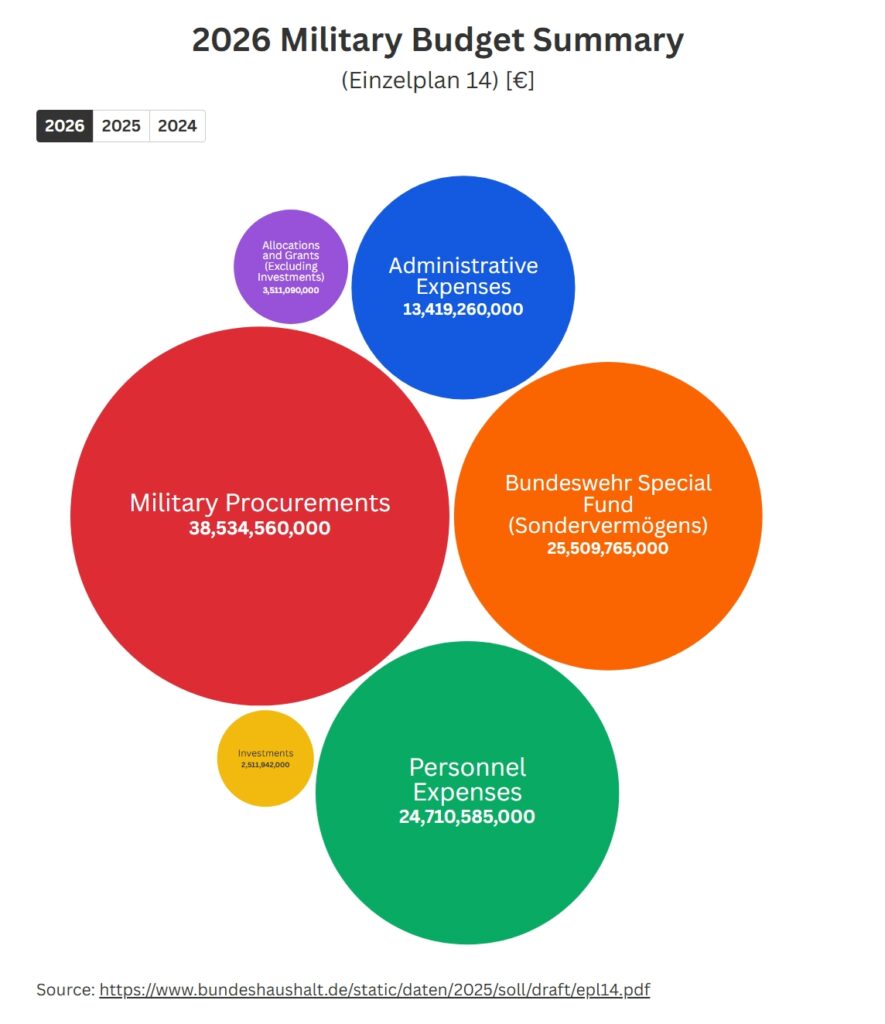
The document, unveiled in Berlin this month, lands with the weight of history. After decades of thrift, the Federal Republic now spends €108.2bn on defence—2.8 per cent of GDP—with the regular budget of €82.69bn topped up by a massive Sondervermögen (German legal term for a separate, earmarked pool of government money), distinct from the regular federal budget worth €25.51bn.
Much more than cash
“Germany is planning to increase defence spending by a fifth in 2027 compared with this year as it seeks to meet NATO’s new target at least six years ahead of schedule,” Financial Times reported. Bundeskanzler Friedrich Merz ties his ambition to the European Union’s search for hard power after Russia’s repeated acts of aggression. (Apart from the invasion of Ukraine, these include incursions in NATO airspace, cyberattacks, and other hybrid-war activities, such as propaganda.)
Finance Minister Lars Klingbeil broke Germany’s fiscal taboo when he justified extra borrowing for guns as well as for bridges. “It is right that we invest in our security and address our investment backlog that has built up over many years,” he said. The coalition has carved out exemptions from the constitutional debt brake not only for defence but also for a €500bn infrastructure fund.
The dual-use results of the latter, such as roads, bridges, and rail hubs, sit neatly with EU military-mobility legislation. Such sums now dwarf those of fiscally constrained France and Britain. The German plan therefore shapes both the EU’s strategic debate and the continent’s industrial revival.
For years Germany’s allies doubted anything would change. The broomstick episode in 2014, when soldiers had to resort to mounting painted rods on Boxer vehicles for want of machine-guns, became a parable of neglect. The new doctrine ends that era. “Our goal is clear: we will continue to strengthen the operational readiness of our Bundeswehr, and at a rapid pace,” said Defence Minister Boris Pistorius. His 35-page strategy, ‘Responsibility for Europe’, states that Russia is the greatest immediate threat and that the United States remains essential yet distracted.
A broader mission
The paper pledges to raise the army from 185,000 to 260,000 regulars by the mid-2030s and the reserve to 200,000. It merges EU and NATO objectives: collective defence, crisis management, homeland support, partnerships, and humanitarian relief. “Germany is positioning itself to be the backbone of European defence, ensuring that NATO’s European pillar can deter threats even if transatlantic politics falter,” wrote the Nordic Defence Review.
Compatibility with various existing concepts is, therefore, crucial. The text calls for “deep precision strike” missiles, robust air defence and rapid data collection. Such capabilities echo the EU’s 2024 Strategic Compass, which urges members to fill gaps in intelligence, long-range fires, and space assets.
It is right that we invest in our security and address our investment backlog that has built up over many years. — German Finance Minister Lars Klingbeil
The Atlantic alliance, US President Donald Trump notwithstanding, looms large. NATO members last year raised the benchmark to five per cent of GDP, including 1.5 per cent for dual-use infrastructure. Berlin vows to reach 3.5 per cent by 2029 and has pencilled in €188.4bn for defence by 2030.
The sum equals roughly 3.7 per cent of the country’s economic output. Should the pledge hold, Germany will become the indispensable conventional power in Europe. Christian Mölling of the Edina think-tank applauds the candour. “There was still a denial that we needed a definition of national interests,” he said.
Past to present
The fiscal U-turn began after Russia’s full invasion of Ukraine in February 2022. Olaf Scholz announced the €100bn Sondervermögen, and promised to meet the old NATO target of two per cent of GDP. Yet delivery lagged. Procurement cycles stretched, ammunition stocks stayed meagre, and by the end of 2023 the Bundeswehr still lacked winter kit for frontline brigades (an unpleasantly familiar problem, one is tempted to remark).
In view of the threats to our freedom and peace on our continent, the rule for our defence now has to be ‘whatever it takes’. — Friedrich Merz, Germany’s Bundeskanzler
The return of Donald Trump to the White House in 2025 accelerated everything. Unnerved by threats to “dismantle” NATO, German voters accepted sweeping increases in defence spending. Two-thirds now back higher budgets. “German society has changed quite a bit,” said Matthias Strohn of Buckingham University.
Mr Merz frames rearmament as insurance in an era when Washington eyes the Indo-Pacific. “In view of the threats to our freedom and peace on our continent, the rule for our defence now has to be ‘whatever it takes,’” the Bundeskanzler said, echoing Mario Draghi’s 2012 euro-saving clarion call. The Bundestag agreed, suspending the debt brake for the armed forces and blessing net borrowing of €174.3bn in 2026.
Buying muscle
The 2026 defence budget sets aside €47.88bn for procurement, 27 per cent of the total—up 50 per cent on 2025. Maintenance and repair receive €7.56bn, with €2.74bn earmarked for digitising vehicles. Infrastructure claims €11.31bn; broader research, €17.1bn; and narrow R&D, €1.58bn. The Atlas Institute for International Affairs judged the mix “a more serious and sober approach to defence policy”. The Nordic Defence Review called the scale “seismic”.
Procurement speed matters as much as size. The Bundeswehr Planning and Procurement Acceleration Act slashes paperwork and widens competition. A new clause sets aside one euro in ten for start-ups and small firms, turning the Mittelstand—Germany’s network of precision engineers—into an arsenal.
Contracts on the march
• Eurofighter Typhoon: 20 additional jets, €4–5bn, assembled at Airbus Defence & Space in Bavaria.
• F-35A Lightning II: 35 stealth aircraft, €4.5bn, ensuring nuclear-sharing duties.
• Boxer 8×8: up to 5,000 modular vehicles, €10bn, built by KNDS Rheinmetall.
• Patria 6×6: about 3,500 infantry vehicles, €7bn, co-produced with Finland’s Patria.
• Leopard 2A8: undisclosed batch within a €52.5bn land-systems tranche through 2041.
• IRIS-T SLM batteries and Skyranger mobile guns: numbers pending, funded from a €34.2bn missile allocation.
• Helsing HX-2 loitering munitions: initial €269m, options to €1.46bn.
• Stark Virtus suicide drones: initial €269m, options to €2.86bn.
• Quantum Systems reconnaissance drones: €210–300m for tactical ISR.
• Ammunition: €15bn in 2026, rising to €70.3bn across the 2041 plan.
Sources: Atlas Institute for International Affairs, Bundesfinanzministerium
The Cyber Innovation Hub and the STArT accelerator steer fresh capital to unmanned systems, quantum encryption and AI. Helsinki-based start-ups find themselves courted by Berlin. Rheinmetall sub-contracts €300m to Wingcopter and Volocopter for drone resupply; Diehl invests €50m with Lilium on electric-VTOL scouts; Airbus channels €120m to a Knorr-Bremse spin-off for sensor fusion; and Hensoldt orders €80m in composite drones from Blackshape.
Newcomers in the supply chain
• The DiHub programme funnels 10 per cent of vehicle and sensor spending to firms under 10 years old.
• Framework contracts let Rheinmetall and Airbus place rolling orders without fresh tenders.
• The Future Force NGP scheme funds prototypes of counter-swarm lasers, hypersonic gliders and battlefield cloud networks.
Money alone cannot fill battalions. Applications rose 20 per cent last year, but the goal of 260,000 soldiers remains distant. Mr Strohn warned that “finding enough volunteers will be the biggest problem”. The defence ministry therefore revives incentives: free vocational study, childcare on bases, and a mid-career sabbatical.
Recruiting warriors
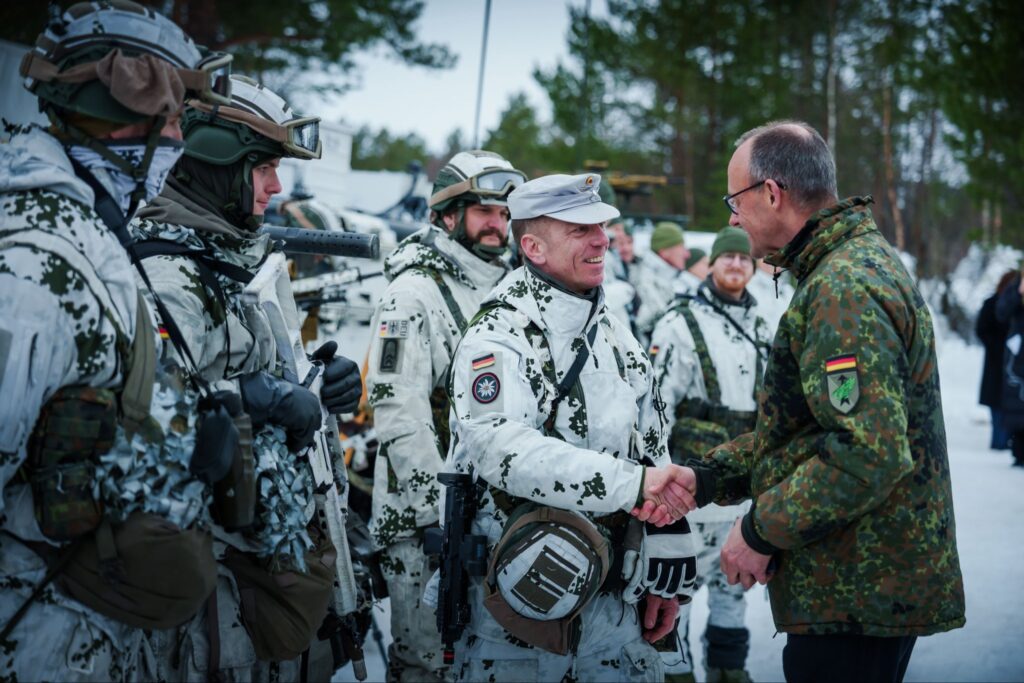
Talk of reinstating conscription hovers but lacks political backing for now. Reservists already train 20 days a year, double the old norm, and the first permanent German brigade in Lithuania, 5,000 strong, will rotate its battalions from 2027.
(If much of the strategy was not classified) we might as well add Vladimir Putin to our mailing list. — German Defence Minister Boris Pistorius
Public opinion, until recently allergic to martial language, has hardened. “I think the path is now set and unless something very drastic happens, like the collapse of Germany’s entire economy, this is going to happen,” Mr Strohn said. Historians invoke 1955, when West Germany joined NATO, as the last transformation on this scale.
Yet today the memory cuts both ways: friends crave German heft against Russia, but some neighbours fret. The Financial Times editorial board offered reassurance: “Renewed German military strength may make some of its neighbours uneasy. But they have less to fear from German militarism than from its continuing reluctance to deploy the forces at its disposal.”
Allied calculus
France, which still nurtures nuclear deterrence and global projection, sees budgets it cannot match. Britain, long the second pillar of NATO, now spends less than Germany. That shift may tilt influence inside the alliance, especially over land doctrine and logistics.
Christoph Meyer of King’s College London predicts a new pecking order: “Growing German firepower will translate into greater German influence in the councils of NATO—if it so wishes.” Eastern members, from Estonia to Romania, welcome the change without caveat. Italy and Spain, burdened by debt, hope German orders spur wider European procurement and thus lower unit costs.
Russia must recalibrate. For now, Moscow out-produces Europe in artillery shells. But Rheinmetall will build 1.5m rounds next year, and the EU’s Act in Support of Ammunition doubles subsidies for powder plants. German ISR satellites, budgeted at €10bn, promise better warning than Ukraine had in 2022.
Industrial churn
Still, a window of vulnerability persists. “They won’t wait until Europe is ready,” warned Mr Meyer. “There is clearly a dangerous transition period now.” The strategy treats that gap as a race: plug it fast with drones, reserves, and forward deployments.
Germany is positioning itself to be the backbone of European defence, ensuring that NATO’s European pillar can deter threats even if transatlantic politics falter. — Nordic Defence Review
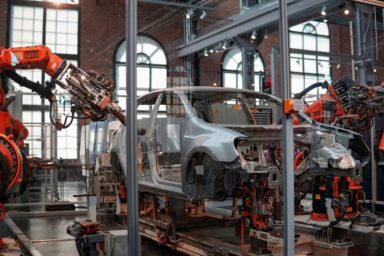
But factories adapt. Disused Opel halls in Thuringia produce Skyranger turrets. A shuttered coal plant near Duisburg becomes an armour-steel mill. Mittelständler in Baden-Württemberg pivot from car parts to barrel forgings. Bankers who once shunned arms firms now offer revolving credit, citing government guarantees. Trade unions, once wary of Kriegswirtschaft, or war economy, back the switch in return for wage hikes and green-energy offsets.
Supply chains spread across the EU. Patria ships hull kits from Finland; MBDA France supplies missile seekers; Czech firms may cast Boxer wheels should Rheinmetall decide so. Brussels applauds the effect, which fits its Defence Industrial Strategy, agreed in March 2026, to keep 60 per cent of procurement within the union. Even post-Brexit Britain joins in: BAE Systems delivers counter-drone radars under an offset for the Eurofighter order.
Bureaucratic hurdles
The Bundeswehr’s culture still lags. Decades of peacekeeping bred caution. Manuals ran hundreds of pages; signatures piled high. The new law short-circuits some loops but cannot erase habits overnight. Mr Pistorius admits parts of the machine “must unlearn perfectionism when speed saves lives”. To test readiness he stages snap drills: last month an armoured company drove from Bavaria to Lithuania in 72 hours, half the time taken in 2022.
Recruiters now tour schools with VR headsets showing drone swarms and satellite feeds. They meet less scepticism than before, though war-weariness from Ukraine tempers enthusiasm. A poll for Der Spiegel found 66 per cent support for higher defence spending but only 41 per cent readiness among 18-24-year-olds to serve. The ministry’s answer is flexibility: short-term contracts, cyber reservists who keep civilian jobs, and a pledge that universal conscription will appear only as a last resort.
Legislative mesh
EU law reinforces these shifts. It lets Berlin subsidise shell lines without breaching single-market rules. The 2024 Military Mobility Regulation clears rail upgrades through a single licence rather than 27 national permits. Germany embeds funds for bridges and tunnels in its €500bn infrastructure pot, with 94 projects (not all of them German) eligible for EU co-financing. That synergy sweetens the politics of big borrowing and ensures Brussels sees German cash as a European public good.
Projects funded under Connecting Europe Facility
- Rail projects: Germany participates in 32 ERTMS (European Rail Traffic Management System) implementations across 11 member states, including upgrades to trains and tracks for cross-border interoperability.
- Road transport: Secure parking areas for trucks built or upgraded in Germany, alongside France, Italy, and Romania.
- Hydrogen infrastructure: Gronau-Epe REW-led storage project: €120.11m. Uniper Green Wilhelmshaven hydrogen terminal: €10.63m.
- Electricity and grid modernisation: Part of 14 cross-border projects awarded €650m total, though specific German shares beyond hydrogen are not detailed.
- TEN-T core network: Ongoing involvement in high-profile cross-border rail like the Brenner Base Tunnel (with Austria/Italy) and Seine-Scheldt link (not exclusively German).
Source: Connecting Europe Facility – European Climate, Infrastructure and Environment Executive Agency
Cost overruns lurk. The Boxer line expanded once already and may strain again. Labour shortages in engineering push wages up. Green goals add complexity: every new barracks must meet energy-neutral standards, lengthening builds. Geopolitics also intrudes. Should America pivot further to Asia, German planners foresee bigger gaps in intelligence satellites and transport planes. Should populists win power in Paris or Rome, EU co-financing could falter.
The roadmap also invites scrutiny rather than slogans. “The short public version of the defence strategy, as opposed to a longer classified one, provides little detail on implementation,” commentators note. (It must be so, Minister Pistorius was quoted as saying, “otherwise we might as well add Vladimir Putin to our mailing list”.) It is implementation that will decide success.
Yet the doctrine’s final virtue is its candour about limits. It lists four phases: restore readiness by 2027; achieve mass by 2030; integrate emerging tech by 2035; and gain “technological superiority over the enemy” by 2039.
Near-term deterrence
The first swallows—which proverbially do not make a summer—arrive soon. Lithuania welcomes the first German brigade in 2027. Poland hosts joint air-defence drills with IRIS-T batteries. Norway invites German submarines to train under ice. Such moves signal collective resolve.
Russia, in turn, rehearses missile strikes on Baltic ports. The risk of miscalculation grows, yet so does the price of offence. By 2028 the Bundeswehr aims to field three armoured divisions fit for high-intensity war, double its current tally.
The broomsticks are compost. Germany now throws euros, engineers, and energy at the deficits that once embarrassed it. The spending surge aligns with EU law on mobility, procurement, and industry, and it underwrites NATO’s tougher targets. Europe gains a linchpin conventional army; Germany gains influence to match its wallet. Deterrence needs both.