Factories across the Union open for drones and shells. Private equity money pours into firms long languishing on bank loans and government drip-feeds. Scattered national productions unite into a formidable defence steam-roller. Brussels wants the European Defence Industry Programme (EDIP) to do all this, EU lawmakers learnt on Tuesday.
Europe’s newest defence-industrial instrument is small in cash terms yet large in ambition. The European Defence Industry Programme, in force since last September and backed by a €1.5bn work plan, promises to knit together scattered national production lines, a sort of ‘weapons without borders’ process.
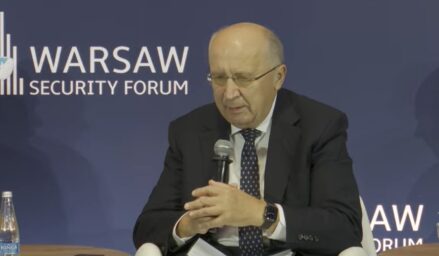
François Arbault, defence industry director at the DG Defence Industry and Space of the European Commission runs the scheme. On 14 April, he outlined to the joint session of the Industry, Research and Energy (ITRE) and the Security and Defence (SEDE) committees how those goals will be met and why speed must trump neatness.
Ambitions abound
SEDE chair MEP Marie-Agnes Strack-Zimmermann (Renew/DEU), who steered the debate, set the scene crisply. “After some tough negotiations, EDIP formally entered into force on 16th September 2025,” she reminded colleagues. “The Commission approved 1.5 billion work programme on 3rd March of 2026.” The numbers are modest beside America’s annual Pentagon budget, yet big enough to test whether Brussels can move money faster than generals run out of ammunition.
Ms Strack-Zimmermann then handed the microphone to Mr Arbault. “The recent adoption of the EDIP programme by the Commission’s College on 30 March of course marked a very important milestone because it helps us to actually collectively implement that brand new program at the fastest possible speed,” the French official said.
“It shows the display of an ambition of the EU and of course of the Commission as part of the institutions to really implement that new programme at the fastest possible speed because we can’t wait to achieve EU defence readiness,” Mr Arbault stressed. The work plan covers 2026-2027, with calls opening in June and staggered deadlines so industry can form consortia without slowing output.
Much of the money—€441m—goes to Industrial Reinforcement Actions that bankroll new capacity where Europe is thinnest. Ammunition propellant, missile warheads and the processors that steer loitering drones top the list. By focusing at component level, Brussels hopes to irrigate many assembly lines with one grant. “We dedicate 240 million euros to grants funding common acquisition projects,” Mr Arbault added, underscoring the twin aim of boosting supply and knitting buyers together.
Industrial muscle first
The Commission official also tied the scheme to Kyiv. “We will be jointly investing with Ukrainian partners into again novel capacities of production,” he said, pointing to €260m reserved for joint plants and a further €35.3m for battlefield innovation vouchers managed by a Ukrainian agency. That link is crucial. Ukrainian artillery fires more in a week than most EU armies order in a year; tapping such demand could keep European presses running at economic scale long after the war ends.
Anything that we do is driven by the sense of urgency. — François Arbault, European Commission Director of Defence Industrial Program at DG Defence Industry and Space
Joint purchasing remains EDIP’s second pillar. The grants are small—rarely above 15 per cent of a contract—but they incentivise finance ministries to pool orders for air-defence missiles, counter-drone kits and naval hulls.
Fragmented demand starves factories of long runs; pooled tenders, even if modest, let firms plan shifts and invest in tooling. The model was tested under EDIRPA, where €300m of EU cash catalysed €1.11bn of joint deals. EDIP pushes the same logic into the mainstream budget.
A portable toolbox
Europe also needs collaboration on grand projects that no single state can shoulder. Hence the European Defence Projects of Common Interest. “This will be instrumental to filling some major capability gaps and it is a member state driven process,” Mr Arbault said.
A Council decision this summer will anoint the first batch; €325m is set aside for ‘big tickets’ ready to start and for ‘small tickets’ that prepare slower coalitions for the next budget cycle. Space launch infrastructure and pan-European air-defence networks are among likely candidates.
Financing gaps for mid-size firms come next. “We will create a fund of funds that will be mandated to invest again in promising generally European startup scale ups and SMEs,” Mr Arbault explained. Defence Equity Facility 2.0 blends EU budget with European Investment Fund money to reach at least €1bn. Venture capital will take early risk; private-equity pools can then scale factories. Without such an anchor, many founders sell out to American buyers once prototypes work.
Rules and preferences
The equity push answers a stubborn problem. Banks lend for receivables; they dislike risk on untested hardware. Institutional investors shy away from anything labelled military. By putting public cash in first, the Commission hopes to normalise defence as an asset class just as energy transition funds did for clean tech a decade ago.
Funding raises the question of who may benefit. “Member states are free to invest in whatever capabilities they see fit for their needs,” Mr Arbault told deputies. But treaty law forces EU grants to favour local industry. When states want to restock American howitzers they must pay from national budgets. “When you invest in equipment, you need to be able to deploy them without asking permission,” he added, hinting at the export controls that can accompany non-EU kit.
Member states are free to invest in whatever capabilities they see fit for their needs. — François Arbault
Parliament pushed him on speed. “Anything that we do is driven by the sense of urgency,” he replied. Three months to draft the work plan set a record, but permits, factory design and workforce training still take time. Europe’s rush for powder already shows the constraint: presses can be ordered in weeks, yet nitrification plants for propellant acids take two years to build and licence.
Balancing now and later
Mr Arbault rejected the idea of choosing between emergency output and deep research. “We need to actually articulate the urgent response to the more long term ambition via R&D actions,” he said.
The European Defence Fund continues to fund counter-hypersonic sensors and stealth materials, while EDIP pays for extra shifts on existing lines. That blend, he argued, is cheaper than buying American off-the-shelf and keeps intellectual property on the continent.
Money, though, remains tight. One Leopard tank costs €25m; a mine-clearing frigate tops €100m. “We are incentivising cooperative behavior via with small grants which de facto cover the complexity of going to ever to procure a product in the European Defence Fund,” Mr Arbault conceded. Bigger cheques will come, if at all, from national treasuries or from SAFE, an EU loan scheme that helps capitals borrow for urgent purchases.
A measured test
EDIP therefore acts less as paymaster than as conductor. It tunes supply chains, sets common standards and signals where private capital can earn a return. If the plan works, ammunition plants opened with its grants will still run at capacity when attention shifts elsewhere, defence start-ups will find domestic capital for Series B rounds, and ministers will think twice before placing yet another boutique order for bespoke kit.
We will create a fund of funds that will be mandated to invest again in promising generally European startup scale ups and SMEs. — François Arbault
The first measure of success will come this summer when member states name their flagship projects and firms bid for the initial calls. Europe’s defence commissioner promises paperwork on the funding portal within weeks. For a continent where procurement cycles often stretch beyond the life of a government, that alone would mark progress.
Whether €1.5bn can do the heavy lifting remains to be seen. The ideas—joint demand, early equity, open supply chains—now have a home, a timetable and, crucially, a budget line.