By withdrawing America’s military presence from Europe one step at a time, Donald Trump is sending a clear message: the continent can no longer take US military backing for granted. Across the EU, governments are rushing to boost their own defences. Yet the price of this military buildup may not be measured in billions of euros alone — the European Union could have to sacrifice part of the identity and values it was built on.
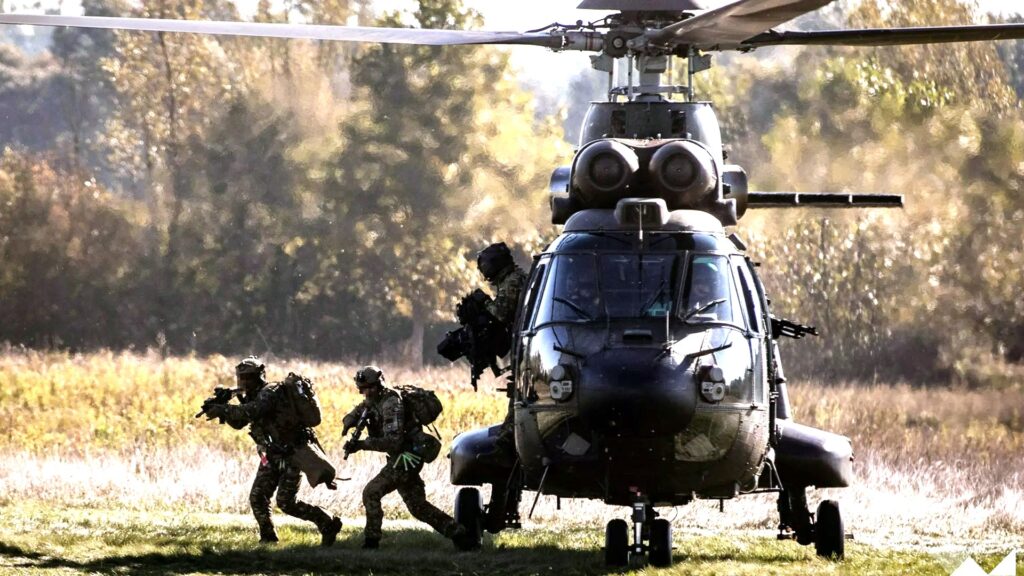
The Pentagon, with little explanation, has cancelled the planned deployment of around 4,000 US troops to Poland. The move, which caught even members of Congress off guard, is the latest sign of a shifting relationship between the United States and Europe. America’s military presence on the continent no longer feels like a fixed strategic constant, but increasingly like a bargaining chip in the day-to-day politics of the White House.
The decision comes just two weeks after Washington announced the withdrawal of 5,000 US troops from Germany. Officially, both moves are part of a broader review of America’s military footprint in Europe.
But the timing also reflects worsening relations between President Donald Trump and European allies — above all German Chancellor Friedrich Merz. Tensions escalated further following criticism of the US operation against Iran. Last month, Merz remarked that the Iranians were humiliating the United States during negotiations.
A US official told Reuters, on condition of anonymity, that the latest decision may be linked to the repositioning of American forces in Germany. Troops originally earmarked for temporary deployment from the US to Poland could come from elsewhere. Roughly 35,000 US troops are currently stationed in Germany.
Unpredictable ally
The Trump administration has continued pressing NATO allies to spend more on defence, repeatedly hinting that America’s military presence in Europe may not remain at current levels. Washington appears to be considering a return to troop numbers seen before Russia’s full-scale invasion of Ukraine in 2022, when then-president Joe Biden reinforced US forces across Europe. In March 2022, over 100,000 American troops were deployed on the continent. Before the invasion, the figure stood at around 65,000 to 70,000.
Europe is therefore grappling not only with fears triggered by Russia’s invasion and the Kremlin’s continuing aggressive rhetoric, but also with the growing unpredictability of its long-standing ally. Over the past year, Trump has repeatedly hinted that he could even walk away from NATO altogether.
For Europe, the message is becoming impossible to ignore: it must build greater security and defence autonomy of its own. Yet this raises another question entirely — how deeply will this transformation reshape Europe’s political model itself?
Changing Europe
According to NATO estimates, European member states and Canada spent $574bn (€493bn) on defence in 2025 — almost a fifth more than the year before. It marks the sharpest annual increase in military spending in seven decades. At the same time, European governments are gradually embracing NATO’s new target of spending five per cent of GDP on defence.
The EU risks losing its value as a peace project if it morphs into a security union without a more balanced and comprehensive political settlement. — Richard Youngs, University of Warwick
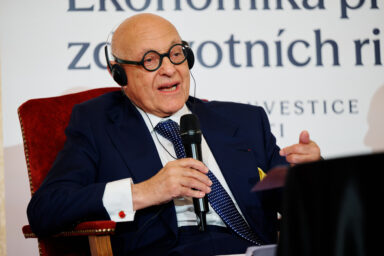
But this is no longer simply about tanks, ammunition, or swelling defence budgets. Europe’s rapid rearmament is beginning to reshape the very machinery of the state — from fiscal priorities and the future of the welfare system to climate and environmental policy. “The security debate should now move into a new phase in which European governments grasp the complex political implications of rearmament,” warns Richard Youngs, Professor of International and European Politics at the University of Warwick.
Europe is also rearming at precisely the moment when parts of the continent are losing faith in the very idea of a shared Europe. Youngs warns that heavily strengthened militaries could one day fall under the control of populist far-right parties. Such movements are already leading opinion polls in countries including France, Germany and the United Kingdom.
Large-scale military expansion in one region can also trigger a wider security domino effect, fuelling further global tensions. There is a growing risk, too, that militarisation could crowd out Europe’s traditional emphasis on social development, diplomacy and conflict prevention. “The EU risks losing its value as a peace project if it morphs into a security union without a more balanced and comprehensive political settlement,” Youngs cautions.
No clear vision
Europe’s rush to rearm is also reopening questions that until recently were almost taboo. In some countries, concerns are quietly growing over the prospect of future German military dominance — an especially sensitive issue given Europe’s history. Debates over a ‘European army’or deeper EU defence integration are therefore returning to the table. Though without any clear sense yet of what such a model would actually look like in practice.
At the same time, European states are increasingly blurring the lines between military and civilian spheres. Alongside rising defence budgets, new joint European instruments are emerging, while some governments are promoting a model of ‘whole-of-society security’ that draws infrastructure, industry and public services into the defence framework alongside the armed forces.
According to Richard Youngs, this is precisely where one of the greatest dangers of the current transformation lies. “As citizens are asked to mobilise around full-spectrum defence, they need a greater say in security policies. They need a voice in the trade-offs that higher defence spending will require,” he argues. So far, he says, Europe’s rearmament has unfolded in a way that strengthens opaque crisis decision-making and could further empower populist and anti-establishment forces.
What the future brings
Meanwhile, the current transformation is already reshaping Europe’s political architecture. Britain is once again becoming a central player in European security debates. New ad hoc coalitions are emerging. More flexible forms of cooperation are gaining ground alongside formal EU institutions.
Europe is proving increasingly capable of finding hundreds of billions of euros for defence. Far more difficult, however, will be reaching agreement on what kind of political order should emerge on a continent preparing for a world with a diminished American presence. Without that debate, Europe’s rearmament may rest on shaky foundations — and could ultimately transform the EU in ways that few today have fully begun to contemplate.